Loading...
Done
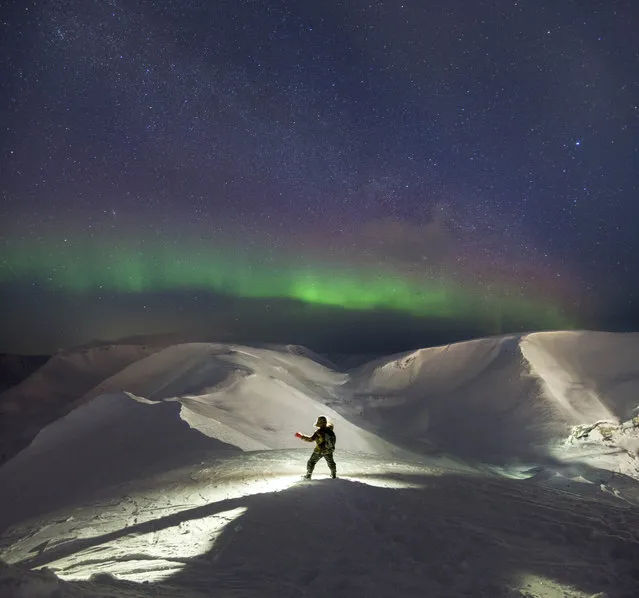
“I spend time trying to get the exposure right”, Vitaly Istomin explained. (Photo by Vitaly Istomin/Caters News Agency)

These Northern Lights “rainbows” have turned the sky greener than the Earth below. Vitaly Istomin, 26, spent several nights in freezing conditions under the stars in northern Russia’s Khibiny Mountains to capture the aurora’s “rainbows”. (Photo by Vitaly Istomin/Caters News Agency)
Details
22 Feb 2018 00:02:00
Tsuchiura National Fireworks Competition, Tsuchiura City, Ibaraki Prefecture. (Photo by Makoto Igari/Caters News Agency)

These kaleidoscopic images showcase the sheer beauty of the mammoth firework displays held across Japan every summer. The Japanese word for fireworks, hanabi, means fire flower, and each year, local governments in Japan throw around 7,000 festivals, or hanabi taikai. Here: Tsuchiura National Fireworks Competition, Tsuchiura City, Ibaraki Prefecture. (Photo by Makoto Igari/Caters News Agency)
Details
25 Sep 2018 00:01:00
This photo of an elephant seal and Gentoo penguin shot by Andrew James in Yankee Harbour, Antarctica. (Photo by Andrew James/Travel Photographer of the Year)

This photo of an elephant seal and Gentoo penguin shot by Andrew James in Yankee Harbour, Antarctica. (Photo by Andrew James/Travel Photographer of the Year)
Details
12 Apr 2019 00:05:00
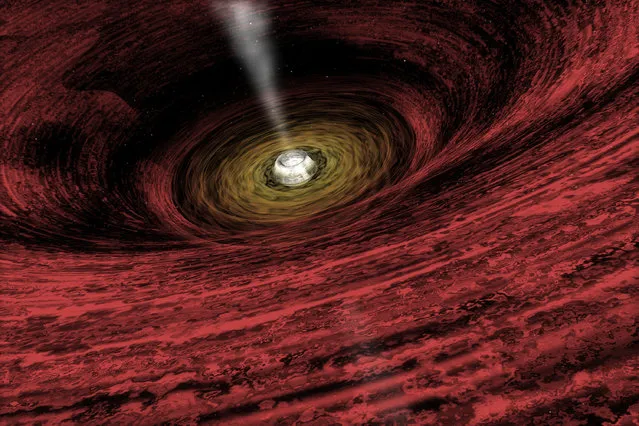
An artist's impression of a growing supermassive black hole located in the early Universe is seen in this NASA handout illustration released on June 15, 2011. Using the deepest X-ray image ever taken, astronomers found the first direct evidence that massive black holes were common in the early universe. This discovery from NASA's Chandra X-Ray Observatory shows that very young black holes grew more aggressively than previously thought, in tandem with the growth of their host galaxies. (Photo by Reuters/NASA/Chandra X-Ray Observatory/A.Hobart)

An artist's impression of a growing supermassive black hole located in the early Universe is seen in this NASA handout illustration released on June 15, 2011. Using the deepest X-ray image ever taken, astronomers found the first direct evidence that massive black holes were common in the early universe. This discovery from NASA's Chandra X-Ray Observatory shows that very young black holes grew more aggressively than previously thought, in tandem with the growth of their host galaxies. (Photo by Reuters/NASA/Chandra X-Ray Observatory/A.Hobart)
Details
11 Feb 2016 12:57:00
Stunning images capture the tribes of Papua New Guinea during a gathering of clans. (Photo by Trevor Cole/Media Drum World)

These powerful images capture the spear-wielding tribes of Papua new Guinea who believe they are possessed with the spirit of the crocodile. They show how the Kangunaman clansmen scar their backs to resemble reptile scales while the Huli Wigmen wear elaborate headdresses to signal they are ready for battle. (Photo by Trevor Cole/Media Drum World)
Details
05 May 2018 00:05:00
Blue Lava, Kawah Ijen Volcano, Indonesia

Located in East Java, Indonesia, Kawah Ijen is a volcano is home to the largest acidic crater lake in the world. What turns the waters of the lake in the 1 km caldera its beautiful turquoise color are the highly sulfuric gases emitted from the volcano underneath.
Details
07 May 2014 12:20:00
Yin and yang. Sеxy women grey background. Sensual women in erotic lingerie. (Photo by Alamy Stock Photo)

Yin and yang. Sеxy women grey background. Sensual women in erotic lingerie. (Photo by Alamy Stock Photo)
Details
18 Feb 2024 05:53:00
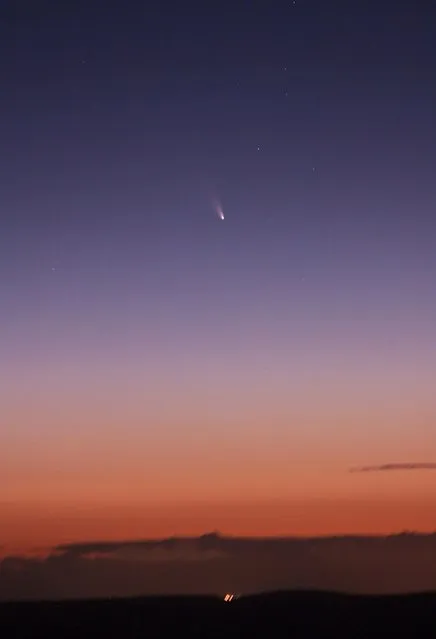
This image provided by NASA shoaws the comet PANSTARRS as seen from Mount Dale, Western Australia on March 5, 2013. According to NASA on March 10, it will make its closest approach to the sun about 28 million miles (45 million kilometers) away. As it continues its nightly trek across the sky, the comet may get lost in the sun's glare but should return and be visible to the naked eye by March 12. (Photo by AP Photo/NASA)

It’s time to start watching for Comet PANSTARRS, one of two comets to get excited about in 2013. Photo: This image provided by NASA shoaws the comet PANSTARRS as seen from Mount Dale, Western Australia on March 5, 2013. According to NASA on March 10, it will make its closest approach to the sun about 28 million miles (45 million kilometers) away. As it continues its nightly trek across the sky, the comet may get lost in the sun's glare but should return and be visible to the naked eye by March 12. (Photo by AP Photo/NASA)
Details
13 Mar 2013 08:03:00