Loading...
Done
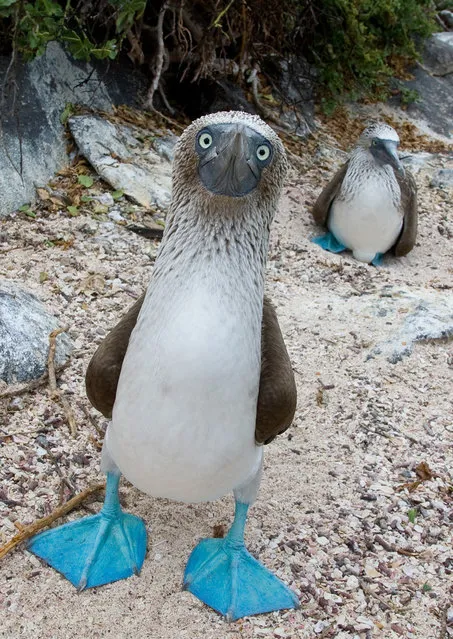
Blue-Footed Booby

The blue-footed booby (Sula nebouxii) is a marine bird in the family Sulidae, which includes ten species of long-winged seabirds. Blue-footed boobies belong to the genus Sula, which comprises six species of boobies. It is easily recognizable by its distinctive bright blue feet, which is a sexually selected trait. Males display their feet in an elaborate mating ritual by lifting their feet up and down while strutting before the female.

See Also: Red
Details
03 Oct 2014 12:42:00
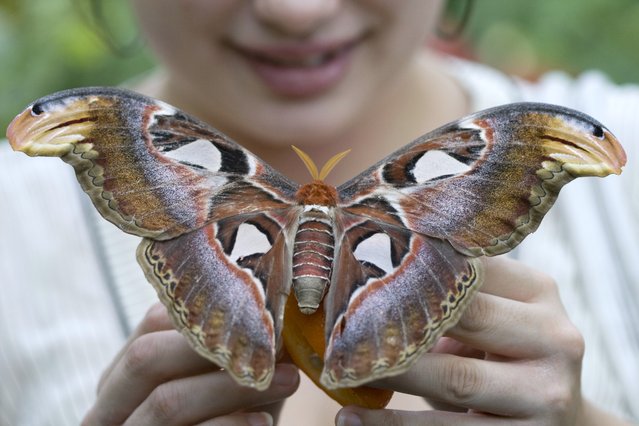
Atlas Moth @ Carleton. (Photo by Terri Oda)

“The Atlas moth (Attacus atlas) is a large saturniid moth found in the tropical and subtropical forests of Southeast Asia, and common across the Malay archipelago. Atlas moths are considered the largest moths in the world in terms of total wing surface area [upwards of c. 400 cm2 (62 sq in)]. Their wingspans are also amongst the largest, reaching over 25 cm (10 in). Females are appreciably larger and heavier”. – Wikipedia. Photo: Atlas Moth. (Photo by Terri Oda)


Details
10 Feb 2013 16:49:00
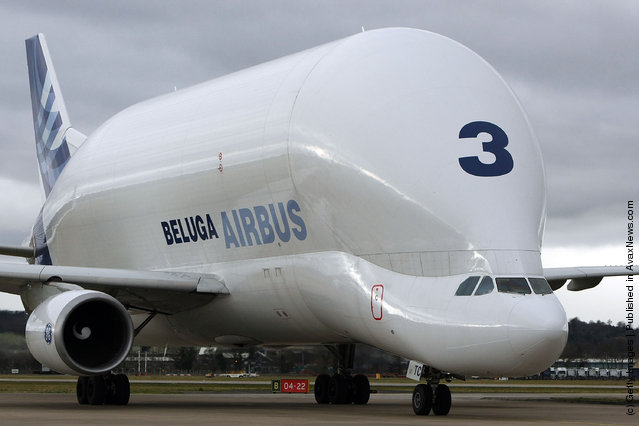
Airbus A300-600ST Beluga

“The Airbus A300-600ST (Super Transporter) or Beluga, is a version of the standard A300-600 wide-body airliner modified to carry aircraft parts and over-sized or awkward cargo. It was officially called the Super Transporter at first, but the name Beluga became popular and has now been officially adopted”. – Wikipedia

Photo: The first Future Strategic Tanker Aircraft wing set is loaded on to a giant Beluga Airbus aircraft for transit to Bremen on February 25, 2009 in Broughton, England. (Photo by Christopher Furlong/Getty Images)
Details
14 Oct 2011 08:42:00
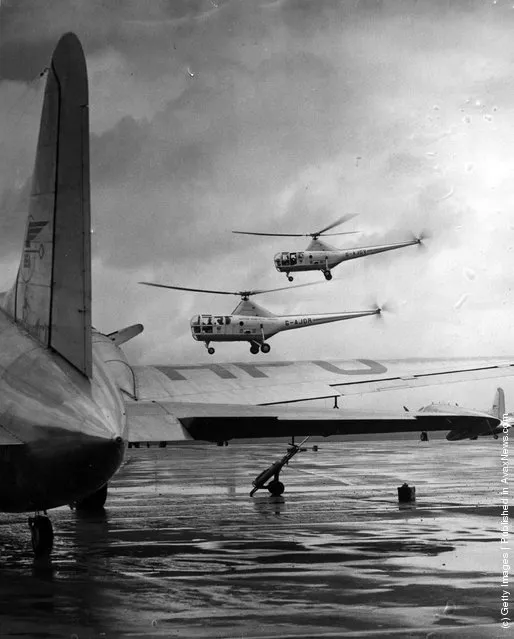
Sikorsky H-5 helicopters

“Igor Sikorsky (May 25, 1889 – October 26, 1972), born Igor Ivanovich Sikorsky was a Russian American pioneer of aviation in both helicopters and fixed-wing aircraft. He designed and flew the world's first multi-engine fixed-wing aircraft, the Russky Vityaz in 1913, and the first airliner, Ilya Muromets, in 1914. After immigrating to the United States in 1919, Sikorsky founded the Sikorsky Aircraft Corporation in 1923, and developed the first of Pan American Airways' ocean-conquering flying boats in the 1930s. In 1939 Sikorsky designed and flew the Vought-Sikorsky VS-300, the first viable American helicopter, which pioneered the rotor configuration used by most helicopters today. Sikorsky would modify the design into the Sikorsky R-4, which became the world's first mass-produced helicopter in 1942”. – Wikipedia

Photo: Westland Sikorsky H-5's, used by British European Airways Helicopters, which fly between London and Birmingham. The Sikorsky H-5, (aka R-5, S-51, HO3S-1, or Horse) (R-5 until 1948; company designation VS-327) is a helicopter built by Sikorsky Aircraft Corporation, formerly used by the United States Air Force, and its predecessor, the United States Army Air Forces, as well as the United States Navy and United States Coast Guard (with the designations HO2S and HO3S). (Photo by Harrison /Topical Press Agency/Getty Images). 22nd May 1951

Details
06 Sep 2011 10:18:00
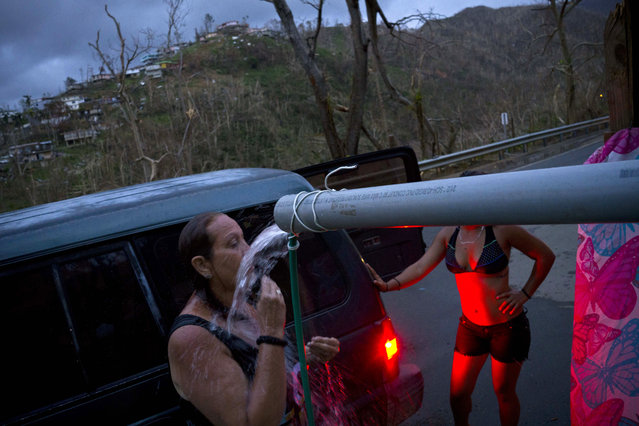
People affected by Hurricane Maria bathe in water piped from a creek in the mountains, in Naranjito, Puerto Rico, Thursday, September 28, 2017. Residents of the area drive to the pipes to bathe because they were left without water supplies by the damage caused by Hurricane Maria. The pipe was set up by a neighbor who ran it from a creek in his property to the side of the road in order to help those left without water. (Photo by Ramon Espinosa/AP Photo)

People affected by Hurricane Maria bathe in water piped from a creek in the mountains, in Naranjito, Puerto Rico, Thursday, September 28, 2017. Residents of the area drive to the pipes to bathe because they were left without water supplies by the damage caused by Hurricane Maria. The pipe was set up by a neighbor who ran it from a creek in his property to the side of the road in order to help those left without water. (Photo by Ramon Espinosa/AP Photo)
Details
29 Sep 2017 07:45:00
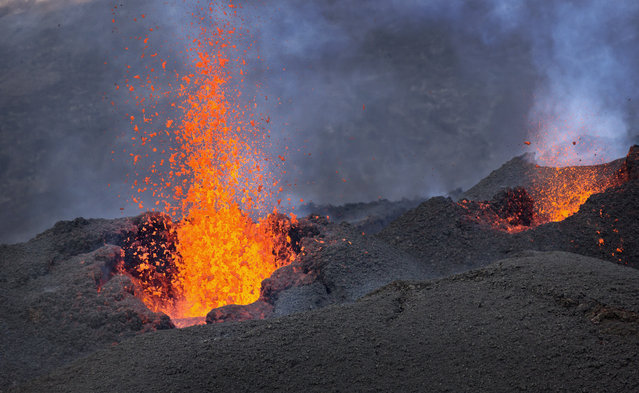
Lava erupts from the Piton de la Fournaise “Peak of the Furnace” volcano, on the southeastern corner of the Indian Ocean island of Reunion Saturday, August 1, 2015. Spewing red-hot lava, one of the most active volcanoes in the world is currently erupting on this Indian Ocean island, where the world's attention has been focused since a wing fragment believed to be from the missing Malaysian jet was discovered washed up on a beach. (Photo by Ben Curtis/AP Photo)

Lava erupts from the Piton de la Fournaise “Peak of the Furnace” volcano, on the southeastern corner of the Indian Ocean island of Reunion Saturday, August 1, 2015. Spewing red-hot lava, one of the most active volcanoes in the world is currently erupting on this Indian Ocean island, where the world's attention has been focused since a wing fragment believed to be from the missing Malaysian jet was discovered washed up on a beach. The lava fountains are shooting as high as 40 meters (44 yards) and are creating cones that are about 20 meters high after only one day of eruption, said Peltier. The volcano is in the Reunion National Park – a world heritage site. The volcano is not seen as dangerous because the lava flows down the east side of the mountain through an uninhabited area called the Grand Brule, or the Big Burned, toward the sea. The last times the volcano threatened the population was in 1977 and 1986. (Photo by Ben Curtis/AP Photo)
Details
03 Aug 2015 12:23:00
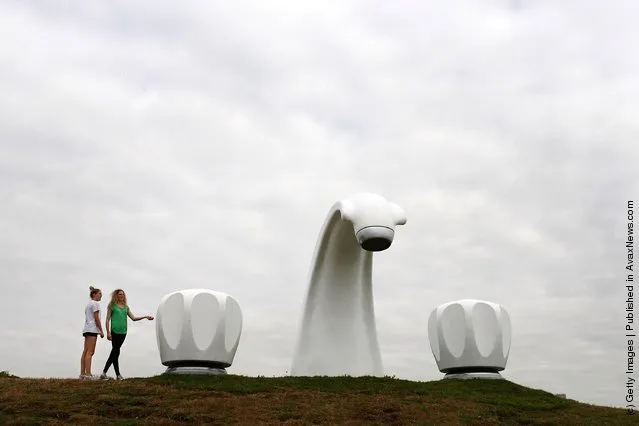
Who Left The Tap Running by artist Simon McGrath is seen as part of the Sculpture by the Sea outdoor exhibition along the Bondi to Bronte coastal walk

Who Left The Tap Running by artist Simon McGrath is seen as part of the Sculpture by the Sea outdoor exhibition along the Bondi to Bronte coastal walk on November 4, 2011 in Sydney, Australia. (Photo by Lisa Maree Williams/Getty Images)
Details
04 Nov 2011 13:48:00
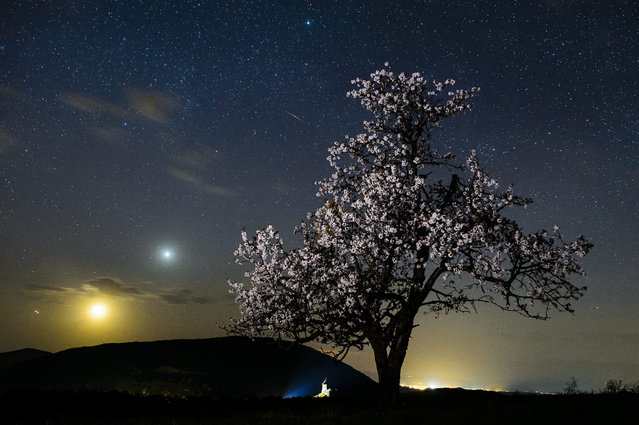
A meteorite burns up in the atmosphere as seen in this photo taken near of Salgotarjan, 109 kms northeast of Budapest, Hungary, late 21 April 2015. The Moon and Venus can be seen on the left. (Photo by Peter Komka/EPA)

A meteorite burns up in the atmosphere as seen in this photo taken near of Salgotarjan, 109 kms northeast of Budapest, Hungary, late 21 April 2015. The Moon and Venus can be seen on the left. (Photo by Peter Komka/EPA)
Details
04 May 2015 09:25:00