Loading...
Done
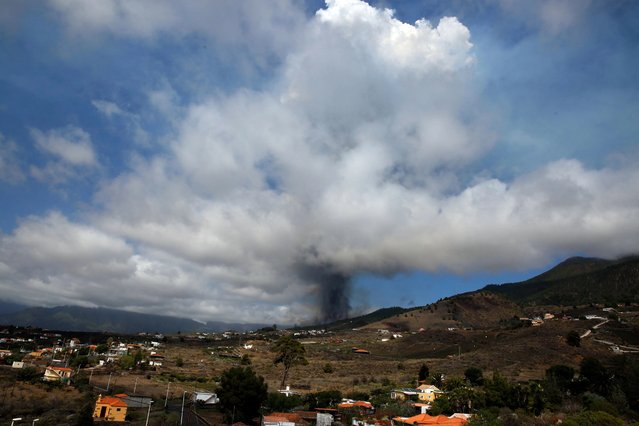
Mount Cumbre Vieja erupts spewing a column of smoke and ash as seen from Los Llanos de Aridane on the Canary island of La Palma on September 19, 2021. (Photo by Desiree Martin/AFP Photo)

Mount Cumbre Vieja erupts spewing a column of smoke and ash as seen from Los Llanos de Aridane on the Canary island of La Palma on September 19, 2021. The Cumbre Vieja volcano erupted on Spain's Canary Islands today spewing out lava, ash and a huge column of smoke after days of increased seismic activity, sparking evacuations of people living nearby, authorities said. Cumbre Vieja straddles a ridge in the south of La Palma island and has erupted twice in the 20th century, first in 1949 then again in 1971. (Photo by Desiree Martin/AFP Photo)
Details
20 Sep 2021 08:27:00
Students wearing masks as a precaution amid the spread of COVID-19 put away a Cuban flag so it does not get wet in the rain on their first day of school after months without face-to-face classes in Havana, Cuba, Monday, November 8, 2021. As Cuba approaches the announced date of Nov. 15 for the reopening of the entire country to the world, getting children back to school is one of its priorities. (Photo by Ramon Espinosa/AP Photo)

Students wearing masks as a precaution amid the spread of COVID-19 put away a Cuban flag so it does not get wet in the rain on their first day of school after months without face-to-face classes in Havana, Cuba, Monday, November 8, 2021. As Cuba approaches the announced date of Nov. 15 for the reopening of the entire country to the world, getting children back to school is one of its priorities. (Photo by Ramon Espinosa/AP Photo)
Details
19 Nov 2021 08:45:00
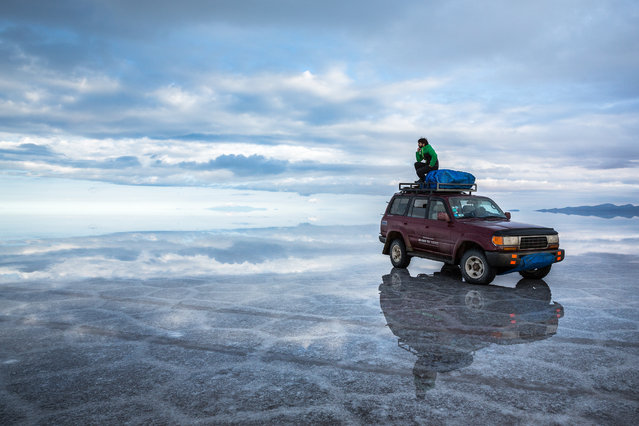
At 10,582 square kilometres, the Bolivian salt flats – otherwise known as Salar de Uyuni – are the largest on the planet and contain between 50 and 70% of the world’s lithium reserves. After exploring Chile and Argentina, photographer Joel Santos decided to travel to Bolivia in January 2017 to check the salt flats off his bucket list. With an electrical storm rolling in, Joel and his two travelling companions were the only souls left on the vast flats and captured the eerie flats without a person in sight. (Photo by Joel Santos/Barcroft Images)

At 10,582 square kilometres, the Bolivian salt flats – otherwise known as Salar de Uyuni – are the largest on the planet and contain between 50 and 70% of the world’s lithium reserves. After exploring Chile and Argentina, photographer Joel Santos decided to travel to Bolivia in January 2017 to check the salt flats off his bucket list. With an electrical storm rolling in, Joel and his two travelling companions were the only souls left on the vast flats and captured the eerie flats without a person in sight. (Photo by Joel Santos/Barcroft Images)
Details
12 Aug 2019 00:03:00
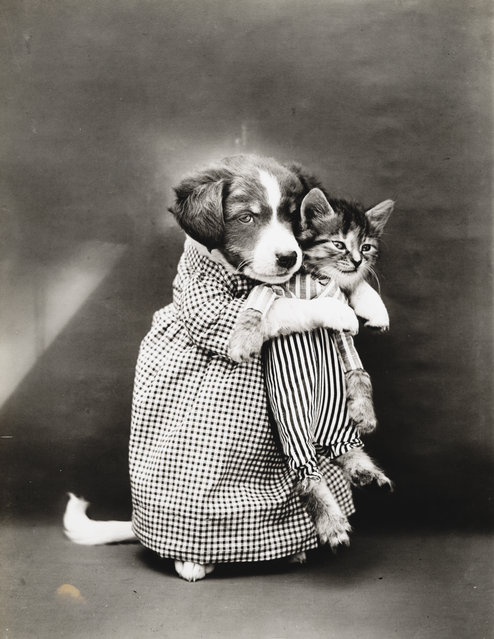
Photograph shows a puppy holding a kitten, 1914. (Photo by Harry Whittier Frees/Library of Congress)

“Harry Whittier Frees (1879–1953) was an American photographer who created novelty postcards and children's books based on his photographs of animals. He dressed the animals and posed them in human situations with props, often with captions; these can be seen as progenitors of modern lolcats”. – Wikipedia. Photo: “The nurse”. Photograph shows a puppy holding a kitten, 1914. (Photo by Harry Whittier Frees/Library of Congress)

P.S. All pictures are presented in high resolution. To see Hi-Res images – just TWICE click on any picture. In other words, click small picture – opens the BIG picture. Click BIG picture – opens VERY BIG picture (if available; this principle works anywhere on the site AvaxNews).
Details
28 Mar 2014 11:20:00
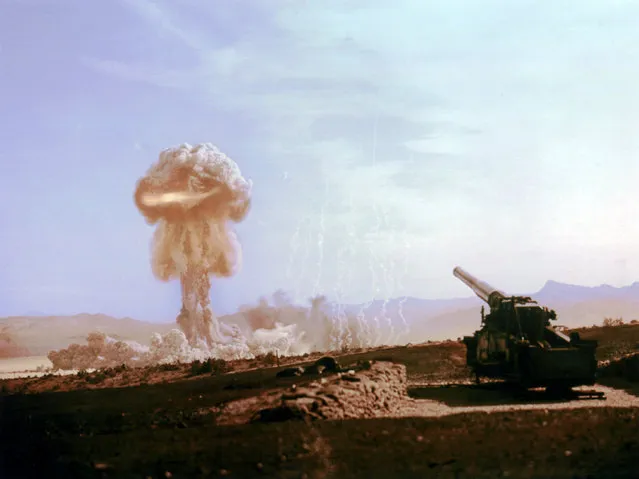
Atomic Annie at work during the Upshot-Knothole test series, 1953. (Photo by Los Alamos National Laboratory/US Army)

“A fter the former Soviet Union conducted its first nuclear test in August 1949, the US reevaluated its postwar defense policies. With the US monopoly on atomic weapons broken, military and political leaders chose to diversify the American stockpile by developing thermonuclear and tactical nuclear weapons. One of the more interesting concepts to come out of this period was atomic artillery, which was successfully tested at the Nevada Proving Grounds (now the Nevada Test Site) in May 1953”. – Alan Carr. Photo: Atomic Annie at work during the Upshot-Knothole test series, 1953. (Photo by Los Alamos National Laboratory/US Army)
Details
11 Mar 2013 11:43:00


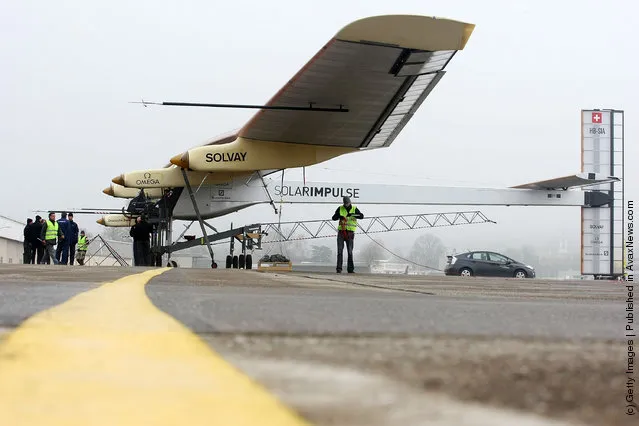
“Solar Impulse is a European long-range solar powered plane project being undertaken by Bertrand Piccard and André Borschberg. The project eventually hopes to succeed in the first circling of the earth with a piloted fixed-wing aircraft using only solar power. The first aircraft, bearing the Swiss aircraft registration code of HB-SIA, is a single-seater, capable of taking off under its own power, and intended to remain airborne up to 36 hours. This aircraft first flew an entire diurnal solar cycle, including nearly 9 hours of night flying, in a 26-hour flight on 7–8 July 2010”. – Wikipedia


Photo: Workers prepare the Solar Impulse airplane HB-SIA for a first runway test on November 19, 2009 in Dubendorf, Switzerland. Solar Impulse chairman Bertrand Piccard, psychatrist and aeronaut, who made the first non-stop round-the-world balloon flight, and CEO and former fighter pilot Andrй Borschberg plan a round-the-world flight, driven only by solar energy, for 2012. (Photo by Johannes Simon/Getty Images)
Details
16 May 2011 08:13:00


Jeremy Davis (L) demonstrates the operation of the safe room shelter door lock to homeowner Rob Hamlin on June 18, 2011 in Neosho, Missouri. Once thought of as a luxury item there has been a surge of interest from homeowners in purchasing shelters to ride out damaging storms ever since a F5 tornado tore through the town of Joplin, Missouri. Ranging in price from $3,000 to $5,000 homeowners can supplement the cost with a mortgage insurance program offered by the U.S. Department of Housing and Urban Development for installing a safe room built to FEMA specifications. Lawmakers in Alabama have even considered requiring construction of storm shelters in mobile home parks after forty people died in April. (Photo by Julie Denesha/Getty Images)
Details
19 Jun 2011 09:26:00


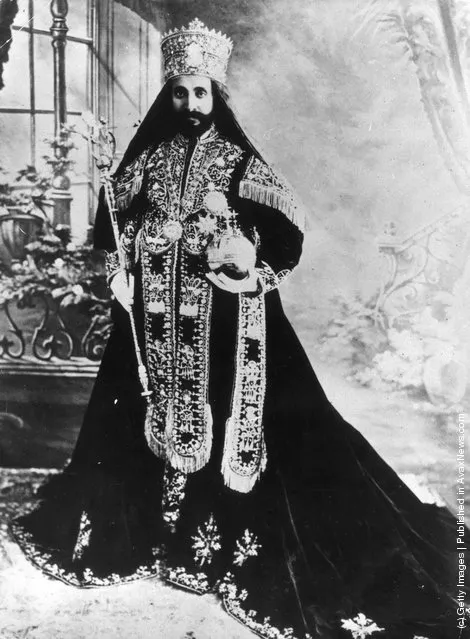
“Haile Selassie I (23 July 1892 – 27 August 1975), born Tafari Makonnen, was Ethiopia's regent from 1916 to 1930 and Emperor of Ethiopia from 1930 to 1974. The heir to a dynasty that traced its origins to the 13th century, and from there by tradition back to King Solomon and Queen Makeda, Empress of Axum, known in the Abrahamic tradition as the Queen of Sheba. Haile Selassie is a defining figure in both Ethiopian and African history.

Haile Selassie is revered as the returned Messiah of the Bible, God incarnate, among the Rastafari movement, the number of followers of which is estimated between 200,000 and 800,000. Begun in Jamaica in the 1930s, the Rastafari movement perceives Haile Selassie as a messianic figure who will lead a future golden age of eternal peace, righteousness, and prosperity. He himself remained an Ethiopian Orthodox Christian throughout his life”. – Wikipedia

Photo: Negusa Negasti, Emperor of Ethiopia Haile Selassie I, known as “Lord of Lords”, “The Conquering Lion of the tribe of Judah”, “Light of the world”, “Elect of God”, in full ceremonial regalia following his coronation. (Photo by Hulton Archive/Getty Images)
Details
21 Jun 2011 11:04:00