Loading...
Done


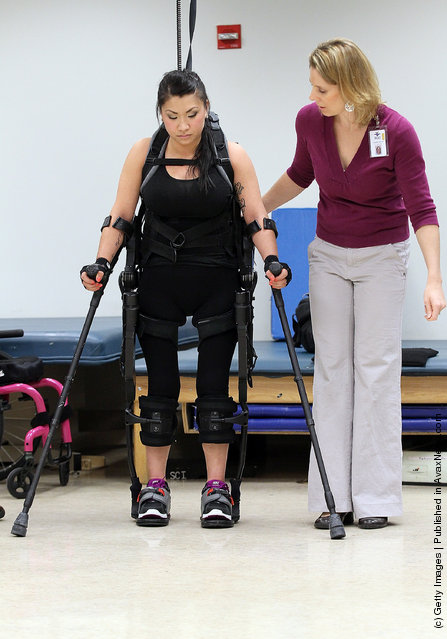
“eLEGS is a wearable, artificially intelligent, bionic device that enables people with paralysis to stand up and walk again. The exoskeleton is battery-powered and rechargeable, fitting comfortably and securely over clothing. Initially, eLEGS will be used under medical supervision for rehabilitation and training”. – BerkeleyBionics.com

Photo: Paralysis victim Stephanie Sablan (L) is helped by physical therapist Shonna Moran as she walks using eLEGS robotic legs at Santa Clara Valley Medical Center on May 25, 2011 in San Jose, California. Sablan, 24, was paralyzed from the waist down earlier this year when she was in a car accident and has begun using the newly developed eLEGS made by Berkeley Bionics. The robot-like battery powered eLEGS fit over clothing and enables people with paralysis to stand up and walk again. (Photo by Justin Sullivan/Getty Images)
Details
26 May 2011 09:56:00
Wax figures with torture instrument named “torture-rack” are seen on October 25, 2014 in Huai'an, Jiangsu province of China. The exhibition, which opened last year at an educational center in the eastern city of Huai'an, includes reenactments of prisoners being hung over a fire, flayed and being tortured on what is known as a “Tiger Bench” – pictured above – a Qing dynasty (1644-1912) device that contorted victims' legs and arms in high pressure positions that could break bones or tear apart joints. (Photo by ChinaFotoPress)

Organizers of an exhibition of ancient instruments of torture in Huai'an, Jiangsu province, have suggested that children, heart disease patients and people with high blood pressure stay away because of the vivid depictions of shocking cruelty. The exhibition has more than 200 instruments of torture on display in the 50,000-square-meter exhibition halls of a restored ancient building. Wax figures, along with sound and light techniques, are incorporated for scary effect. The local government said the exhibition is for tourists and historians to research ancient torture practices. (Photo by ChinaFotoPress)
Details
29 Oct 2014 12:22:00
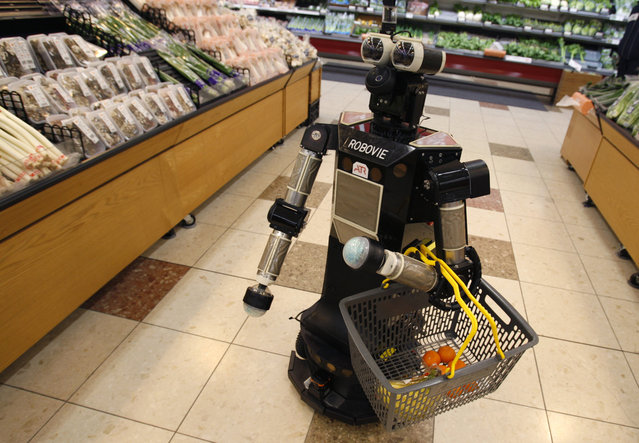
A robot named “Robovie-II”, developed by Japanese robotics research institution ATR, moves around at a grocery store during a shopping assisting experiment by utilizing the robot in an ubiquitous network technology platform in Kyoto, western Japan January 6, 2010. The robot greets the shopper at the entrance of the store, follows him to the shelves while holding a grocery basket and reminds him of the items on a shopping list, which the shopper would have entered beforehand in a specialized mobile device. The experiment is aimed to gather data in order to provide livelihood support for the elderly by using robots and network technologies, ATR's researcher Satoshi Koizumi said. (Photo by Yuriko Nakao/Reuters)

A robot named “Robovie-II”, developed by Japanese robotics research institution ATR, moves around at a grocery store during a shopping assisting experiment by utilizing the robot in an ubiquitous network technology platform in Kyoto, western Japan January 6, 2010. (Photo by Yuriko Nakao/Reuters)
Details
02 Feb 2018 06:54:00
Baka pygmies in their forest home preparing food in, Sangha Forest, Central African Republic, February 2016. (Photo by Susan Schulman/Barcroft Images)

Baka pygmies in their forest home preparing food in, Sangha Forest, Central African Republic, February 2016. Here, in their forest home, traditional life continues in the face of multiplying challenges ranging from poachers, to ill health. Deep in the rainforests of central Africa lives one of the world’s most mysterious tribes. (Photo by Susan Schulman/Barcroft Images)
Details
18 Feb 2017 00:01:00


Eight-year-old handicapped Chinese girl Qian Hongyan crawls with two home-made props and part of a basketball at Zhuangxia Village on January 5, 2005 in Luliang County of Qujing City, Yunnan Province, China. The girl who lost both of her legs in a traffic accident in 2000 at the age of three, struggles to live her life with a basketball as an underprop, “walking” between school and home by herself. The girl's story is widely reported in the country, and experts from China Rehabilitation Research Center has come to Qian's home to help her for rehabilitative treatment early 2005. (Photo by China Photos/Getty Images)
Details
29 Jun 2011 11:33:00
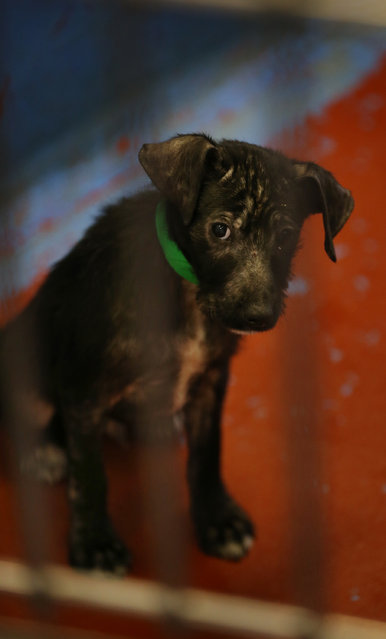
Santa, a dog abandoned two days before Christmas, is looked after by Charlene Gunner at Battersea Dogs and Cats Home on December 27, 2012 in London, England.  The home was founded 150 years ago and has rescued, reunited and rehomed over three million dogs and cats. The average stay for a dog is just 28 days although some stay much longer. Around 550 dogs and 200 cats are provided refuge by Battersea at any given time.  (Photo by Peter Macdiarmid)

Santa, a dog abandoned two days before Christmas, is looked after by Charlene Gunner at Battersea Dogs and Cats Home on December 27, 2012 in London, England. The home was founded 150 years ago and has rescued, reunited and rehomed over three million dogs and cats. The average stay for a dog is just 28 days although some stay much longer. Around 550 dogs and 200 cats are provided refuge by Battersea at any given time. (Photo by Peter Macdiarmid)
Details
28 Dec 2012 08:52:00
A man watches a wave hit a rock pool at Curl Curl beach as large swell hits the East Coast of Australia on June 6, 2016 in Sydney, Australia. Torrential rain over the weekend saw streets and homes flooded while wind gusts up to 120km per hour brought down trees and powerlines. A king tide has also seen beachside homes evacuated on Sydney's northern beaches as large waves erode the coast. (Photo by Cameron Spencer/Getty Images)

A man watches a wave hit a rock pool at Curl Curl beach as large swell hits the East Coast of Australia on June 6, 2016 in Sydney, Australia. Torrential rain over the weekend saw streets and homes flooded while wind gusts up to 120km per hour brought down trees and powerlines. A king tide has also seen beachside homes evacuated on Sydney's northern beaches as large waves erode the coast. (Photo by Cameron Spencer/Getty Images)
Details
25 Jul 2016 11:30:00
Ary Borges feeds his tiger named Dan at his home in Maringa, Brazil, Thursday, September 26, 2013.  Borges is in a legal battle with federal wildlife officials to keep his endangered animals from undergoing vasectomies and being taken away from him. He defends his right to breed the animals and says he gives them a better home than they might find elsewhere in Brazil. (Photo by Renata Brito/AP Photo)

Ary Borges feeds his tiger named Dan at his home in Maringa, Brazil, Thursday, September 26, 2013. Borges is in a legal battle with federal wildlife officials to keep his endangered animals from undergoing vasectomies and being taken away from him. He defends his right to breed the animals and says he gives them a better home than they might find elsewhere in Brazil. (Photo by Renata Brito/AP Photo)
Details
29 Sep 2013 12:49:00