Loading...
Done
Employees conduct a final check to fix any cavities in the seams of balls inside the soccer ball factory that produces official match balls for the 2014 World Cup in Brazil, in Sialkot, Punjab province May 16, 2014. (Photo by Sara Farid/Reuters)

Employees conduct a final check to fix any cavities in the seams of balls inside the soccer ball factory that produces official match balls for the 2014 World Cup in Brazil, in Sialkot, Punjab province May 16, 2014. It was when he felt the roar of the crowd at the 2006 World Cup in Germany that Pakistani factory owner Khawaja Akhtar first dreamt up a goal of his own: to manufacture the ball for the biggest soccer tournament on the planet. Last year he finally got his chance – but only 33 days to make it happen. (Photo by Sara Farid/Reuters)
Details
26 May 2014 13:59:00
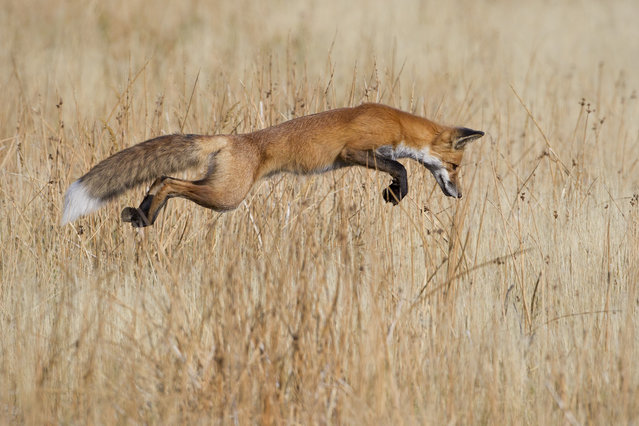
Canada: “Lucky pounce”. (Photo by Connor Stefanison/Wildlife Photographer of the Year 2013)

The winners of The London’s Natural History Museum's prestigious Wildlife Photographer of the Year for 2013 have finally been unveiled. Selected from almost 43,000 entries from 96 countries, the winners offer a glimpse of the stunning array of natural beauty on our planet. Photo: Canada: “Lucky pounce”. “Anticipating the pounce – that was the hardest part”, says Connor, who had come to Yellowstone National Park, Wyoming, USA, in search of wildlife as much as the spectacular landscape. He had found this fox, his first ever, on his last day in the park. It was so absorbed in hunting that Connor had plenty of time to get out of the car and settle behind a rock. It quartered the grassland, back and forth, and then started staring intently at a patch of ground, giving Connor just enough warning of the action to come. When it sprung up, Connor got his shot. And when it landed, the fox got his mouse. (Photo by Connor Stefanison/Wildlife Photographer of the Year 2013)
Details
17 Oct 2013 08:12:00
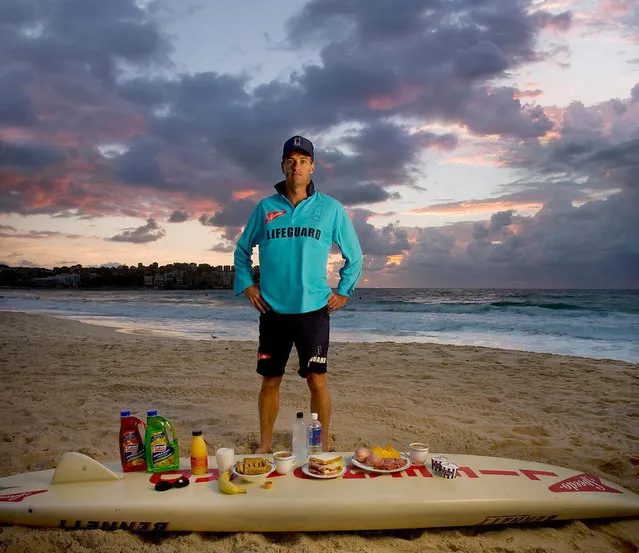
What the World Eats By Peter Menzel And Faith D'Aluisio Part 2

A stunning photographic collection featuring portraits of people from 30 countries and the food they eat in one day. In this fascinating study of people and their diets, 80 profiles are organized by the total number of calories each person puts away in a day. Featuring a Japanese sumo wrestler, a Massai herdswoman, world-renowned Spanish chef Ferran Adria, an American competitive eater, and more, these compulsively readable personal stories also include demographic particulars, including age, activity level, height, and weight. Essays from Harvard primatologist Richard Wrangham, journalist Michael Pollan, and others discuss the implications of our modern diets for our health and for the planet. This compelling blend of photography and investigative reportage expands our understanding of the complex relationships among individuals, culture, and food.
Details
02 May 2014 09:20:00
Inside the new Digital Art Museum in Tokyo, Japan on June 21, 2018. (Photo by South West News Service)

Inside the new Digital Art Museum in Tokyo, Japan on June 21, 2018. These incredible photos show what it looks like inside a groundbreaking new digital art museum in Japan. A trip to the Mori Building Digital Art Museum: teamLab Borderless in Tokyo, which opened last week, can make you feel like they you are dreaming and aims to fully immerse visitors in the art. Spanning a spacious 10,000 square metres, 520 computers and 470 high-tech projectors create the illusion that the visitor is wandering through rice fields, following shoals of fish or even bouncing on a galaxy of planets. (Photo by South West News Service)
Details
29 Jun 2018 00:01:00
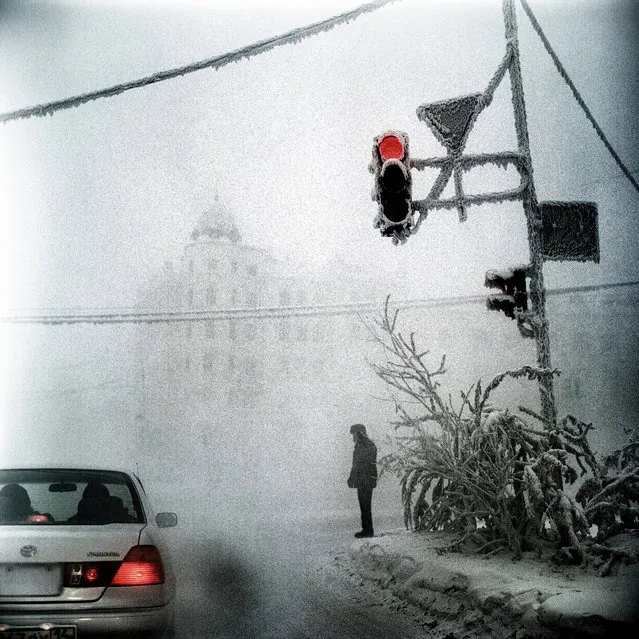
January 2013. A scene in Yakutsk, Siberia, the coldest city in the world. (Photo by Steeve Iuncker/Agence VU)

Yakutsk, a remote city in Eastern Siberia along the Lena River, is the coldest city in the world. Located 1840 km away from Irkoustk and 5000 km away from Moscow, this city founded in 1632 by the Cossacks imposes upon its inhabitants an extreme way of life. And yet, despite particularly harsh conditions, Yakutsk boasts a population of 270,000, or a quarter of the entire population of Siberia. No other place on the planet experiences the temperature extreme found here: in winter, the temperatures regularly fall to minus 40° (the coldest temperature recorded was –64°C) and in summer often reaches temperatures above 30°C. Photo: January 2013. A scene in Yakutsk, Siberia, the coldest city in the world. (Photo by Steeve Iuncker/Agence VU)
Details
29 Apr 2013 10:30:00
Human Barbie Doll Valeria Lukyanova aka Naamah From The Ukraine

This is a “swami” - Valeria Lukyanova (born August 23, 1985), from Odessa, Ukraine. Her other names: Naamah (Нахема; Na'amah (Hebrew: נעמה‎) – is a demonic legendary creature, the mother of divination), Amatue, Nagval and Goddess (бАгиня). She is fond of esoteric, believes that 2012 will be the end of the world, and waits for the planet Nibiru (I'm not kidding). This girl had amused the Russian-language Internet (because the Russians are cynical and heartless people). IMHO she is very beautiful (technical characteristics – Chest: 88cm (34,64 in; may be longer already); Waist: 47cm (18,5 in; may be lesser already) and Hips: 88cm (34,64 in)). Enjoy. (Photos by Valeria Lukyanova)
Details
06 Aug 2012 11:35:00
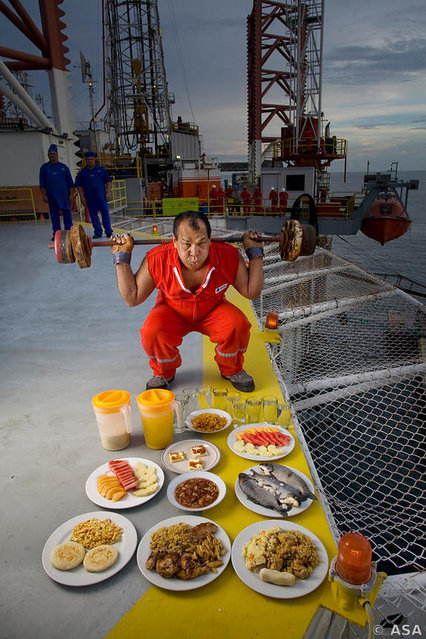
What the World Eats By Peter Menzel And Faith D'Aluisio Part 1

A stunning photographic collection featuring portraits of people from 30 countries and the food they eat in one day. In this fascinating study of people and their diets, 80 profiles are organized by the total number of calories each person puts away in a day. Featuring a Japanese sumo wrestler, a Massai herdswoman, world-renowned Spanish chef Ferran Adria, an American competitive eater, and more, these compulsively readable personal stories also include demographic particulars, including age, activity level, height, and weight. Essays from Harvard primatologist Richard Wrangham, journalist Michael Pollan, and others discuss the implications of our modern diets for our health and for the planet. This compelling blend of photography and investigative reportage expands our understanding of the complex relationships among individuals, culture, and food.
Details
23 Apr 2014 14:34:00


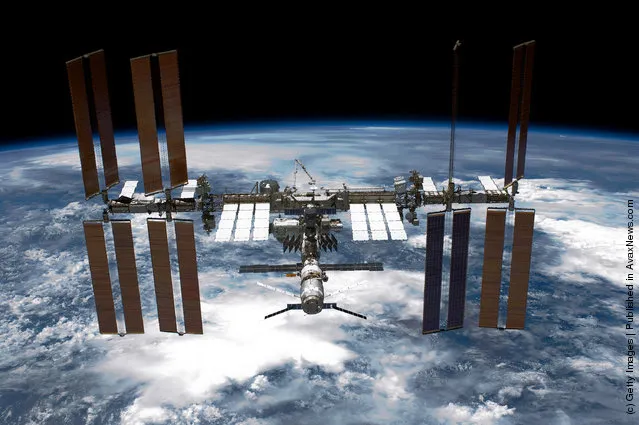
Back dropped by planet Earth the International Space Station (ISS) is seen from NASA space shuttle Endeavour after the station and shuttle began their post-undocking relative separation May 29, 2011 in space. After 20 years, 25 missions and more than 115 million miles in space, NASA space shuttle Endeavour is on the last leg of its final flight to the International Space Station before being retired and donated to the California Science Center in Los Angeles. Capt. Mark E. Kelly, U.S. Rep. Gabrielle Giffords' (D-AZ) husband, has lead mission STS-134 as it delivered the Express Logistics Carrier-3 (ELC-3) and the Alpha Magnetic Spectrometer (AMS-2) to the International Space Station. (Photo by NASA via Getty Images)
Details
01 Jun 2011 06:47:00