Loading...
Done


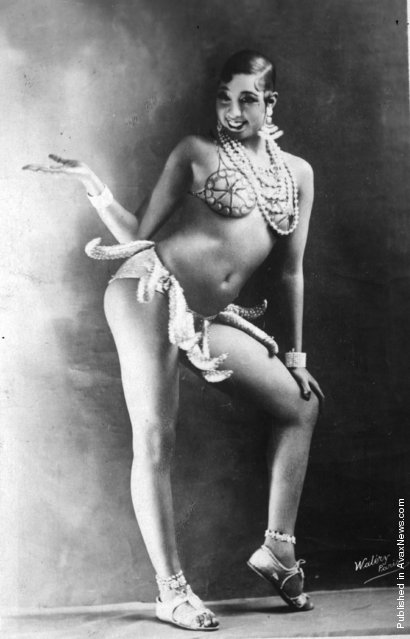
“Josephine Baker (June 3, 1906 – April 12, 1975) was an American-born French dancer, singer, and actress. Nicknamed the “Bronze Venus”, the “Black Pearl”, and even the “Créole Goddess” in anglophone nations.

Baker was the first African American female to star in a major motion picture and to integrate an American concert hall, and to become a world-famous entertainer. She is also noted for her contributions to the Civil Rights Movement in the United States (she was offered the unofficial leadership of the movement by Coretta Scott King in 1968 following Martin Luther King, Jr.'s assassination, but turned it down), for assisting the French Resistance during World War II and for being the first American-born woman to receive the French military honor, the Croix de guerre”.

Photo: American entertainer Josephine Baker in costume for her famous “banana dance”. Baker was an overnight sensation when she arrived in Paris in the mid-1920s. (Photo by Walery/Getty Images)
Details
18 Mar 2011 10:22:00
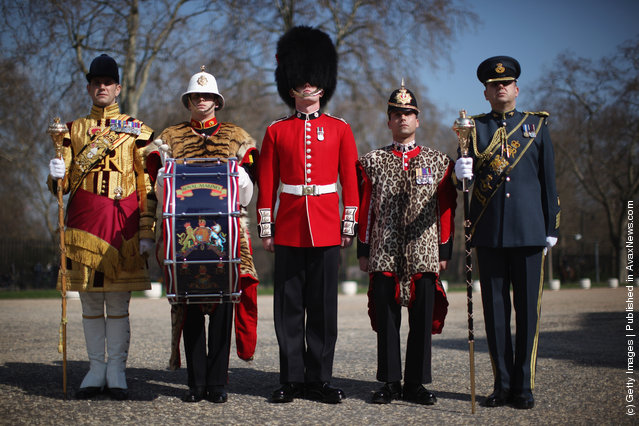
(L-R) Senior Drum Major Betts of the Scotts Guard, Bugler Lee Kidd, Guardsman Adam Deer of the Coldstream Guards and Lance corporal Michael Strong of the Princess of Wales's Royal Regiment pose in their full ceremonial attire at Wellington Barracks

(L-R) Senior Drum Major Betts of the Scotts Guard, Bugler Lee Kidd, Guardsman Adam Deer of the Coldstream Guards and Lance corporal Michael Strong of the Princess of Wales's Royal Regiment pose in their full ceremonial attire at Wellington Barracks on March 21, 2012 in London, England. The group make up part of the ceremonial military personnel who will play a key role during Her Majesty the Queens Diamond Jubilee celebrations between June 2–5. (Photo by Dan Kitwood/Getty Images)
Details
23 Mar 2012 11:50:00
United States Coast Guard Academy Cadets Second Class Aurimas Juodka, left, and Sheila Bertrand get in the face of “swab” Kevin Lennox as Bravo Company finishes at the barber shop and mailroom during R-Day, the reporting-in day that marks the beginning of the 7-week “Swab Summer” for the class of 2018 Monday, June 30, 2014, in New London, Conn. (Photo by Sean D. Elliot/AP Photo/The Day)

United States Coast Guard Academy Cadets Second Class Aurimas Juodka, left, and Sheila Bertrand get in the face of “swab” Kevin Lennox as Bravo Company finishes at the barber shop and mailroom during R-Day, the reporting-in day that marks the beginning of the 7-week “Swab Summer” for the class of 2018 Monday, June 30, 2014, in New London, Conn. About 250 prospective cadets, Swabs, start the program designed to indoctrinate them to the military life of the academy and at the end will be accepted into the corps of cadets. (Photo by Sean D. Elliot/AP Photo/The Day)
Details
05 Jul 2014 12:20:00
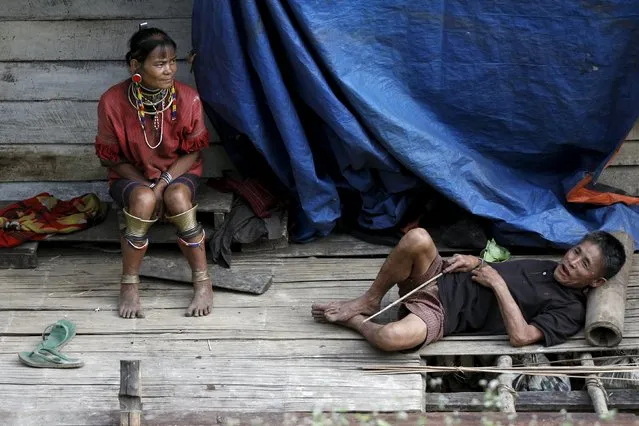
An ethnic Kayaw couple Mu Htoo and her husband Htaw Eili rest at their home at Htaykho village in the Kayah state, Myanmar September 12, 2015. (Photo by Soe Zeya Tun/Reuters)

An ethnic Kayaw couple Mu Htoo and her husband Htaw Eili rest at their home at Htaykho village in the Kayah state, Myanmar September 12, 2015. With about 30,000 members, the Kayaw are one of the smallest ethnic minorities among Myanmar's 135 groups. Their village has for decades been off-limits, as armed rebels fought the military before a recent ceasefire stopped the bloody conflict here. The rebels in the area have put down their guns and taken to the hills to grow rice and corn, but slash-and-burn cultivation methods mean they struggle to find new places to farm. (Photo by Soe Zeya Tun/Reuters)
Details
21 Oct 2015 08:03:00


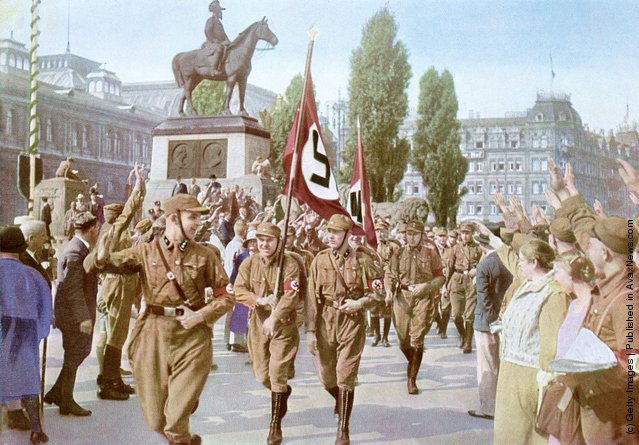
“Horst Ludwig Wessel (October 9, 1907 – February 23, 1930) was a German Nazi activist who was made a posthumous hero of the Nazi movement following his violent death in 1930. He was the author of the lyrics to the song “Die Fahne hoch” (“The Flag On High”), usually known as Horst-Wessel-Lied (“The Horst Wessel Song”), which became the Nazi Party anthem and, de facto, Germany's co-national anthem from 1933 to 1945”. – Wikipedia

Photo: German Nazi activist Horst Wessel (left) at the head of a parade of S.A. stormtroopers, or “brownshirts”, in Nuremberg, Germany, 1929. (Photo by Hulton Archive/Getty Images)
Details
08 Jul 2011 09:38:00
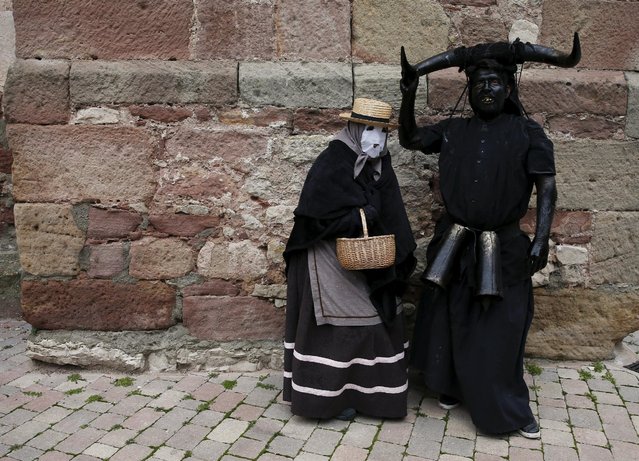
A reveller (R), dressed as “Diablos de Luzon” (Luzon Devils), stands next to a person dressed as a “Mascaritas” during carnival celebrations in the village of Luzon, Spain, February 6, 2016. (Photo by Sergio Perez/Reuters)

A reveller (R), dressed as “Diablos de Luzon” (Luzon Devils), stands next to a person dressed as a “Mascaritas” during carnival celebrations in the village of Luzon, Spain, February 6, 2016. The “Diablos” cover themselves in a mixture of soot and oil and adorn their heads with black-stained bull horns as they parade throughout the village with cowbells clanging around their waists to expel the evil spirits. (Photo by Sergio Perez/Reuters)
Details
08 Feb 2016 11:49:00
Call Paradei In Sao Paulo

Call Parade is an ongoing public art project in São Paulo sponsored by Brazilian telecommunications firm Vivo, that paired 100 artists with 100 street-side phone booths giving them free reign to transform the peculiar hooded fixtures into anything imaginable. The exhibition has proven to be extremely popular and Brazilian photographer Mariane Borgomani set out to capture a number of the phones, my favorite of which is the painted day/night treatment above by artist Maramgoní.
Details
26 Jun 2015 07:41:00
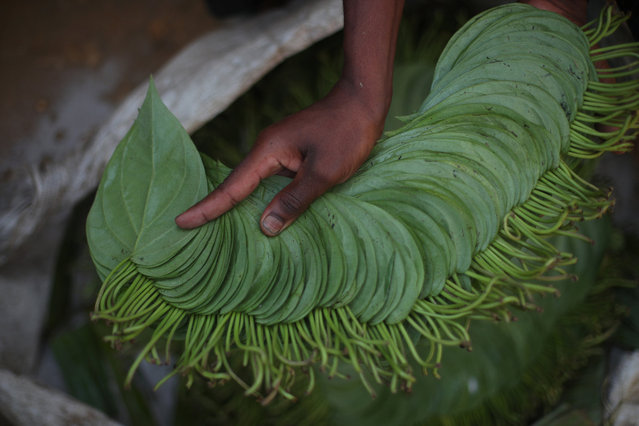
Faruk, 17, a Rohingya refugee trader holds betel leaves which are on sale at a stall in Palong Khali refugee camp near Cox's Bazar, Bangladesh, November 3, 2017. He left his village in Myanmar when the military opened fire towards the Rohingya. “I buy this betel leaf from Palong Khali market, in one bundle there are 160 pieces, I buy it for 80 taka and I sell it for 100 taka. Bangladeshi's and I sell for the same rate in the camp. Outside in the local market it is 80 taka per bundle. My problem is that I don't have money so I can't buy anything to eat, I can't buy fish to eat”, he said. (Photo by Hannah McKay/Reuters)

Faruk, 17, a Rohingya refugee trader holds betel leaves which are on sale at a stall in Palong Khali refugee camp near Cox's Bazar, Bangladesh, November 3, 2017. He left his village in Myanmar when the military opened fire towards the Rohingya. “I buy this betel leaf from Palong Khali market, in one bundle there are 160 pieces, I buy it for 80 taka and I sell it for 100 taka (1 Bangladeshi Taka = 0.012 US Dollar). Bangladeshi's and I sell for the same rate in the camp. Outside in the local market it is 80 taka per bundle. My problem is that I don't have money so I can't buy anything to eat, I can't buy fish to eat”, he said. (Photo by Hannah McKay/Reuters)
Details
27 Nov 2017 08:54:00