Loading...
Done
Japan To Commemorate 6 Months Anniversary Of Earthquake And Tsunami

In this composite image, (Bottom Photo) a car drives past a ship called Asia Symphony that was left stranded prior to the sixth month anniversary of the March 11 earthquake and massive tsunami on September 10, 2011 in Kamaishi, Iwate Prefecture, Japan. (Top Photo) Local residents walk past the Asia Symphony, which has been left stranded after being lifted up onto the promenade of the docks March 24, 2011 in Kamaishi, Iwate Prefecture, Japan. A 9.0 magnitude strong earthquake struck Japan offshore on March 11 at 2:46pm local time, triggering a tsunami wave of up to ten metres which engulfed large parts of north-eastern Japan and also damaging the Fukushima nuclear plant, causing the worst nuclear crisis in decades. The current number of dead and missing is reportedly estimated to be 22,900. (Photo by Athit Perawongmetha/Getty Images)
Details
11 Sep 2011 10:06:00
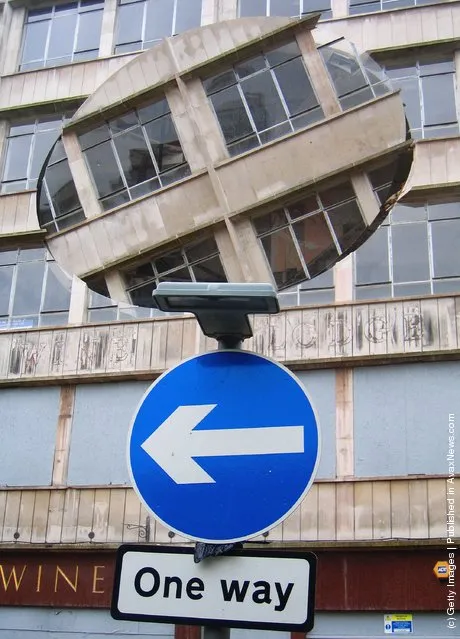
An installation by the artist Richard Wilson, entitled 'Turning the Place Over', is built into the condemned Cross Keys House in Moorfields as part of the Capital of Culture for 2008

“Richard Wilson (born May 24, 1953) is a sculptor, installation artist and musician. Wilson's work is characterised by architectural concerns with volume, illusionary spaces and auditory perception”. – Wikipedia

Photo: An installation by the artist Richard Wilson, entitled “Turning the Place Over”, is built into the condemned Cross Keys House in Moorfields as part of the Capital of Culture for 2008, on June 25, 2007 in Liverpool, England. The piece consists of an 8 metre ovoid cut from the building's facade that oscillates in three dimensions. (Photo by Jim Dyson/Getty Images)
Details
27 Mar 2012 10:31:00
«After Presents», 1996. Siri Kaur: “I was 14 when Simran was born in 1990. We have different mothers, so we grew up separately and I made pictures with her whenever I saw her. The work of Sally Mann and Nan Goldin gave me permission to see my family as a valid art subject. This image shows the aftermath of Christmas morning. Simran is unselfconsciously lounging on the floor, melding into her beloved dog”. (Photo by Siri Kaur)

«After Presents», 1996. Siri Kaur: “I was 14 when Simran was born in 1990. We have different mothers, so we grew up separately and I made pictures with her whenever I saw her. The work of Sally Mann and Nan Goldin gave me permission to see my family as a valid art subject. This image shows the aftermath of Christmas morning. Simran is unselfconsciously lounging on the floor, melding into her beloved dog”. (Photo by Siri Kaur)
Details
10 Aug 2025 04:03:00
Male members of the Zeleziar folk dance group whip and water the local girls dressed in traditional clothing, during Easter in Bociar, Slovakia on April 1, 2024. Boys and younger men visit the houses of young girls, whip them with fresh-cut decorated wickers and sprinkle water on them. By tradition, the whipping should give the girls strength, health, and abundance throughout the whole year. (Photo by Robert Nemeti/Anadolu via Getty Images)

Male members of the Zeleziar folk dance group whip and water the local girls dressed in traditional clothing, during Easter in Bociar, Slovakia on April 1, 2024. Boys and younger men visit the houses of young girls, whip them with fresh-cut decorated wickers and sprinkle water on them. By tradition, the whipping should give the girls strength, health, and abundance throughout the whole year. (Photo by Robert Nemeti/Anadolu via Getty Images)
Details
18 Aug 2025 03:18:00
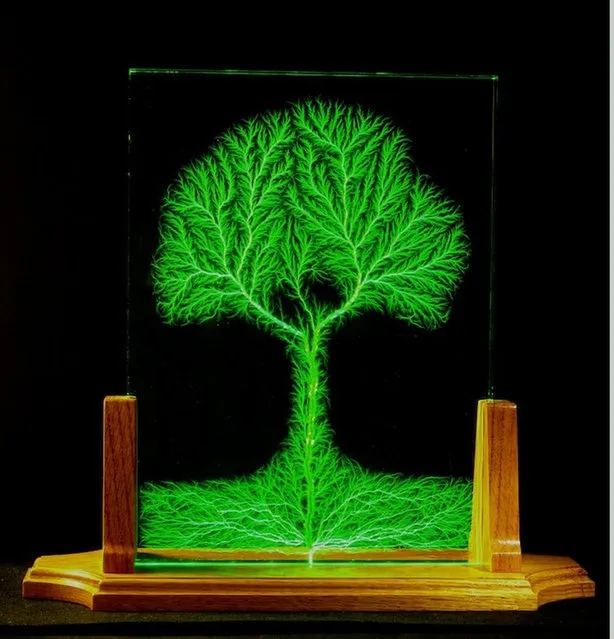
A Flash of Lightning by Bert Hickman

Hickman's experimental art, which reflects the vein-like extensions that electrical charges burn into surfaces they come in contact with, are referred to as Lichtenberg figures. The diverging patterns present in each of the artist's "paintings" are natural occurrences from subjecting the panels to tiny lightning storms through a handy device known as a particle accelerator. Hickman is like a modern-day Zeus, painting with lightning bolts.
Details
26 Nov 2012 14:15:00
American science fiction writer L. Ron Hubbard, founder of the Church of Scientology, uses his Hubbard Electrometer

“Lafayette Ronald Hubbard (March 13, 1911 – January 24, 1986), better known as L. Ron Hubbard (and often referred to by his initials, LRH), was an American pulp fiction author and religious leader who founded the Church of Scientology. After establishing a career as a writer, becoming best known for his science fiction and fantasy stories, he developed a self-help system called Dianetics which was first published in May 1950. He subsequently developed his ideas into a wide-ranging set of doctrines and rituals as part of a new religious movement that he called Scientology. His writings became the guiding texts for the Church of Scientology and a number of affiliated organizations that address such diverse topics as business administration, literacy and drug rehabilitation”. – Wikipedia

Photo: American science fiction writer L. Ron Hubbard, founder of the Church of Scientology, uses his Hubbard Electrometer (patent pending) to determine whether tomatoes experience pain, 1959. His work led him to the conclusion that tomatoes “scream when sliced”. (Photo by Scott Lauder/Evening Standard/Hulton Archive/Getty Images)
Details
09 Sep 2011 09:34:00
A Tenggerese shaman praying for worshippers at Widodaren cave during the Tenggerese Hindu Yadnya Kasada festival on July 31, 2015 in Probolinggo, East Java, Indonesia. The festival is the main festival of the Tenggerese people and lasts about a month. On the fourteenth day, the Tenggerese make the journey to Mount Bromo to make offerings of rice, fruits, vegetables, flowers and livestock to the mountain gods by throwing them into the volcano's caldera. (Photo by Ulet Ifansasti/Getty Images)

A Tenggerese shaman praying for worshippers at Widodaren cave during the Tenggerese Hindu Yadnya Kasada festival on July 31, 2015 in Probolinggo, East Java, Indonesia. The festival is the main festival of the Tenggerese people and lasts about a month. On the fourteenth day, the Tenggerese make the journey to Mount Bromo to make offerings of rice, fruits, vegetables, flowers and livestock to the mountain gods by throwing them into the volcano's caldera. The origin of the festival lies in the 15th century when a princess named Roro Anteng started the principality of Tengger with her husband Joko Seger, and the childless couple asked the mountain Gods for help in bearing children. The legend says the Gods granted them 24 children but on the provision that the 25th must be tossed into the volcano in sacrifice. The 25th child, Kesuma, was finally sacrificed in this way after initial refusal, and the tradition of throwing sacrifices into the caldera to appease the mountain Gods continues today. (Photo by Ulet Ifansasti/Getty Images)
Details
01 Aug 2015 12:07:00
A handout photo provided by the Police department in Lippe on 01 June 2015 of a British “Challenger 2” tank after it rolled over a car's front in Lippe, Germany, 01 June 2015. Police reported that a 18-year old female driving beginner from Detmold apparently overlooked a convoy of tanks when she turned left onto the Panzeringstrasse (lit. Tank Ring Road). The driver of the convoy'e leading tank, a 24-year old British national, was not able to stop his vehicle fast enough, hit the car and overran the vehicle's front. The young female car driver remained unhurt. The exclusive damage to the car was estimated at about 12,000 euro. (Photo by EPA/Polizei Lippe)

A handout photo provided by the Police department in Lippe on 01 June 2015 of a British “Challenger 2” tank after it rolled over a car's front in Lippe, Germany, 01 June 2015. Police reported that a 18-year old female driving beginner from Detmold apparently overlooked a convoy of tanks when she turned left onto the Panzeringstrasse (lit. Tank Ring Road). (Photo by EPA/Polizei Lippe)
Details
06 Mar 2020 00:03:00