Loading...
Done
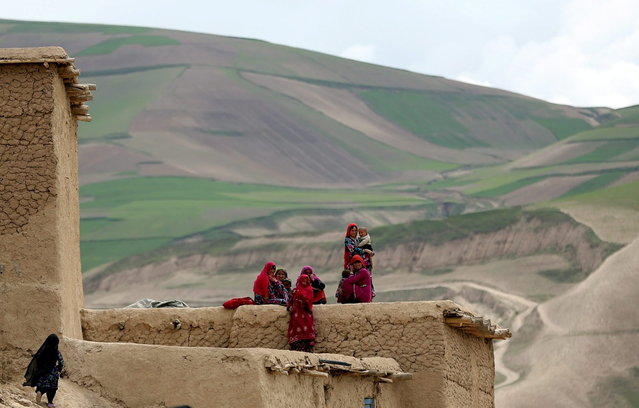
In this Sunday, May 4, 2014 photo, Survivors sit with their possessions near the site of Friday's landslide that buried Abi-Barik village in Badakhshan province, northeastern Afghanistan. Stranded and with no homes, many of the families have struggled to get aid. Some have gone to nearby villages to stay with relatives or friends, while others have slept in tents provided by aid groups. The unlucky ones have slept outside. (Photo by Massoud Hossaini/AP Photo)

In this Sunday, May 4, 2014 photo, Survivors sit with their possessions near the site of Friday's landslide that buried Abi-Barik village in Badakhshan province, northeastern Afghanistan. Stranded and with no homes, many of the families have struggled to get aid. Some have gone to nearby villages to stay with relatives or friends, while others have slept in tents provided by aid groups. The unlucky ones have slept outside. (Photo by Massoud Hossaini/AP Photo)
Details
09 May 2014 10:01:00
A decades-old television. (Photo by Mark C. O'Flaherty)

The official name for this tiny speck of land – the size of 12 football pitches – is Hashima, but few call it that. In English, its most commonly used name means “Battleship Island” and, viewed from a certain angle offshore, its silhouette is uncannily dreadnought in nature. It was a mining facility until 1974, when it was abandoned to the elements, before partially reopening as a tourist attraction in 2009. Photo: A decades-old television. (Photo by Mark C. O'Flaherty)
Details
15 Jun 2014 11:24:00


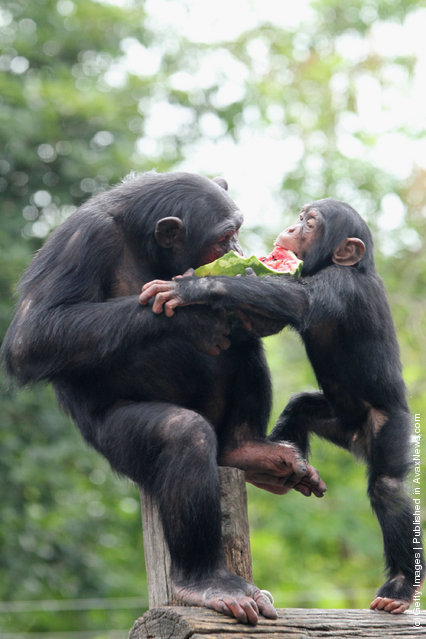
Two chimpanzees share a piece of watermelon at Taronga Zoo on December 23, 2010 in Sydney, Australia. (Photo by Rick Stevens/Taronga Zoo via Getty Images)
Details
29 May 2011 10:52:00


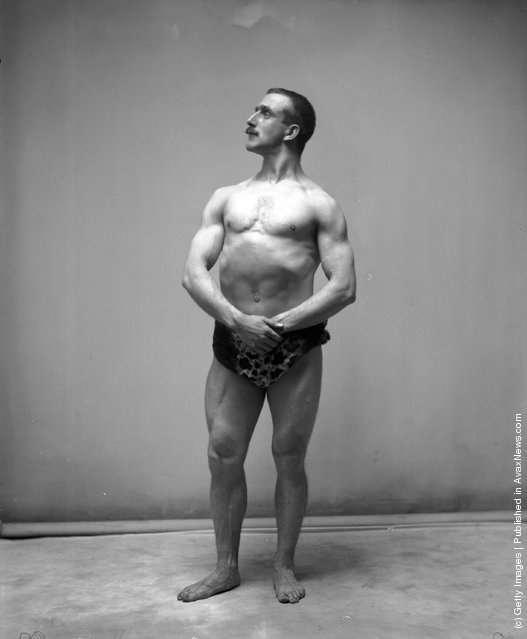
Winner of the Sandow bodybuilding competition, Mr. Murray. (Photo by Reinhold Thiele/Thiele/Getty Images). Circa 1905
Details
27 Jul 2011 12:35:00
A man walks on the Cobb as storm waves break behind in Lyme Regis, England

A man walks on the Cobb as storm waves break behind on December 13, 2011 in Lyme Regis, England. (Photo by Matt Cardy/Getty Images)
Details
16 Dec 2011 13:49:00


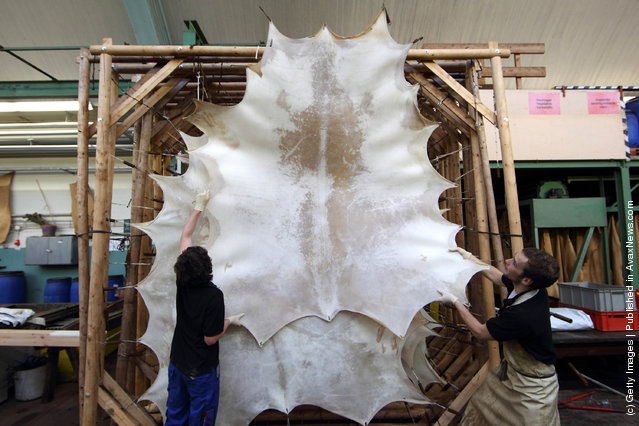
REUTLINGEN, GERMANY - NOVEMBER 17: Students hang out finished parchment leather at the LGR (Lederinstitut Gerberschule Reutlingen) tannery school on November 17, 2010 in Reutlingen, Germany. Even in early antiquity and up their hair or dried goat and sheep skins were used as material for documents. In the small Asian city Pergamon these skins were processed in large quantities for this purpose, so they formed the main trading arm of the city, of which the name is parchment is derived. In medieval times, reached the parchment is of great importance, it was such as France's production under the supervision of the University of Paris. Even now, important documents, placed on their unlimited shelf life as possible large value (eg diplomas, addresses, memory, writings, documents for primary and keystones) written on parchment...
Details
20 Nov 2011 18:17:00
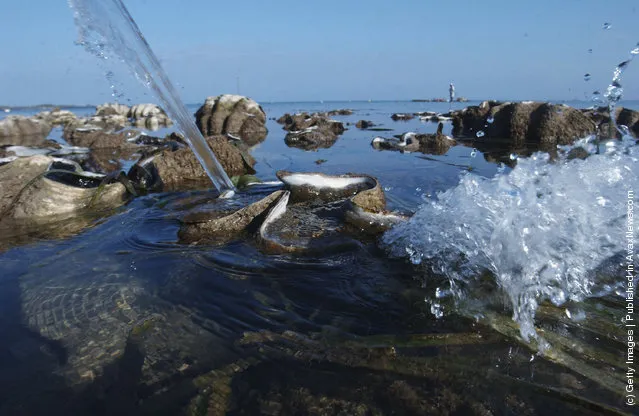
Tridacna Gigas, or Giant Clams

“The giant clam, Tridacna gigas (known as pā’ua in Cook Islands Māori), is the largest living bivalve mollusc. T. gigas is one of the most endangered clam species. It was mentioned as early as 1825 in scientific reports. One of a number of large clam species native to the shallow coral reefs of the South Pacific and Indian oceans, they can weigh more than 200 kilograms (440 lb) measure as much as 120 cm (47 in) across, and have an average lifespan in the wild of 100 years or more”. – Wikipedia

Photo: Tridacna Gigas, or Giant Clams spew water as a traditional fisherman passes by a small sanctuary on January 23, 2004 near Bolinao in the Northern Philippines. The clams, prime builders for coral reefs and providing shelter for spawning fish and other marine life, are exposed by low tides in the sanctuary. Overfishing and pollution throughout the country are not only threatening food security, but are also starting to choke one of the few working clam sanctuaries in the world. (Photo by David Greedy/Getty Images)
Details
01 Oct 2011 13:10:00


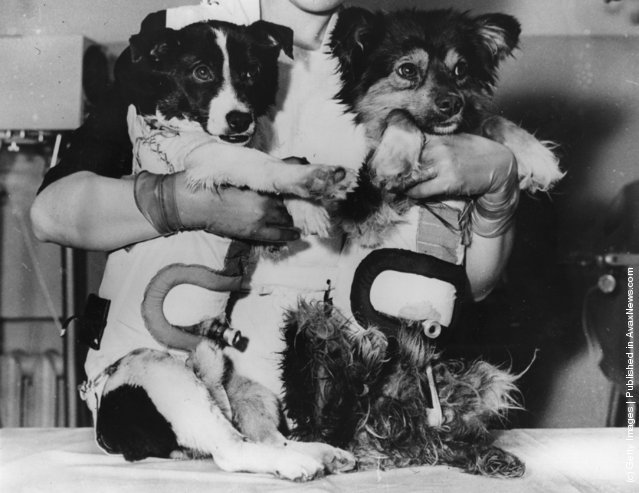
Two dogs sent into outer space by the Soviet Union after their safe return to earth. They spent 22 days in orbit. (Photo by Central Press/Getty Images). 22nd March 1966
Details
12 Apr 2011 09:39:00