Loading...
Done
On August 31, 2012, a long filament of solar material that had been hovering in the sun's atmosphere, the corona, erupted out into space at 4:36 p.m. EDT. The coronal mass ejection, or CME, traveled at over 900 miles per second. The CME did not travel directly toward Earth, but did connect with Earth's magnetic environment, or magnetosphere, causing aurora to appear on the night of Monday, September 3. (Photo by NASA/GSFC/SDO)

On August 31, 2012, a long filament of solar material that had been hovering in the sun's atmosphere, the corona, erupted out into space at 4:36 p.m. EDT. The coronal mass ejection, or CME, traveled at over 900 miles per second. The CME did not travel directly toward Earth, but did connect with Earth's magnetic environment, or magnetosphere, causing aurora to appear on the night of Monday, September 3. (Photo by NASA/GSFC/SDO via The Atlantic)
Details
14 Sep 2012 09:01:00
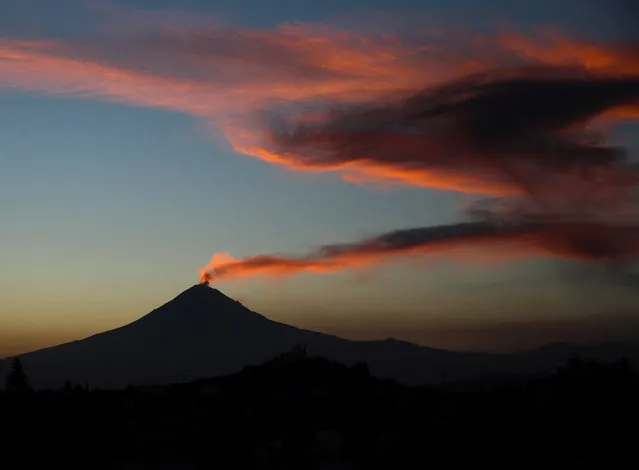
A general view shows a column of steam emerging from Popocatepetl volcano, after an increase in volcanic activity with steam and ash eruptions have been registered recently, according to local media, as seen from San Andres Cholula municipality, in the state of Puebla, Mexico on February 1, 2023. (Photo by Henry Romero/Reuters)

A general view shows a column of steam emerging from Popocatepetl volcano, after an increase in volcanic activity with steam and ash eruptions have been registered recently, according to local media, as seen from San Andres Cholula municipality, in the state of Puebla, Mexico on February 1, 2023. (Photo by Henry Romero/Reuters)
Details
28 Mar 2023 03:32:00
(L-R) Chris Diamantopoulos,  AnnaLynne McCord, Matt Jones and Jane Seymour visit the Build Series at Build Studio on January 23, 2018 in New York City, United States. (Photo by Brad Barket/Getty Images)

(L-R) Chris Diamantopoulos, AnnaLynne McCord, Matt Jones and Jane Seymour visit the Build Series at Build Studio on January 23, 2018 in New York City, United States. (Photo by Brad Barket/Getty Images)
Details
25 Jan 2018 09:08:00
Twenty-year-old women draped in traditional kimonos gather for their “Coming-of-Age Day” ceremony at the Tokyo Disneyland in Urayasu, eastern suburb of Tokyo on January 13, 2020. (Photo by Kazuhiro Nogi/AFP Photo)

Twenty-year-old women draped in traditional kimonos gather for their “Coming-of-Age Day” ceremony at the Tokyo Disneyland in Urayasu, eastern suburb of Tokyo on January 13, 2020. (Photo by Kazuhiro Nogi/AFP Photo)
Details
01 Jan 2021 00:01:00
Toure, a Gambian salt harvester, holds a basket filled with  the salt collected from the crust of the bottom of the Lake Retba (Pink Lake) in Senegal on March 16, 2021. Lake Retba, divided from the Atlantic Ocean by a narrow corridor of dunes, owes its name to the pink waters caused by the Dunaliella salina algae and is known for its high salt content, up to 40% in some areas. (Photo by Marco Longari/AFP Photo)

Toure, a Gambian salt harvester, holds a basket filled with the salt collected from the crust of the bottom of the Lake Retba (Pink Lake) in Senegal on March 16, 2021. Lake Retba, divided from the Atlantic Ocean by a narrow corridor of dunes, owes its name to the pink waters caused by the Dunaliella salina algae and is known for its high salt content, up to 40% in some areas. (Photo by Marco Longari/AFP Photo)
Details
24 Mar 2021 10:29:00
An aerial view shows a sinkhole 3.5 km (2 miles) to the east of Solikamsk-2 mine in Perm region, November 20, 2014. Shares in Russia's Uralkali, the world's top potash producer, fell sharply for a second day on Wednesday after a mine accident that could reduce global supplies and push up prices of the crop nutrient worldwide. (Photo by Reuters/Press service of Uralkali company)

An aerial view shows a sinkhole 3.5 km (2 miles) to the east of Solikamsk-2 mine in Perm region, November 20, 2014. Shares in Russia's Uralkali, the world's top potash producer, fell sharply for a second day on Wednesday after a mine accident that could reduce global supplies and push up prices of the crop nutrient worldwide. Uralkali shares have fallen 28 percent since Tuesday when it suspended work at its Solikamsk-2 mine, which accounts for a fifth of the company's output and 3.5 percent of global capacity, following an inflow of water. A sinkhole, stretching 30 by 40 metres (yards), found at an abandoned mine 3.5 km (2 miles) to the east, increased concern about the future of the mine because an inflow of water and the resulting sinkhole in 2006 forced another Uralkali operation to shut permanently. (Photo by Reuters/Press service of Uralkali company)
Details
22 Nov 2014 13:51:00
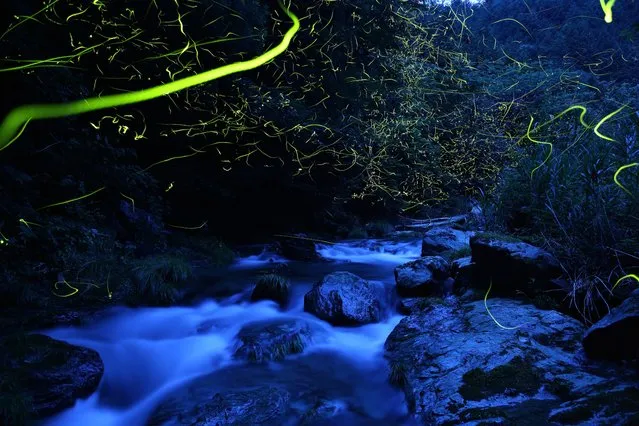
“In the late afternoon after a rain, genji botaru fireflies (luciola cruciate) dance above the swollen creek. The rocks darkened by the rain reflecting the blue sky, and the yellow-green ribbon of the glow from the fireflies, make a beautiful contrast”. – Takehito Miyatake. (Photo by Takehito Miyatake/Steven Kasher Gallery)

“In the late afternoon after a rain, genji botaru fireflies (luciola cruciate) dance above the swollen creek. The rocks darkened by the rain reflecting the blue sky, and the yellow-green ribbon of the glow from the fireflies, make a beautiful contrast”. – Takehito Miyatake. (Photo by Takehito Miyatake/Steven Kasher Gallery)
Details
19 Jun 2014 09:13:00
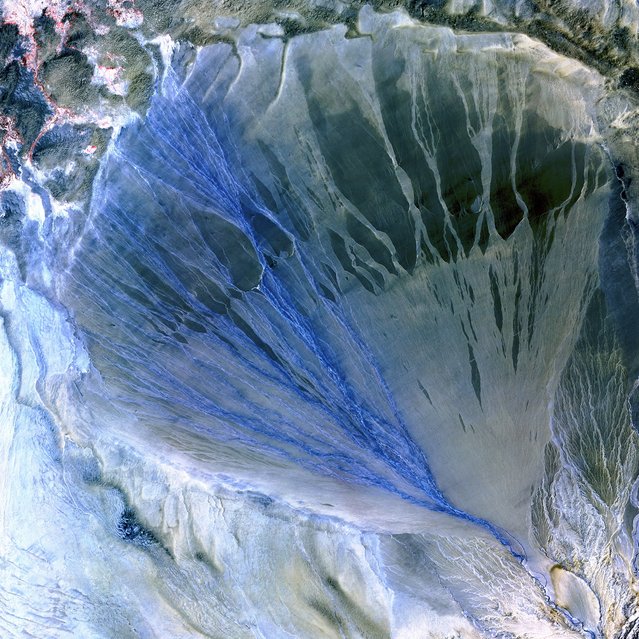
Alluvial Fan, China. A vast alluvial fan blossoms across the desolate landscape between the Kunlun and Altun mountain ranges that form the southern border of the Taklimakan Desert in China’s XinJiang Province. Image taken by the ASTER instrument on NASA’s Terra satellite on May 2nd, 2002. (Photo by NASA/GSFC/USGS EROS Data Center)

Alluvial Fan, China. A vast alluvial fan blossoms across the desolate landscape between the Kunlun and Altun mountain ranges that form the southern border of the Taklimakan Desert in China’s XinJiang Province. Image taken by the ASTER instrument on NASA’s Terra satellite on May 2nd, 2002. (Photo by NASA/GSFC/USGS EROS Data Center)
Details
07 Jan 2013 09:27:00