Loading...
Done
Photographers work on the red carpet after the screening of the film “Mad Max: Fury Road” out of competition at the 68th Cannes Film Festival in Cannes, southern France, May 14, 2015. (Photo by Regis Duvignau/Reuters)

Photographers work on the red carpet after the screening of the film “Mad Max: Fury Road” out of competition at the 68th Cannes Film Festival in Cannes, southern France, May 14, 2015. (Photo by Regis Duvignau/Reuters)
Details
15 May 2015 10:22:00
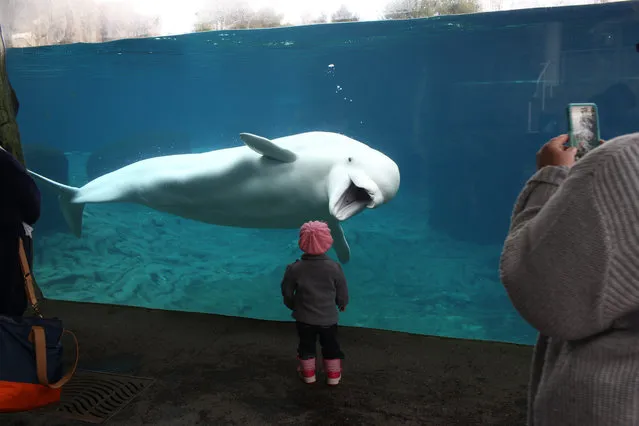
Juno, a Beluga whale, greets a young viewer at the Mystic aquarium in Connecticut, USA on December 5, 2015. (Photo by Tim Clayton/Corbis)

Juno, a Beluga whale, greets a young viewer at the Mystic aquarium in Connecticut, USA on December 5, 2015. (Photo by Tim Clayton/Corbis)
Details
07 Dec 2015 12:05:00
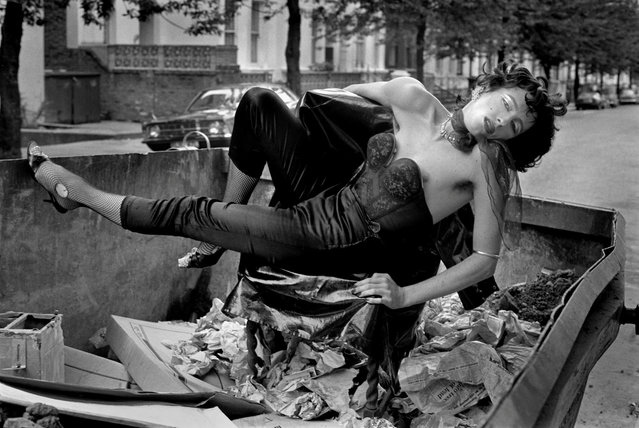
“A very delicate person, beneath the flamboyance”. Jasper, Ladbroke Grove, 1977. “In the 1970s, Australia was rather cut off. I’d always wanted to live abroad, so I moved to Rome and then London. I was an art historian, but started studying photography part-time. I was interested in the demi-monde culture and began mixing in all sorts of circles. Jasper was a rather wonderful character. He was from Sydney, but he was living downstairs from me in Ladbroke Grove, in a flat rented to some gay friends. It was fairly eclectic. Jasper was always playing around with clothes and makeup. If he was looking particularly wonderful, I might get out my lights and take a shot. Or he might put makeup on me. He wasn’t always in drag, but he was permanently in diva mode, dependably louche, funny and naughty. I think all that comes across in the image. He was actually a very delicate person, though, beneath the wit and flamboyance. Jasper floated through London all too briefly. His real name was Peter MacMahon, but to us he was only ever Jasper Havoc, an alter ego he’d created while part of a transvestite troupe called Sylvia and the Synthetics. They were legendary in Sydney gay culture. On this day, we’d been taking some pictures inside and had gone out into the streets to fool around some more. Jasper was wearing a corset and fishnets ensemble, with other bits and pieces, and we joked about him being trashy as he lay in the skip. We just took the shot for ourselves. It wasn’t done with any publication in mind, or anything else. This was way before the internet and people didn’t share images. If you dressed up, it was just for that moment”. (Photo by Jane England)

“A very delicate person, beneath the flamboyance”. Jasper, Ladbroke Grove, 1977. “In the 1970s, Australia was rather cut off. I’d always wanted to live abroad, so I moved to Rome and then London. I was an art historian, but started studying photography part-time. I was interested in the demi-monde culture and began mixing in all sorts of circles. Jasper was a rather wonderful character...”. (Photo by Jane England)
Details
26 Jun 2017 09:04:00
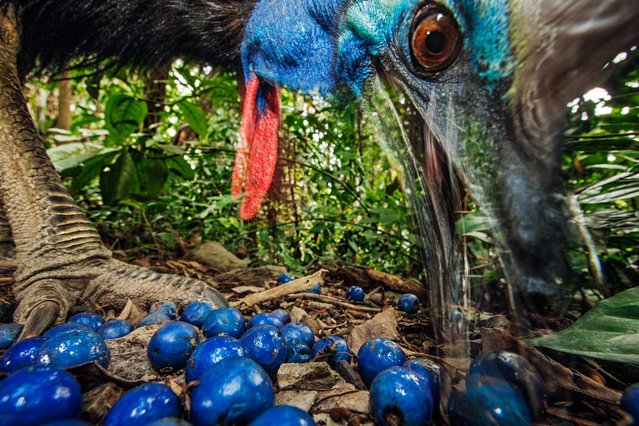
“Cassowaries are large, flightless birds related to emus and (more distantly) to ostriches, rheas, and kiwis”, writes Olivia Judson in the September issue of National Geographic magazine. (Photo by Christian Ziegler/National Geographic)

“Cassowaries are large, flightless birds related to emus and (more distantly) to ostriches, rheas, and kiwis”, writes Olivia Judson in the September issue of National Geographic magazine. How large? People-size: Adult males stand well over five foot five and top 110 pounds. Females are even taller, and can weigh more than 160 pounds. Dangerous when roused, they’re shy and peaceable when left alone. But even birds this big and tough are prey to habitat loss. The dense New Guinea and Australia rain forests where they live have dwindled. Today cassowaries might number 1,500 to 2,000. And because they help shape those same forests – by moving seeds from one place to another – “if they vanish”, Judson writes, “the structure of the forest would gradually change” too. (Photo by Christian Ziegler/National Geographic)

Details
06 Jan 2014 12:21:00
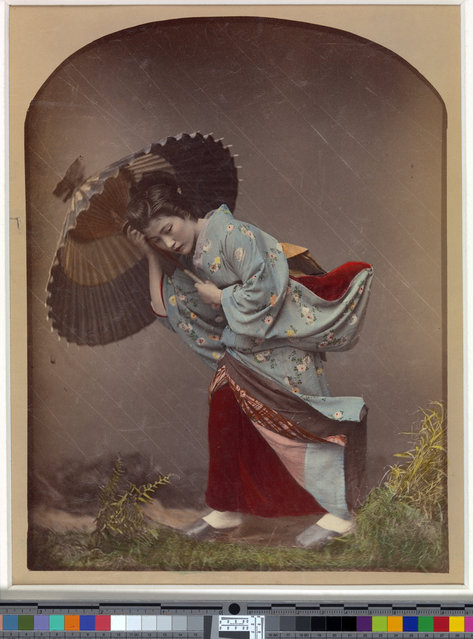
“Woman with Umbrella in Rain” by Raimund von Stillfried. Artist: Kusakabe Kimbei (Japanese, 1841–1934), 1870s. (Photo courtesy of The Metropolitan Museum of Art)

“Woman with Umbrella in Rain” by Raimund von Stillfried. Artist: Kusakabe Kimbei (Japanese, 1841–1934), 1870s. Commercial photography studios in Meiji-era Japan were renowned for the subtlety and refinement of their coloring techniques. This hand-tinted image of a young woman caught in a heavy rainstorm achieved its naturalistic effect by knitting together multiple strands of artifice: the greenery in the foreground was a studio prop; the flaps of the kimono were suspended by thin wires to create the impression of a strong wind; and long, diagonal marks were made on the negative to suggest streaks of rain. (Photo courtesy of The Metropolitan Museum of Art)
Details
12 May 2013 10:13:00
A Humboldt penguin stands on weighing scales whilst being photographed by members of the press during a photocall at the annual weigh-in at London Zoo in London, Britain, 24 August 2016. Every animal that is in the zoo is weighed and measured and the statistics recorded so the data can be shared with zoos across the world. (Photo by Hannah McKay/EPA)

A Humboldt penguin stands on weighing scales whilst being photographed by members of the press during a photocall at the annual weigh-in at London Zoo in London, Britain, 24 August 2016. Every animal that is in the zoo is weighed and measured and the statistics recorded so the data can be shared with zoos across the world. (Photo by Hannah McKay/EPA)
Details
25 Aug 2016 10:06:00
Miss Nord-Pas-de-Calais Camille Cerf (C) is congratulated by Miss Ile de France 2014 Margaux Savary (L) and Miss Auvergne 2014 Morgane Laporte after Cerf won the Miss France 2015 beauty contest on December 6, 2014 in Orleans. (Photo by Guillaume Souvant/AFP Photo)

Miss Nord-Pas-de-Calais Camille Cerf (C) is congratulated by Miss Ile de France 2014 Margaux Savary (L) and Miss Auvergne 2014 Morgane Laporte after Cerf won the Miss France 2015 beauty contest on December 6, 2014 in Orleans. (Photo by Guillaume Souvant/AFP Photo)
Details
13 Dec 2014 12:33:00
Csilla Orgel, a geologist of Crew 125 EuroMoonMars B mission, makes her way back to the Mars Desert Research Station (MDRS) in the Utah desert March 3, 2013. (Photo by Jim Urquhart/Reuters)

NASA says it could be another 20 years before humans touch down on Mars, but in a sense, the Mars Society has been exploring the red planet for more than a decade – in Utah. Photo: Csilla Orgel, a geologist of Crew 125 EuroMoonMars B mission, makes her way back to the Mars Desert Research Station (MDRS) in the Utah desert March 3, 2013. The MDRS aims to investigate the feasibility of a human exploration of Mars and uses the Utah desert's Mars-like terrain to simulate working conditions on the red planet. Scientists, students and enthusiasts work together developing field tactics and studying the terrain. All outdoor exploration is done wearing simulated spacesuits and carrying air supply packs and crews live together in a small communication base with limited amounts of electricity, food, oxygen and water. Everything needed to survive must be produced, fixed and replaced on site. (Photo by Jim Urquhart/Reuters)
Details
14 Mar 2013 12:11:00