Loading...
Done
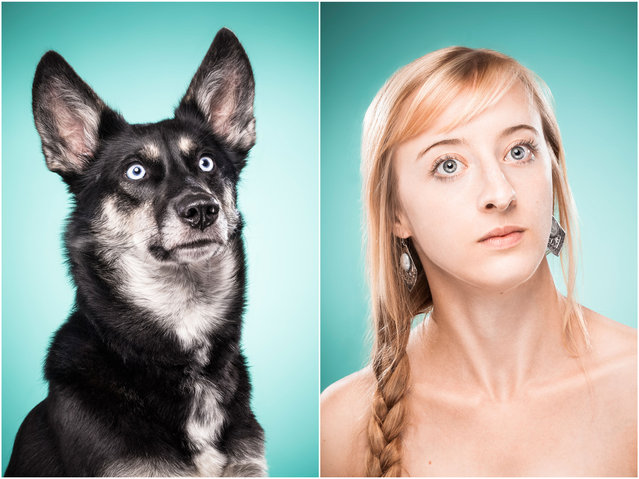
Amina and Zazou the dog. (Photo by Ines Opifanti/Caters News)

Barking mad owners have proved they really do look like their pets – by performing impressions of their own dogs. In a series of hilarious “paw”-traits, owners pull their best faces to look like their pooches. Snapped by photographer Ines Opifanti, people stuck their tongues out, yawned and tilted their heads in curiosity at the camera. Opifanti, from Hamburg, Germany, came up with the idea while interacting with her own dogs, two pug/French bulldog crossbreeds. Here: Amina and Zazou the dog. (Photo by Ines Opifanti/Caters News)
Details
02 Sep 2015 12:21:00
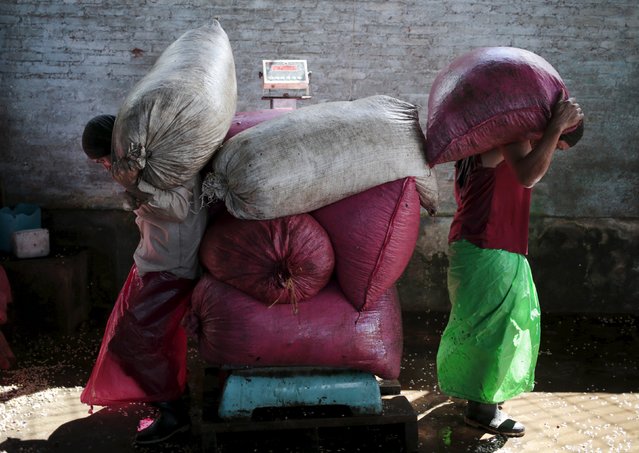
Workers carry sacks of coffee beans at a warehouse at the Nogales farm in Jinotega, Nicaragua January 7, 2016. (Photo by Oswaldo Rivas/Reuters)

Workers carry sacks of coffee beans at a warehouse at the Nogales farm in Jinotega, Nicaragua January 7, 2016. Soaring temperatures in Central America due to climate change are forcing farmers to pull up coffee trees and replace them with cocoa, spurring a revival in the cultivation of a crop once so essential to the region's economy. (Photo by Oswaldo Rivas/Reuters)
Details
20 Jan 2016 08:00:00
Due to the lack of available space inside, most passengers resort to sitting on top of the train. (Photo by Yousuf Tushar/Solent News & Photo Agency)

A busy rush hour sees thousands of commuters climbing on board a train – as well as holding onto its sides and sitting on the roof before it speeds off. Men, women and children climb and are pulled up onto the roof of the train, which is around 12ft (3.6m) high, as they try to find themselves a space. With no seats available inside, many commuters decide to take the risk and choose a rooftop view for their journey out of Dhaka city, in Bangladesh. (Photo by Yousuf Tushar/Solent News & Photo Agency)
Details
14 Mar 2017 00:03:00
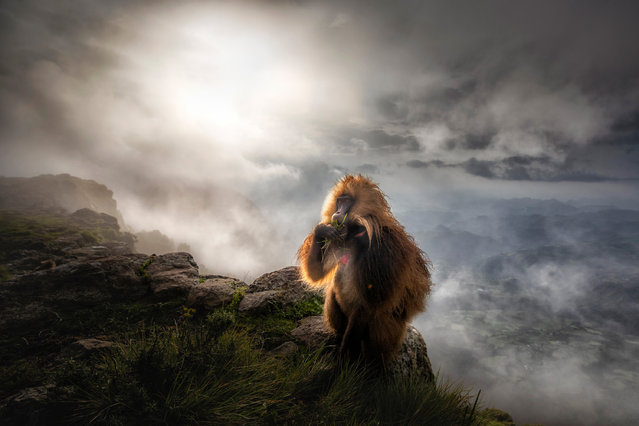
Highly commended, mammals: Gelada after the storm – Marco Gaiotti (Italy). “Gelada baboons are the only monkey species in the world that feed on grasses. They are native to the tableland of Ethiopia. Every morning large family groups wander from their sleeping places in the steep rock face, up to 1,000 metres high, to the feeding grounds at the tablelands. This image clearly depicts their feeding strategy: they pull out bunches of grass, sort the stalks and then lift them to their mouth. This shot was taken towards the end of the rainy season after a heavy storm”. (Photo by Marco Gaiotti/2019 GDT European Wildlife Photographer of the Year)

Highly commended, mammals: Gelada after the storm – Marco Gaiotti (Italy). “Gelada baboons are the only monkey species in the world that feed on grasses. They are native to the tableland of Ethiopia. Every morning large family groups wander from their sleeping places in the steep rock face, up to 1,000 metres high, to the feeding grounds at the tablelands. This image clearly depicts their feeding strategy: they pull out bunches of grass, sort the stalks and then lift them to their mouth. This shot was taken towards the end of the rainy season after a heavy storm”. (Photo by Marco Gaiotti/2019 GDT European Wildlife Photographer of the Year)
Details
31 Oct 2019 00:03:00
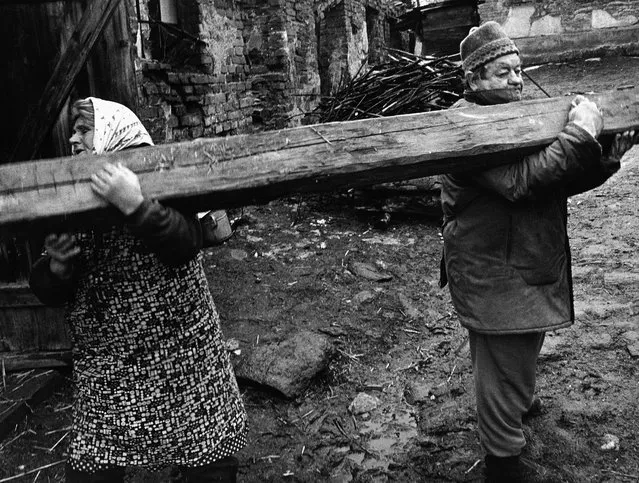
A love story with two log choppers. “In 1993, I was working on a project about life in the Olomouc region of Czechoslovakia. One day, I came to the village of Dlouhá Loučka-Křivá and went into a courtyard where I saw two old people, a husband and wife, sawing firewood for winter. They were working quietly, concentrating. I watched them fetch a beam from a wrecked barn, but they didn’t discuss how they planned to carry it to the saw. The woman faced one way, the man the other. When they realised, the woman eventually turned and followed her husband. The picture I took is the picture of many relationships – when each partner wants something different, but they have to come to an agreement, pull together eventually”. (Photo by Jindrich Streit)

A love story with two log choppers. “In 1993, I was working on a project about life in the Olomouc region of Czechoslovakia. One day, I came to the village of Dlouhá Loučka-Křivá and went into a courtyard where I saw two old people, a husband and wife, sawing firewood for winter. They were working quietly, concentrating. I watched them fetch a beam from a wrecked barn, but they didn’t discuss how they planned to carry it to the saw. The woman faced one way, the man the other. When they realised, the woman eventually turned and followed her husband. The picture I took is the picture of many relationships – when each partner wants something different, but they have to come to an agreement, pull together eventually”. (Photo by Jindrich Streit)
Details
04 Aug 2016 12:34:00
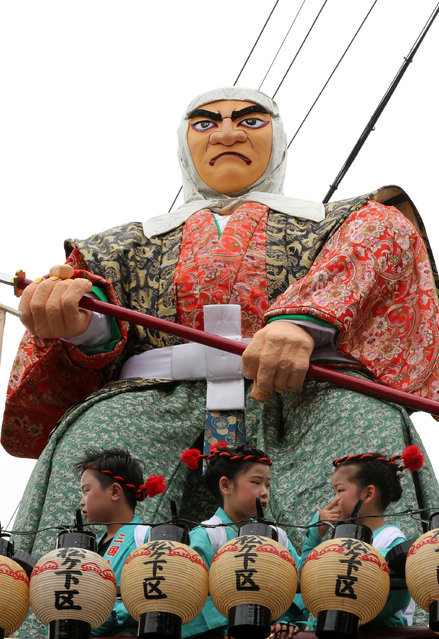
Children dressed in festival costume sit on the huge paper doll of historical Japanese figure named Hashi-Benkeii on the carts during the Mikuini annual festival on May 20, 2014 in Sakai, Japan. The annual festival takes place from May 19-21 and is attended by thousands of visitors. During the festival people dressed in traditional Japanese costumes pull carts carrying 6 meter high dolls of Japanese historical figures through the narrow streets. The origins of the festival are unclear but its history can be traced back more than 250 years. (Photo by Buddhika Weerasinghe/Getty Images)

Children dressed in festival costume sit on the huge paper doll of historical Japanese figure named Hashi-Benkeii on the carts during the Mikuini annual festival on May 20, 2014 in Sakai, Japan. The annual festival takes place from May 19-21 and is attended by thousands of visitors. During the festival people dressed in traditional Japanese costumes pull carts carrying 6 meter high dolls of Japanese historical figures through the narrow streets. The origins of the festival are unclear but its history can be traced back more than 250 years. (Photo by Buddhika Weerasinghe/Getty Images)
Details
21 May 2014 08:49:00
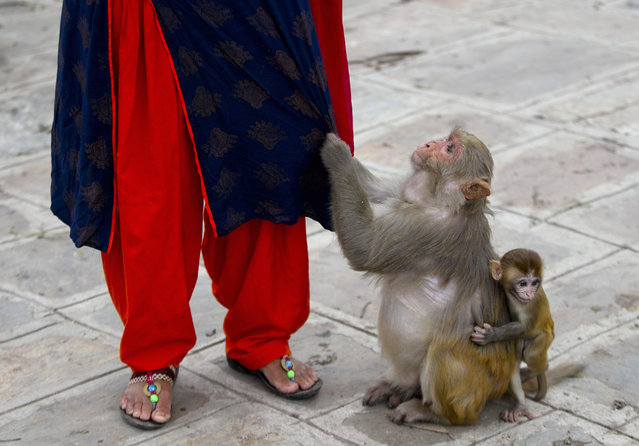
In this July 8, 2019, photo, a monkey pulls on the clothes of Saraswati Dangol as she arrives to feed monkeys in the forest near Pashupatinath temple in Kathmandu, Nepal. For the past four years, Dangol has been bringing the bread every day to feed the monkeys. As soon as they see her with her white sack, they gather around her, some patiently waiting for their turn while others less patiently snatching the bread from her hands. Many of Dangol's regulars are elderly, or are mother or baby monkeys who are unable to fight for their share of food in the wild. (Photo by Niranjan Shrestha/AP Photo)

In this July 8, 2019, photo, a monkey pulls on the clothes of Saraswati Dangol as she arrives to feed monkeys in the forest near Pashupatinath temple in Kathmandu, Nepal. For the past four years, Dangol has been bringing the bread every day to feed the monkeys. As soon as they see her with her white sack, they gather around her, some patiently waiting for their turn while others less patiently snatching the bread from her hands. Many of Dangol's regulars are elderly, or are mother or baby monkeys who are unable to fight for their share of food in the wild. (Photo by Niranjan Shrestha/AP Photo)
Details
26 Jul 2019 00:03:00


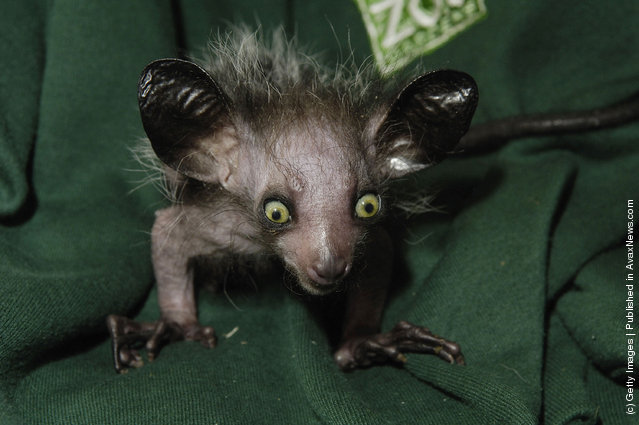
“The aye-aye (Daubentonia madagascariensis) is a lemur, a strepsirrhine primate native to Madagascar that combines rodent-like teeth and a special thin middle finger to fill the same ecological niche as a woodpecker. It is the world's largest nocturnal primate, and is characterized by its unusual method of finding food; it taps on trees to find grubs, then gnaws holes in the wood and inserts its narrow middle finger to pull the grubs out. The only other animal species known to find food in this way is the striped possum. From an ecological point of view the aye-aye fills the niche of a woodpecker as it is capable of penetrating wood to extract the invertebrates within”. – Wikipedia

Photo: In this handout image from Bristol Zoo is seen the first captive bred aye-aye in the UK named “Kintana” (meaning star in Malagasy) April 15, 2005 at Bristol Zoo Gardens, England. The zoo announced today only the second baby aye-aye to be hand-reared in the world (the first was in Jersey Zoo) and has now made his first public appearance since his birth on 11 February 2005. (Photo by Rob Cousins/Bristol Zoo via Getty Images)
Details
13 Apr 2011 13:33:00