Loading...
Done
English-French actress Jane Birkin shopping with a basket bag in Paris on June 4, 1970. (Photo by WATFORD/Mirrorpix/Mirrorpix via Getty Images)

English-French actress Jane Birkin shopping with a basket bag in Paris on June 4, 1970. (Photo by WATFORD/Mirrorpix/Mirrorpix via Getty Images)
Details
30 Jul 2020 00:03:00
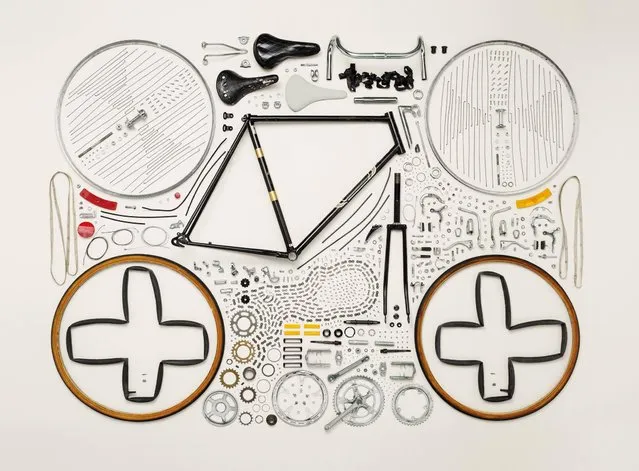
Deconstructed Objects By Todd McLellan

It is simply staggering how complicated some items really are. We never think about it, but some items that we use every day consist of hundreds of parts meticulously put together and working perfectly. Todd McLellan is a photographer who based his newest book “Things Come Apart” on the complexity of various old and new tech. By carefully taking apart various items and arranging all of the parts in perfect order, Todd has allowed us not only to look inside various appliances, but also to appreciate the astounding complexity of these items. Just like the human mind, we are so used to seeing and talking with people that we forget just how complicated their minds really are. It would be great if we could “take apart” the human mind in order to gain some insight into the person’s thoughts and desires. However, very few people are capable of doing it, while the rest will remain blind to the obvious. (Photo by Todd McLellan)
Details
15 Nov 2014 12:30:00
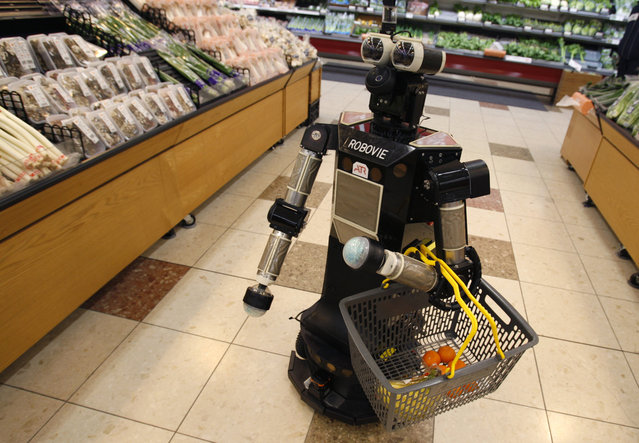
A robot named “Robovie-II”, developed by Japanese robotics research institution ATR, moves around at a grocery store during a shopping assisting experiment by utilizing the robot in an ubiquitous network technology platform in Kyoto, western Japan January 6, 2010. The robot greets the shopper at the entrance of the store, follows him to the shelves while holding a grocery basket and reminds him of the items on a shopping list, which the shopper would have entered beforehand in a specialized mobile device. The experiment is aimed to gather data in order to provide livelihood support for the elderly by using robots and network technologies, ATR's researcher Satoshi Koizumi said. (Photo by Yuriko Nakao/Reuters)

A robot named “Robovie-II”, developed by Japanese robotics research institution ATR, moves around at a grocery store during a shopping assisting experiment by utilizing the robot in an ubiquitous network technology platform in Kyoto, western Japan January 6, 2010. (Photo by Yuriko Nakao/Reuters)
Details
02 Feb 2018 06:54:00
A woman carries her child in a basket as she walks on a road in Allahabad, India, August 11, 2016. (Photo by Jitendra Prakash/Reuters)

A woman carries her child in a basket as she walks on a road in Allahabad, India, August 11, 2016. (Photo by Jitendra Prakash/Reuters)
Details
14 Aug 2016 10:24:00
A labourer carries a basket of bananas inside a wholesale fruit and vegetable market in Bengaluru, India, August 22, 2016. (Photo by Abhishek N. Chinnappa/Reuters)

A labourer carries a basket of bananas inside a wholesale fruit and vegetable market in Bengaluru, India, August 22, 2016. (Photo by Abhishek N. Chinnappa/Reuters)
Details
03 Sep 2016 10:02:00
Donut Doubles By Brandon Voges

Ever wonder what a human head would look like if he or she was turned into a pastry? Well now you can, thanks to the works created by the photographer Brandon Voges. Some of the pictures are light and funny, while others are pretty gruesome and outright disgusting. For example, the comparison of an old lady with some chunky, orange-colored pastry coated with what looks like syrup, really makes you lose your appetite. It is a wonder how they decided to use such an unappealing picture to promote an annual food show of the National Restaurant Association. (Photo by Brandon Voges)
Details
17 Oct 2014 07:00:00
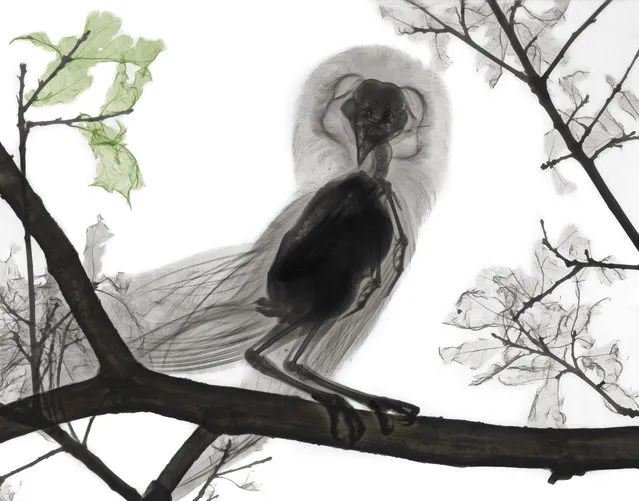
Coloured X-ray of a barn owl. A physicist has used X-ray to create an extraordinary collection of artwork. Arie van't Riets pictures reveal birds, fish, monkeys and flowers in an incredible new light. The 66-year-old, from Bathmen in the Netherlands, began X-raying flowers as a means to teach radiographers and physicians how the machine worked. But after adding a bit of colour to the pictures, the retired medical physicist realised the potential for an exciting new collection of art. (Photo by Arie van't Riet/Barcroft Media)

Coloured X-ray of a barn owl. A physicist has used X-ray to create an extraordinary collection of artwork. Arie van't Riets pictures reveal birds, fish, monkeys and flowers in an incredible new light. The 66-year-old, from Bathmen in the Netherlands, began X-raying flowers as a means to teach radiographers and physicians how the machine worked. But after adding a bit of colour to the pictures, the retired medical physicist realised the potential for an exciting new collection of art. (Photo by Arie van't Riet/Barcroft Media)
Details
08 Jul 2014 13:25:00
Soap Bubble Structures by Kym Cox. Bubbles optimise space and minimise their surface area for a given volume of air. This phenomenon makes them a useful tool in many areas of research, in particular, materials science and ‘packing’ – how things fit together. Bubble walls drain under gravity, thin at the top, thick at the bottom, which interferes with travelling lightwaves to create bands of colour. Black spots show the wall is too thin for interference colours, indicating the bubble is about to burst. (Photo by Kym Cox/2019 Science Photographer of the Year/RPS)

Soap Bubble Structures by Kym Cox. Bubbles optimise space and minimise their surface area for a given volume of air. This phenomenon makes them a useful tool in many areas of research, in particular, materials science and “packing” – how things fit together. Bubble walls drain under gravity, thin at the top, thick at the bottom, which interferes with travelling lightwaves to create bands of colour. Black spots show the wall is too thin for interference colours, indicating the bubble is about to burst. (Photo by Kym Cox/2019 Science Photographer of the Year/RPS)
Details
15 Aug 2019 00:03:00