Loading...
Done
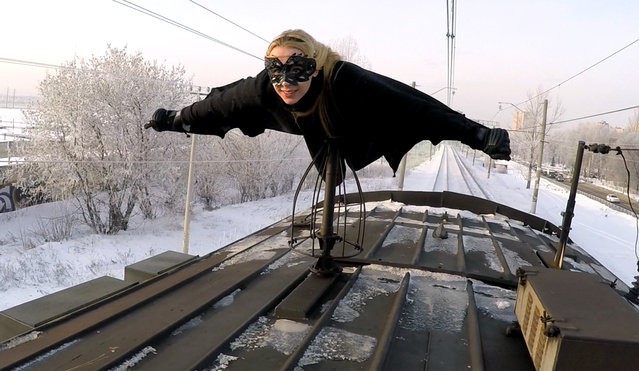
Rush-hour in Russia means one thing for this daredevil: train surfing! The 19-year-old daredevil who goes by the name Kobzarro started train surfing aged 15 as a way of escaping an oppressive family life. Here Kobzarro can be seen balanced on top of a train as it speeds through the wintery Russian environment. Kobzarro is so dedicated to train surfing that she rarely gets inside a train. Even in winter she prefers to travel in this less conventional way. It has resulted in a few run ins with the law, but Kobzarro says it has never resulted in anything more serious than a fine, with many police officers even being interested in the train surfing community. (Photo by Caters News Agency)

Rush-hour in Russia means one thing for this daredevil: train surfing! The 19-year-old daredevil who goes by the name Kobzarro started train surfing aged 15 as a way of escaping an oppressive family life. Here Kobzarro can be seen balanced on top of a train as it speeds through the wintery Russian environment. Kobzarro is so dedicated to train surfing that she rarely gets inside a train. Even in winter she prefers to travel in this less conventional way. It has resulted in a few run ins with the law, but Kobzarro says it has never resulted in anything more serious than a fine, with many police officers even being interested in the train surfing community. (Photo by Caters News Agency)
Details
11 Nov 2016 08:28:00
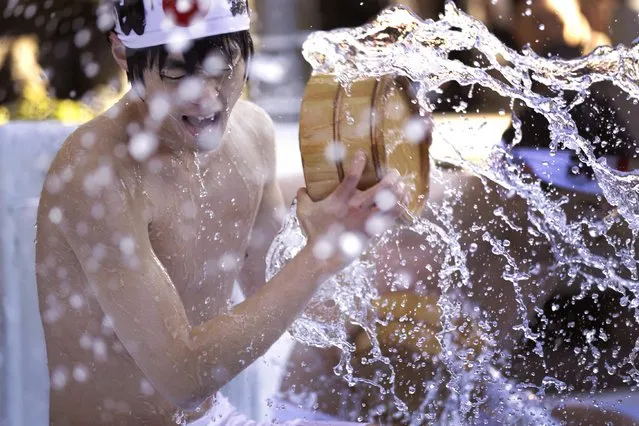
A half-naked shrine parishioner using a wooden tub pours cold water onto himself during an annual cold-endurance festival at the Kanda Myojin Shinto shrine in Tokyo, Saturday, January 10, 2015. Pouring cold water on their bodies is believed to purify their souls. (Photo by Eugene Hoshiko/AP Photo)

A half-naked shrine parishioner using a wooden tub pours cold water onto himself during an annual cold-endurance festival at the Kanda Myojin Shinto shrine in Tokyo, Saturday, January 10, 2015. Pouring cold water on their bodies is believed to purify their souls. (Photo by Eugene Hoshiko/AP Photo)
Details
11 Jan 2015 12:52:00
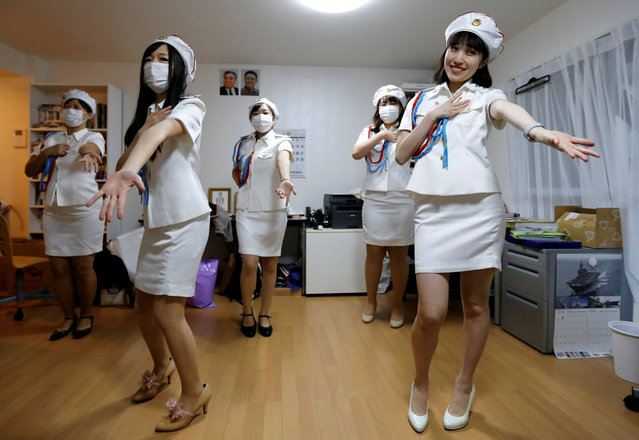
Chunhun (R), the leader of Japan's North Korea fan club called sengun-joshi, or military-first girls, and other members practice a Moranbong Band dance in Tokyo, Japan on November 2, 2017. (Photo by Toru Hanai/Reuters)

Chunhun (R), the leader of Japan's North Korea fan club called sengun-joshi, or military-first girls, and other members practice a Moranbong Band dance in Tokyo, Japan on November 2, 2017. (Photo by Toru Hanai/Reuters)
Details
03 Nov 2017 07:34:00
Dog Shopkeeper  In Musashi-Koganei,Tokyo

A friendly Shiba Inu in Musashi-Koganei, Tokyo greets customers at the Shimada Cigarette Shop, and he is becoming somewhat of a local celebrity.
Details
09 Aug 2014 10:35:00
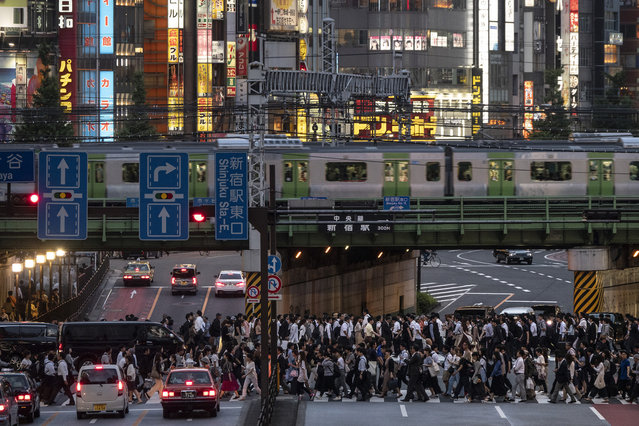
In this Tuesday, June 4, 2019, photo, a Yamanote Line train travels above commuters walking across the crossing during evening rush hours in the Shinjuku district of Tokyo. Operated by the East Japan Railway Co., the Yamanote Line in Tokyo makes a loop around the center of the city, connecting 29 stations that include key stops such as Shinjuku, Shibuya and Ikebukuro. A complete loop of about an hour offers scenes of Japanese daily lives. (Photo by Jae C. Hong/AP Photo)

In this Tuesday, June 4, 2019, photo, a Yamanote Line train travels above commuters walking across the crossing during evening rush hours in the Shinjuku district of Tokyo. Operated by the East Japan Railway Co., the Yamanote Line in Tokyo makes a loop around the center of the city, connecting 29 stations that include key stops such as Shinjuku, Shibuya and Ikebukuro. A complete loop of about an hour offers scenes of Japanese daily lives. (Photo by Jae C. Hong/AP Photo)
Details
27 Jun 2019 00:03:00
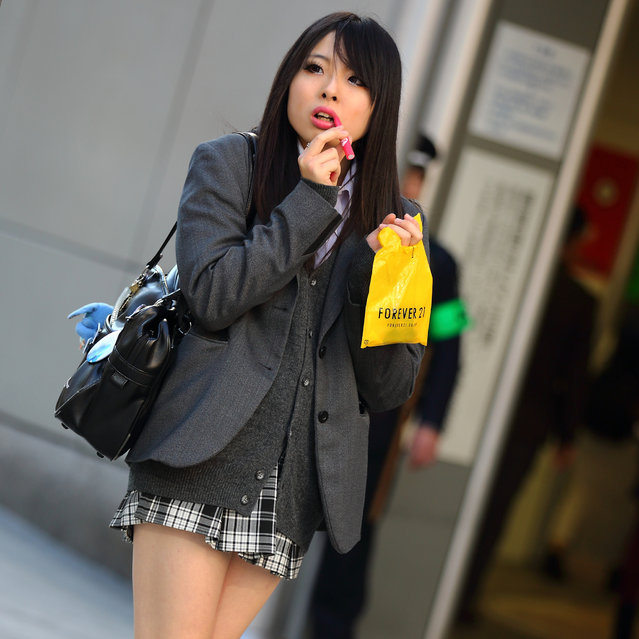
“Lip color”. Shibuya, 2012. (Asian (Street) Impressions)

“Lip color”. Shibuya, 2012. (Photo and caption by Asian (Street) Impressions)
Details
20 Oct 2013 09:11:00
“Milk Moustaches”. (Photo and caption by Ben Torode)

“Milk Moustaches”. (Photo and caption by Ben Torode)
Details
01 Nov 2013 12:02:00
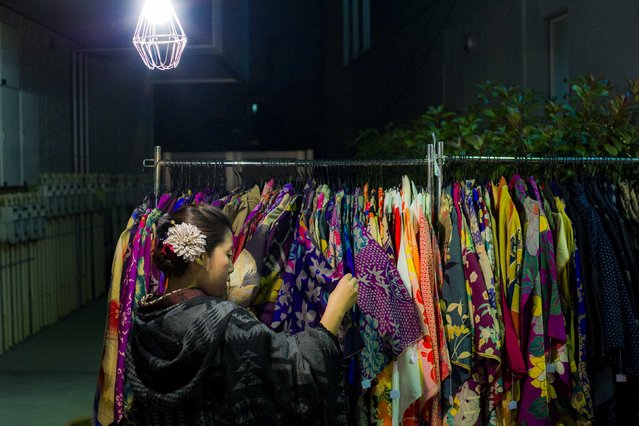
A woman browses through kimonos for sale at Boroichi flea market in Tokyo December 15, 2014. In the 16th century, Boroichi was a place for farmers to buy and sell rags, known as boro, for mending clothes and weaving sandals. Now in its 436th year, the original spirit lingers, with about 700 stands hawking fabric, used clothes and piles of rags. Others sell kitchen tools, pottery, seaweed and spices. (Photo by Thomas Peter/Reuters)

A woman browses through kimonos for sale at Boroichi flea market in Tokyo December 15, 2014. In the 16th century, Boroichi was a place for farmers to buy and sell rags, known as boro, for mending clothes and weaving sandals. Now in its 436th year, the original spirit lingers, with about 700 stands hawking fabric, used clothes and piles of rags. Others sell kitchen tools, pottery, seaweed and spices. About 200,000 people flock to the market, which is only open for four mid-winter days a year – two in December and two in January. (Photo by Thomas Peter/Reuters)
Details
19 Dec 2014 12:50:00