Loading...
Done
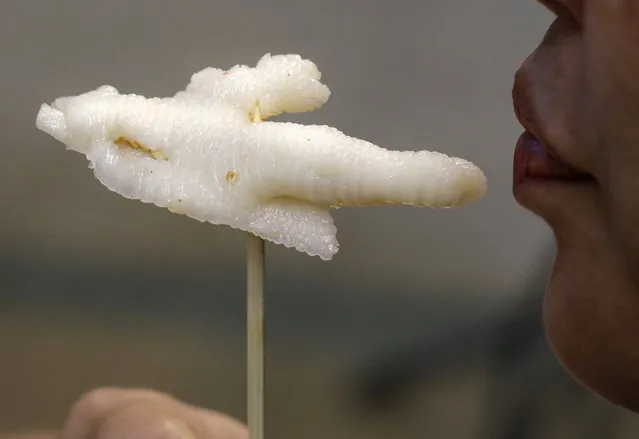
In this Monday, January 23, 2017 photo, chicken feet snacks shop owner Leung Kin-kung testes a chicken feet in Hong Kong. (Photo by Vincent Yu/AP Photo)

In this Monday, January 23, 2017 photo, chicken feet snacks shop owner Leung Kin-kung testes a chicken feet in Hong Kong. Saturday marks the start of the lunar Year of the Rooster and families in China will reunite for festivities, fireworks and food. While tradition calls for feasting on “auspicious” foods, many will also munch on staple snacks like “phoenix claws”, the Chinese name for chicken feet. (Photo by Vincent Yu/AP Photo)
Details
30 Jan 2017 08:08:00
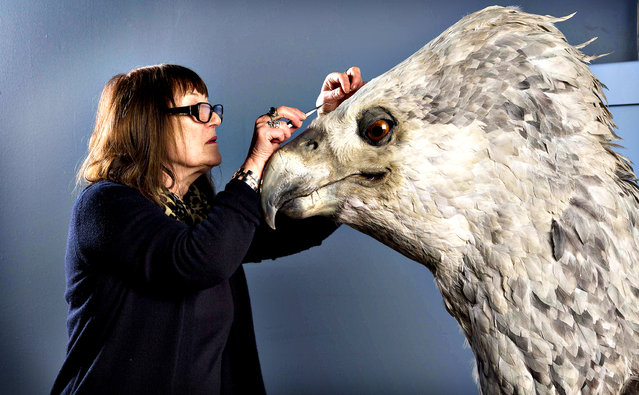
Undated handout photo of Buckbeak, a Hippogriff that lived with Rubeus Hagrid in the Harry Potter series, has his feathers preened and replenished by featherologist Val Jones, as he will feature in the the Feathers and Flight event at Warner Bros. Studio Tour London. (Photo credit should read: Tim Anderson/PA Wire)

Undated handout photo of Buckbeak, a Hippogriff that lived with Rubeus Hagrid in the Harry Potter series, has his feathers preened and replenished by featherologist Val Jones, as he will feature in the the Feathers and Flight event at Warner Bros. Studio Tour London. This is the first make-over Buckbeak has received since the hugely popular Harry Potter film series was made. His intricate coat is created from thousands of individually airbrushed chicken and goose feathers that Val will carefully clean and replenish in time for the start of Feathers and Flight. Val will lead an expert team to demonstrate the techniques that made winged wonders such as Buckbeak and Fawkes the Phoenix a reality on screen. (Photo by Tim Anderson/PA Wire)
Details
22 Mar 2014 13:56:00
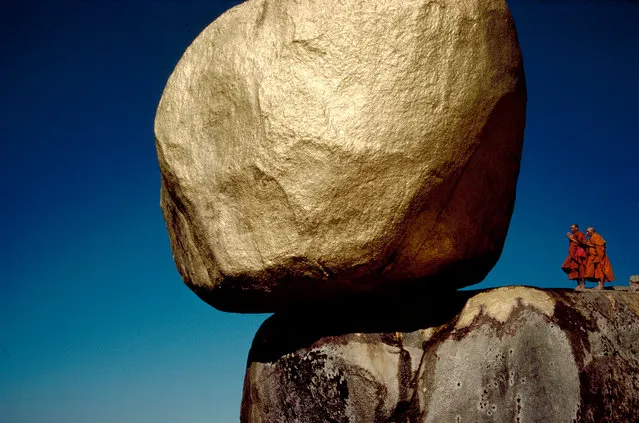
Kyaiktiyo, Burma, 1978. The Golden Rock at Shwe Pyi Daw (the Golden Country), the Buddhist holy place. Hiroji Kubota writes: “I was desperate to keep a distance from America for a while; luckily, I found Burma and its gentle and compassionate people. In the spring of 1978, on the top of the hill where I took this photo, I had two Leica bodies: the one with Tri-X and the other with Kodachrome 64. Soon after, I realised that the colour one looked very colourful and was more powerful. That was my decisive moment, to become a colour photographer”. (Photo by Hiroji Kubota/Magnum Photos)

Kyaiktiyo, Burma, 1978. The Golden Rock at Shwe Pyi Daw (the Golden Country), the Buddhist holy place. Hiroji Kubota writes: “I was desperate to keep a distance from America for a while; luckily, I found Burma and its gentle and compassionate people. In the spring of 1978, on the top of the hill where I took this photo, I had two Leica bodies: the one with Tri-X and the other with Kodachrome 64. Soon after, I realised that the colour one looked very colourful and was more powerful. That was my decisive moment, to become a colour photographer”. (Photo by Hiroji Kubota/Magnum Photos)
Details
10 Jun 2016 13:30:00
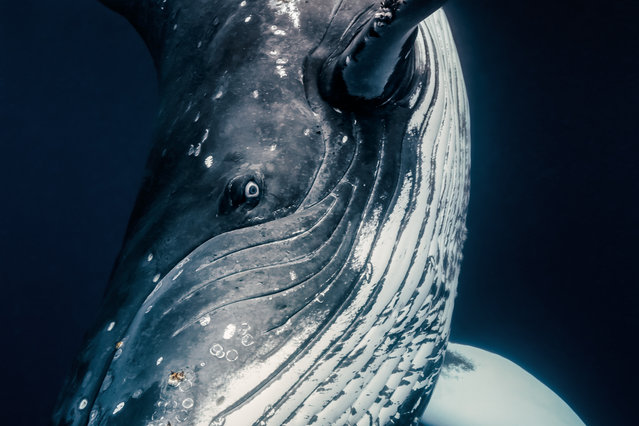
“To look into a whale’s eye is life-changing and humbling. Well, it’s the same with dolphins but they are mostly very fast in the water. A whale’s eye is unexpectedly looking, just like a human eye, kinda checking you out”. (Photo by Rita Kluge/The Guardian)

With the humpback calving season drawing to a close, here’s a look at some of Rita Kluge’s distinctive marine photos from the south Pacific. The Sydney-based photographer fell in love with whales after witnessing southern rights from the New South Wales coastline as they travelled to and from their feeding grounds in the Antarctic. She has since been to Tonga, where humpbacks breed and calf in winter months, to photograph them in the water. (Photo by Rita Kluge/The Guardian)
Details
26 Oct 2016 11:09:00
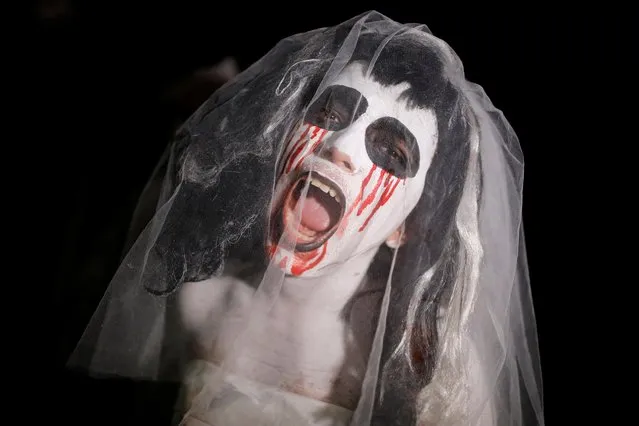
A young man dressed as “La Llorona”, participates in a parade called “La Calabiuza” on the eve of the Day of the Dead in Tonacatepeque, El Salvador, November 1, 2019. (Photo by Jose Cabezas/Reuters)

A young man dressed as “La Llorona”, participates in a parade called “La Calabiuza” on the eve of the Day of the Dead in Tonacatepeque, El Salvador, November 1, 2019. (Photo by Jose Cabezas/Reuters)
Details
06 Nov 2019 00:01:00
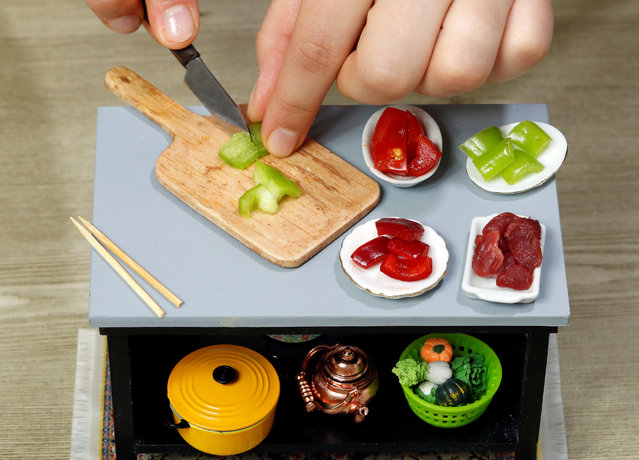
Miniature food cook Burcu Celenoglu Aydin prepares a dish at her mini kitchen in Istanbul, Turkey April 7, 2018. Social marketing coordinator Burcu Celenoglu Aydin and her husband videographer Anil Aydin cook renowned dishes of Turkish cuisine in tiny measures and upload the videos on social media. (Photo by Murad Sezer/Reuters)

Miniature food cook Burcu Celenoglu Aydin prepares a dish at her mini kitchen in Istanbul, Turkey April 7, 2018. Social marketing coordinator Burcu Celenoglu Aydin and her husband videographer Anil Aydin cook renowned dishes of Turkish cuisine in tiny measures and upload the videos on social media. (Photo by Murad Sezer/Reuters)
Details
16 Apr 2018 00:05:00
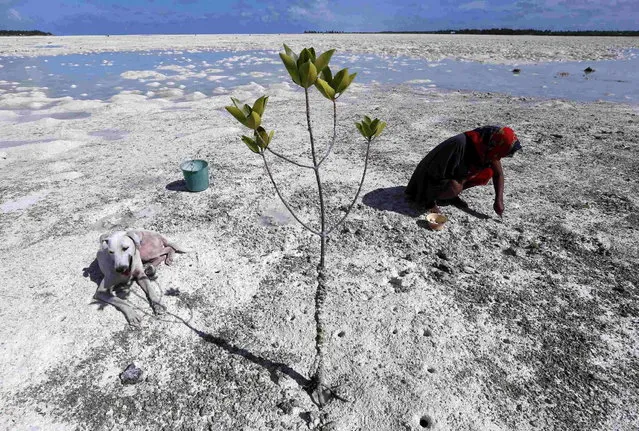
A dog sits in the shade of a mangrove tree as a woman uses a fork to dig for shellfish on the reef-mud flats of a lagoon located at South Tarawa in the central Pacific island nation of Kiribati May 23, 2013. (Photo by David Gray/Reuters)

A dog sits in the shade of a mangrove tree as a woman uses a fork to dig for shellfish on the reef-mud flats of a lagoon located at South Tarawa in the central Pacific island nation of Kiribati May 23, 2013. Kiribati consists of a chain of 33 atolls and islands that stand just metres above sea level, spread over a huge expanse of otherwise empty ocean. With surrounding sea levels rising, Kiribati President Anote Tong has predicted his country will likely become uninhabitable in 30-60 years because of inundation and contamination of its freshwater supplies. (Photo by David Gray/Reuters)
Details
13 Jun 2013 09:23:00
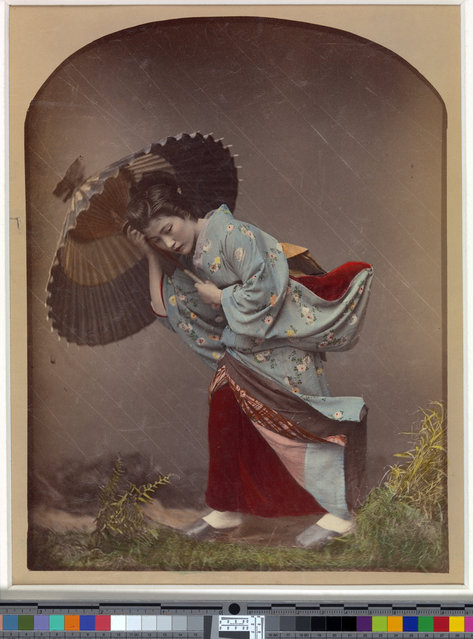
“Woman with Umbrella in Rain” by Raimund von Stillfried. Artist: Kusakabe Kimbei (Japanese, 1841–1934), 1870s. (Photo courtesy of The Metropolitan Museum of Art)

“Woman with Umbrella in Rain” by Raimund von Stillfried. Artist: Kusakabe Kimbei (Japanese, 1841–1934), 1870s. Commercial photography studios in Meiji-era Japan were renowned for the subtlety and refinement of their coloring techniques. This hand-tinted image of a young woman caught in a heavy rainstorm achieved its naturalistic effect by knitting together multiple strands of artifice: the greenery in the foreground was a studio prop; the flaps of the kimono were suspended by thin wires to create the impression of a strong wind; and long, diagonal marks were made on the negative to suggest streaks of rain. (Photo courtesy of The Metropolitan Museum of Art)
Details
12 May 2013 10:13:00