Emma the Maltese's fur blows in the wind as she rides in her owner's purse on 5th Avenue at Central Park in New York December 2, 2014. (Photo by Carlo Allegri/Reuters)
A member of a local swimming club holds a Russian national flag as he dives in at the start of a 24-hour swimming marathon near the western Siberian city of Barnaul March 29, 2014. Thirty members of the club will swim in turn during the event, held to mark Crimea becoming part of Russia, local media reported. (Photo by Andrei Kasprishin/Reuters)
People are seen in the crowd as Serbian Emir Kusturica & The No Smoking Orchestra performs during the third day of the Mexican musicial festival Vive Latino, at the Foro Sol in Mexico City, on March 29, 2014. (Photo by Alfredo Estrella/AFP Photo)
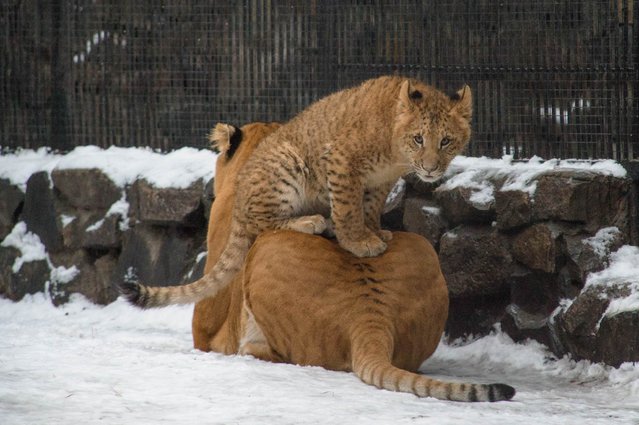
Six-month old female liliger cub Eva plays in snow with her mother Zita in the Zoo in Novosibirsk, Russia, Thursday, December 5, 2013. The cub's mother is Zita, a liger – half-lioness, half-tiger, and its father is a lion, Sam. (Photo by Ilnar Salakhiev/AP Photo)
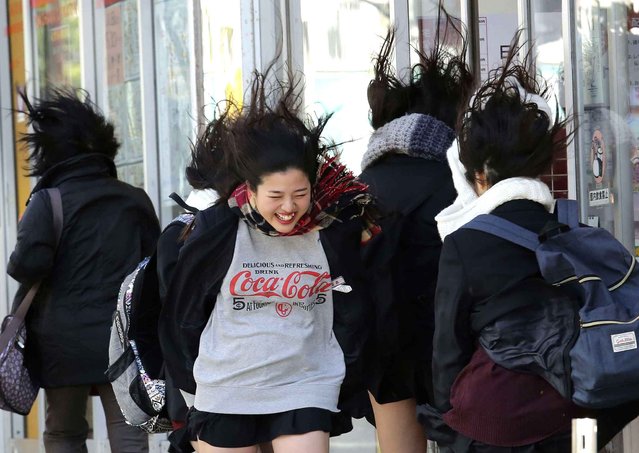
A girl smiles as her hair is blown by a strong wind in the Chinatown area in Yokohama, near Tokyo, Friday, January 27, 2017. (Photo by Koji Sasahara/AP Photo)
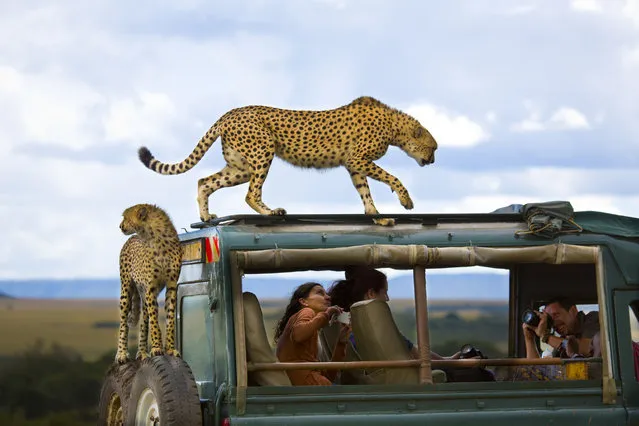
“Say cheese”. Cheetahs jumped on the vehicle of tourists in Masai Mara national park, Kenya. (Photo and caption by Yanai Bonneh/National Geographic Traveler Photo Contest)
ATTENTION! All pictures are presented in high resolution. To see Hi-Res images – just TWICE click on any picture. In other words, click small picture – opens the BIG picture. Click BIG picture – opens VERY BIG picture.
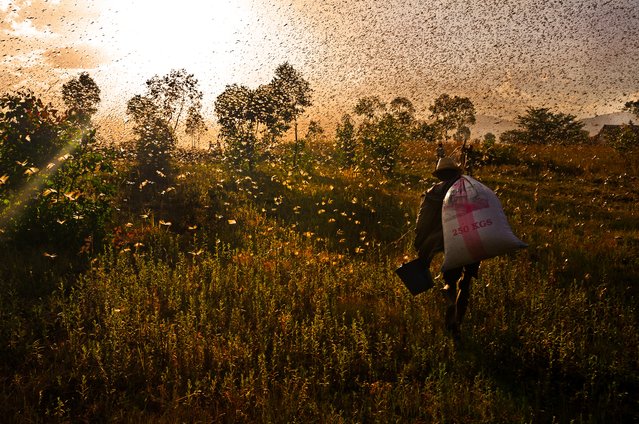
“Locusts & Men”. Oppression, interaction, collaboration. In the life cycle of nature nothing is lost, but the coexistence of different species is sometimes difficult. In Madagascar periodically returns the archaic antagonism between man and the migratory locust, in a circle of life where the two species are looking for space and food for their survival. At the end of the day a man walks home carrying on his shoulders the heavy bag which contains the locusts captured during the day. The insects provide nutritious meals for the man and his family. Photo location: Madagascar, 2013. (Photo and caption by Michele Martinelli/National Geographic Photo Contest)
ATTENTION! All pictures are presented in high resolution. To see Hi-Res images – just TWICE click on any picture. In other words, click small picture – opens the BIG picture. Click BIG picture – opens VERY BIG picture.
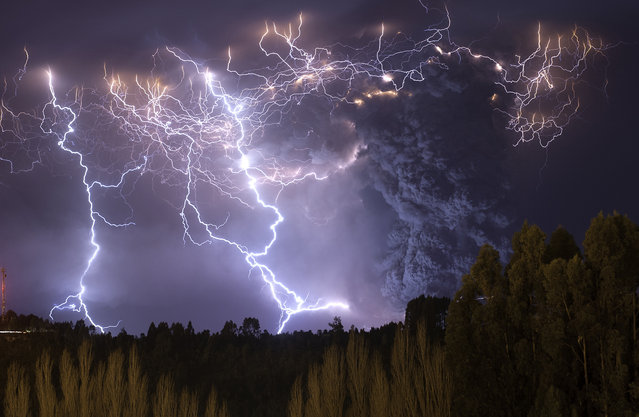
The eruption of Cordon Caulle began on June 4, 2011, located in the Region of Los Rios in Chile. For about 12 months, people and animals became accustomed to living with the daily fall of ash, which also caused problems in the air traffic in South America. The explosions and lightning during first days of the eruption could be seen from hundreds of miles around. This photograph was taken on the second night of eruption from the town of Lago Ranco. (Photo and caption by Francisco Negroni/National Geographic Traveler Photo Contest)
ATTENTION! All pictures are presented in high resolution. To see Hi-Res images – just TWICE click on any picture. In other words, click small picture – opens the BIG picture. Click BIG picture – opens VERY BIG picture.