Loading...
Done
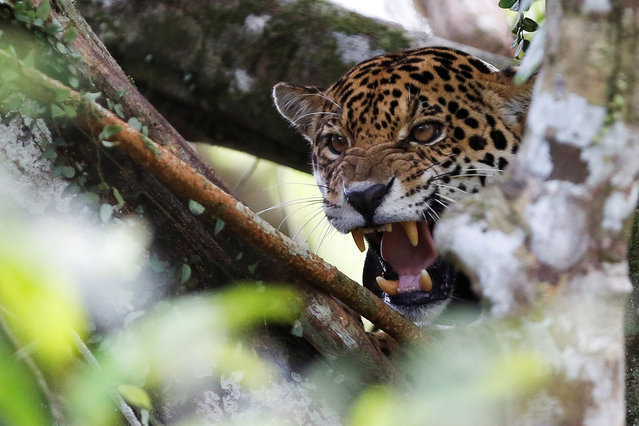
A female adult jaguar, which has a cub, growls at the Mamiraua Sustainable Development Reserve in Uarini, Amazonas state, Brazil, June 5, 2017. (Photo by Bruno Kelly/Reuters)

Brazilian jaguars, imperilled by hunters, ranchers and destruction of their habitat, have learned to survive at least one menace – flooding in the Amazon. They take to the trees. Although they can be six feet long and 200 pounds, the largest South American cats nimbly navigate treetops where they stay from April to July when the rainforest floor is under meters-deep water. Here: A female adult jaguar, which has a cub, growls at the Mamiraua Sustainable Development Reserve in Uarini, Amazonas state, Brazil, June 5, 2017. (Photo by Bruno Kelly/Reuters)
Details
07 Apr 2018 00:03:00
Jersey Boys Premiere

Christopher Walken, Angelo Galasso and Clint Eastwood attend the premiere of Jersey Boys in New York June 9, 2014. REUTERS/Andrew Kelly

Details
10 Jun 2014 11:37:00
Viewing The Earth From Space

Despite any political differences between the United States and Russia, the space agencies of the two countries continue their cooperative work in Earth's orbit, aboard the International Space Station. Apart from the research being done in microgravity, ISS crew members continue to send back amazing images of our home world, photographed from low Earth orbit. Gathered here are recent images of Earth from aboard the ISS, and from a handful of other NASA satellites.
Details
01 Jun 2014 12:36:00
Things Cut in Half

HalfPics is a Twitter feed pointing to things cut in half like a bowl of ramen, a Mini Cooper, and toothpaste. Their tagline: “Ever wonder what stuff looks like when it’s cut in half?” Yes. We previously posted about “Cut Food,” a photo series of foods cut neatly in half by food photographer Beth Galton and food stylist Charlotte Omnès.


See also:Things Cut in Half Part2
Details
07 Sep 2013 10:32:00
UN City In Copenhagen

Cooperation is key to success. This motto was used by the Government of Denmark when they decided to create a project that bore the name of UN City. This compound was designed to house all nine Copenhagen based UN agencies under a single roof. This embodies the core idea of the United Nations, since this project allows for better efficiency and practicality thanks to joint effort. The first plans for the UN City were hatched in 2002. After 11 years, in 2013 the first stage of the project was finally finished. Presently, Campus 1 of UN City accommodates 1,300 staff member, while Campus 2 is going to become the largest humanitarian warehouse in the whole world.
Details
28 Feb 2015 16:17:00
In this Thursday, October 18, 2018 photo, contestants wait for their performance backstage during the National Amateur Body Builders' Association competition in Tel Aviv, Israel. (Photo by Oded Balilty/AP Photo)

In this Thursday, October 18, 2018 photo, contestants wait for their performance backstage during the National Amateur Body Builders' Association competition in Tel Aviv, Israel. Dozens of glistening competitors took the stage for the annual body building and fitness competition last week. But behind the scenes, machismo makes way for cooperation. (Photo by Oded Balilty/AP Photo)


Details
25 Oct 2018 00:01:00
Things Cut in Half

HalfPics is a Twitter feed pointing to things cut in half like a bowl of ramen, a Mini Cooper, and toothpaste. Their tagline: “Ever wonder what stuff looks like when it’s cut in half?” Yes. We previously posted about “Cut Food,” a photo series of foods cut neatly in half by food photographer Beth Galton and food stylist Charlotte Omnès.

See also:Things Cut in Half Part1
Details
09 Sep 2013 10:05:00
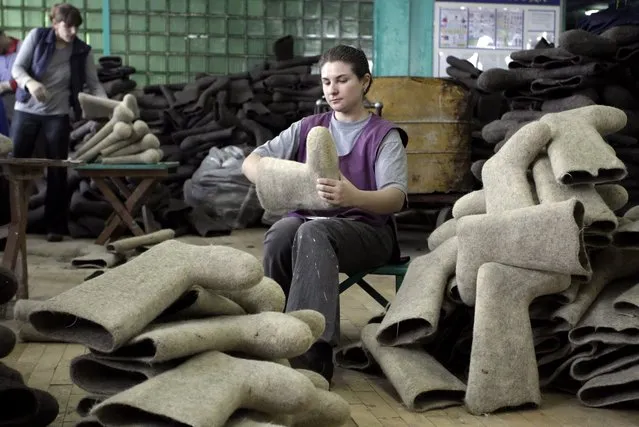
Belarusian workers works at a felt boot factory in Smilovichi, some 35km from Minsk, Belarus, 16 January 2012. (Photo by Tatyana Zenkovich/EPA)

The Smilovichi Felting Factory in Belarus was founded in 1928, when Smilovichi was a small Jewish settlement of craftsmen. Five of those craftsmen organized a small artel (a cooperative association of craftsmen who all live and work together), which produced warm boots called “valenki” for cold weather. Photo: Belarusian workers works at a felt boot factory in Smilovichi, some 35km from Minsk, Belarus, 16 January 2012. (Photo by Tatyana Zenkovich/EPA)
Details
18 Oct 2013 10:02:00