Loading...
Done
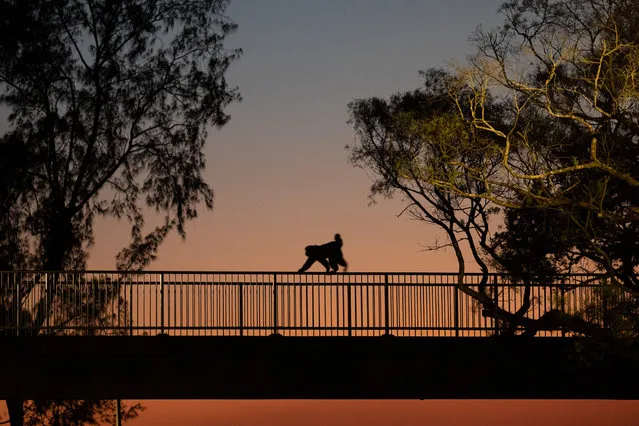
A macaque crosses a pedestrian overpass in Hong Kong, China, 08 November 2021. According the Agriculture, Fisheries and Conservation Department, AFCD, the total population of wild monkeys in Hong Kong is about 1,800, distributed in 30 social troops. (Photo by Jerome Favre/EPA/EFE)

A macaque crosses a pedestrian overpass in Hong Kong, China, 08 November 2021. According the Agriculture, Fisheries and Conservation Department, AFCD, the total population of wild monkeys in Hong Kong is about 1,800, distributed in 30 social troops. (Photo by Jerome Favre/EPA/EFE)
Details
15 Nov 2021 08:44:00
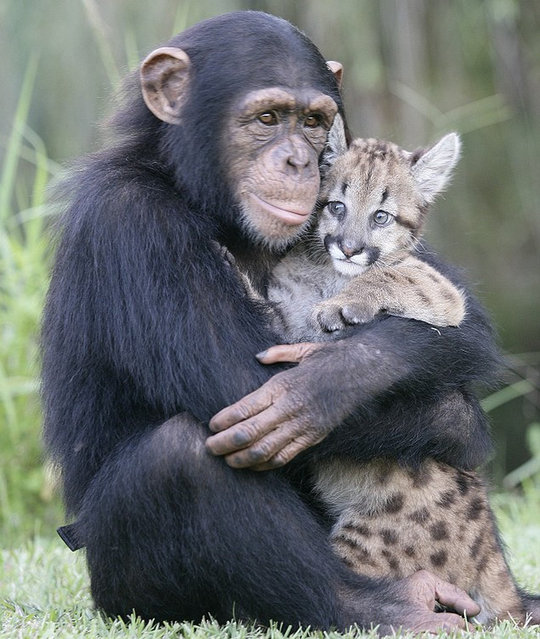
Chimp Mothers Tiger Cubs

Orphaned chimp Anjana lives with the resident feline curator at T.I.G.E.R.S, who taught the monkey how to care for all sorts of ferocious furry foster felines, including the Institute’s latest arrival Sierra.
Details
21 Sep 2012 10:28:00
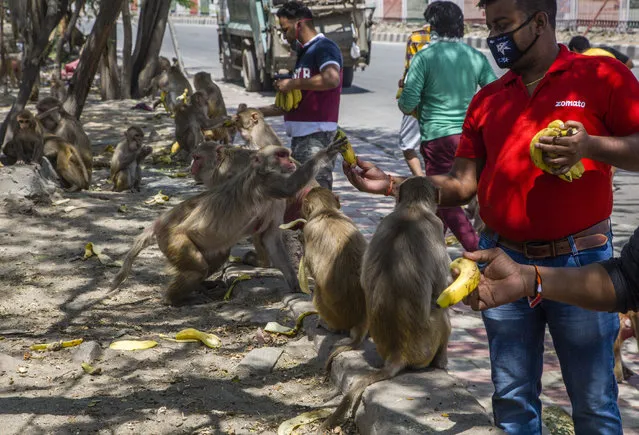
Men give bananas to monkeys gathered on the side of the road as India remains under an unprecedented lockdown over the highly contagious coronavirus (COVID-19) on April 08, 2020 in New Delhi, India. Wild animals, including monkeys, are roaming human settlements in India as people are staying indoors due to the 21-day lockdown. With India's 1.3 billion population and tens of millions of cars off the roads, wildlife is moving towards areas inhabited by humans. Wild animals in many countries have been seen roaming streets. A study says some 60 percent of the new diseases found around the globe every year are zoonotic, meaning they originate in animals and are passed on to humans. COVID-19 is a zoonotic disease that is suspected to have come from the wet markets of Wuhan, China. (Photo by Yawar Nazir/Getty Images)

Men give bananas to monkeys gathered on the side of the road as India remains under an unprecedented lockdown over the highly contagious coronavirus (COVID-19) on April 08, 2020 in New Delhi, India. Wild animals, including monkeys, are roaming human settlements in India as people are staying indoors due to the 21-day lockdown. (Photo by Yawar Nazir/Getty Images)
Details
12 Apr 2020 00:05:00
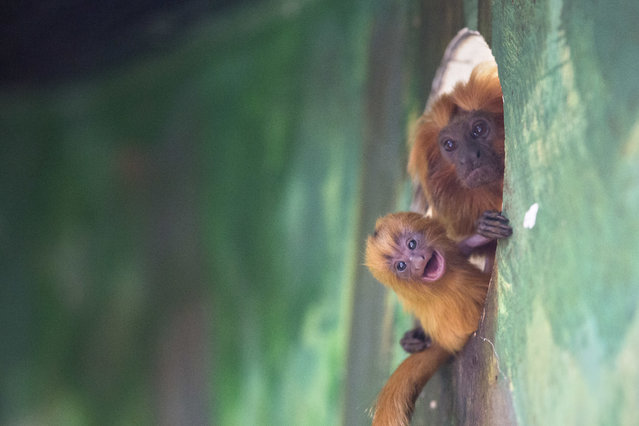
A golden lion tamarin monkey holds its newly born baby at a zoo in Jerusalem, Thursday, March 22, 2018. Golden lion tamarins are among the rarest animals in the world, according to the World Wildlife Fund. It is listed as endangered according to the International Union for Conservation of Nature. (Photo by Sebastian Scheiner/AP Photo)

A golden lion tamarin monkey holds its newly born baby at a zoo in Jerusalem, Thursday, March 22, 2018. Golden lion tamarins are among the rarest animals in the world, according to the World Wildlife Fund. It is listed as endangered according to the International Union for Conservation of Nature. (Photo by Sebastian Scheiner/AP Photo)
Details
23 Mar 2018 06:26:00
Funny Drawing By October Jones

Although October Jones is technically an illustrator, we think he needs to consider switching his full-time job to “daily commute doodler.” Almost every day during his train commute, he creates little drawings, inspired by the people around him on the train.
Details
14 Feb 2014 13:26:00
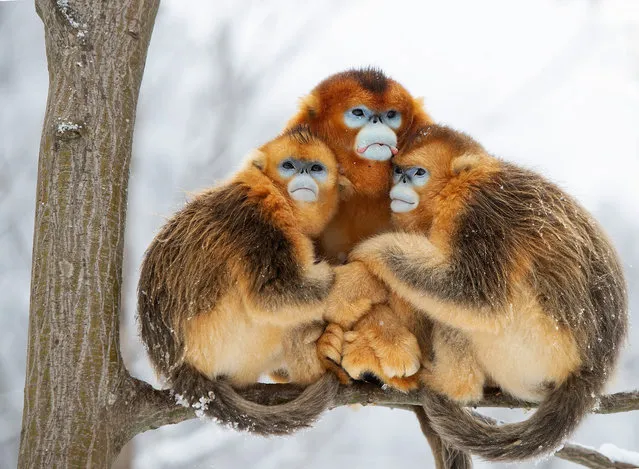
A golden huddle by Minqiang Lu, China. Two females and a male golden snub-nosed monkey huddle together to keep warm in the extreme cold. Threatened by forest loss and fragmentation, this endangered species is confined to central China. Restricted to living high up in the temperate forests, these monkeys – here in the Qinling mountains in Shaanxi province – feed mostly in the trees, on leaves, bark, buds and lichen. In heavy wind and snow, Minqiang walked up the mountain carrying his equipment. He stayed for half an hour in temperatures of –10C opposite the tree where the group was huddled before achieving this eye-level composition. (Photo by Minqiang Lu/Wildlife Photographer of the Year)

A golden huddle by Minqiang Lu, China. Two females and a male golden snub-nosed monkey huddle together to keep warm in the extreme cold. Threatened by forest loss and fragmentation, this endangered species is confined to central China. Restricted to living high up in the temperate forests, these monkeys – here in the Qinling mountains in Shaanxi province – feed mostly in the trees, on leaves, bark, buds and lichen. In heavy wind and snow, Minqiang walked up the mountain carrying his equipment. He stayed for half an hour in temperatures of –10C opposite the tree where the group was huddled before achieving this eye-level composition. (Photo by Minqiang Lu/Wildlife Photographer of the Year)
Details
12 Jan 2023 01:19:00
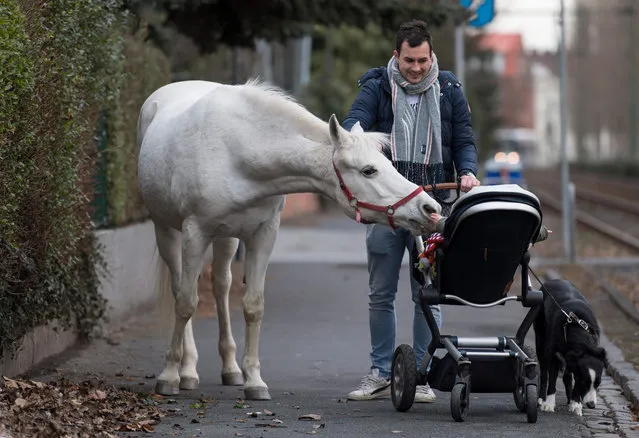
The Arabian mare “Jenny” curiously sniffs at the child of Raphael Wöllstein, who is on his way to the train, on her daily walk through the Fechenheim district of Frankfurt, Germany on March 8, 2019. Her owner opens the stable door for the 22-year-old horse every morning. Then the animal can decide for itself where it wants to spend the day. So that nobody thinks she's escaped, a sign with the inscription “My name is Jenny, didn't run away, just go for a walk” is on the halter. (Photo by Boris Roessler/dpa)

The Arabian mare “Jenny” curiously sniffs at the child of Raphael Wöllstein, who is on his way to the train, on her daily walk through the Fechenheim district of Frankfurt, Germany on March 8, 2019. Her owner opens the stable door for the 22-year-old horse every morning. Then the animal can decide for itself where it wants to spend the day. So that nobody thinks she's escaped, a sign with the inscription “My name is Jenny, didn't run away, just go for a walk” is on the halter. (Photo by Boris Roessler/dpa)
Details
10 Mar 2019 00:07:00
Lv Mengmeng, who was born in 1995, poses for a photograph in Shanghai August 22, 2014. When asked if she would like siblings, Mengmeng said: “Maybe brothers, because I think they could protect me”. (Photo by Carlos Barria/Reuters)

Reuters Photographer Carlos Barria photographed a person born in each year China's one child policy has been in existence; from a man born in 1979, to a baby born in 2014, and asked them if they would have like to have siblings. Here: Lv Mengmeng, who was born in 1995, poses for a photograph in Shanghai August 22, 2014. When asked if she would like siblings, Mengmeng said: “Maybe brothers, because I think they could protect me”. (Photo by Carlos Barria/Reuters)
Details
06 Oct 2014 08:20:00