Loading...
Done
Conversations with History by Photographer David Emitt Adams

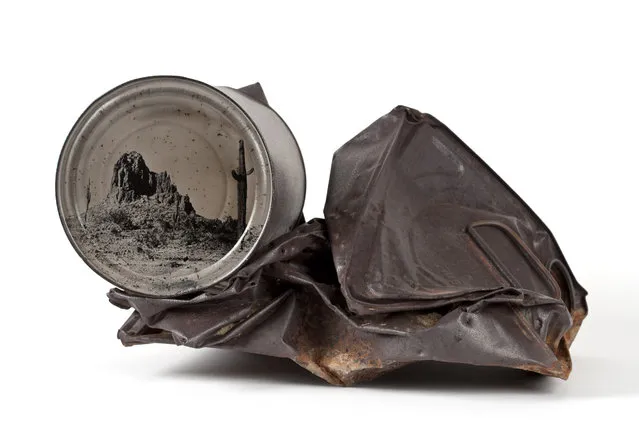
Photographer David Emitt Adams creates tintypes on discarded cans he collects from the Sonoran Desert. In his artist statement, Adams says that some are more than four decades old, which have earned a deep reddish-brown, rusty coloration. (Photo by David Emitt Adams)
Details
19 Mar 2014 05:24:00
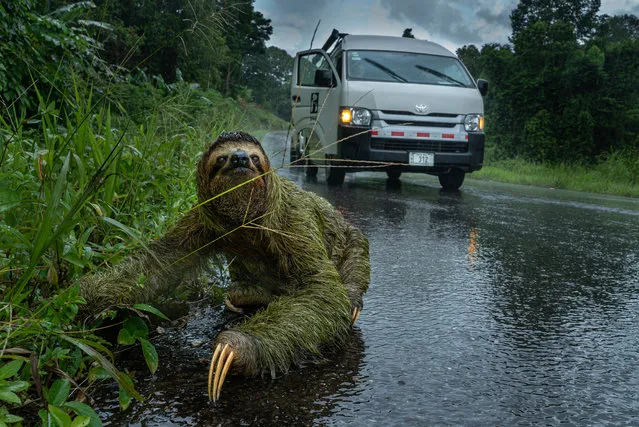
People and Nature category winner: Why did the sloth cross the road? by Andrew Whitworth (Osa Conservation and University of Glasgow), taken in Osa Peninsula, Costa Rica. “I was driving out from the Osa Peninsula, located on the southern Pacific coast of Costa Rica on a dark, stormy day. This female three-toed sloth (Bradypus variegatus) had luckily just about made it across the road, and the drivers of the Toyota on this occasion had spotted her in good time”. (Photo by Andrew Whitworth/2019 British Ecological Society Photography Competition)

People and Nature category winner: Why did the sloth cross the road? by Andrew Whitworth (Osa Conservation and University of Glasgow), taken in Osa Peninsula, Costa Rica. “I was driving out from the Osa Peninsula, located on the southern Pacific coast of Costa Rica on a dark, stormy day. This female three-toed sloth (Bradypus variegatus) had luckily just about made it across the road, and the drivers of the Toyota on this occasion had spotted her in good time”. (Photo by Andrew Whitworth/2019 British Ecological Society Photography Competition)
Details
30 Nov 2019 00:05:00
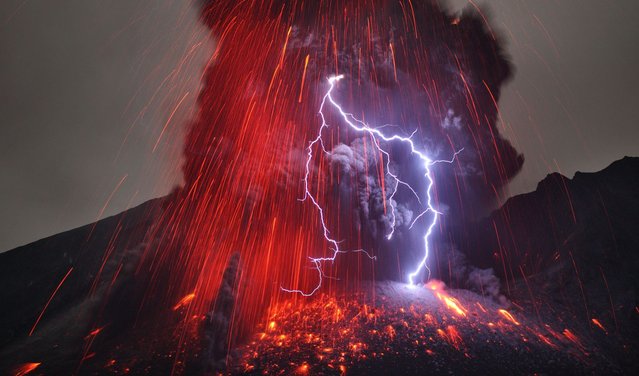
Lightning only ever strikes a volcanic eruption during heavy “vulcanian” or “plinian” explosions when the amount of red lava is very low. (Photo by Martin Rietze/Guzelian)

Martin Rietze is a “volcano-chaser”, a particular breed of photographer who takes big risks for big shots. He was able to capture destructive and beautiful forces of nature at work on a trip to Japan in February 2013. His photos show the Sakurajima Volcano, an active volcanic who's record-breaking 1914 eruption sent lava flows across the island. (Photo by Martin Rietze/Guzelian)
Details
08 Apr 2013 10:49:00
Spanish soldiers of the 7th Airborne Light Infantry Brigade “Galicia” fire a howitzer Light Gun L118 during maneuvers with other units in preparation to NATO's Very High Readiness Joint Task Force (VJTF) in Zaragoza, Spain, April 19, 2016. (Photo by Javier Cebollada/EPA)

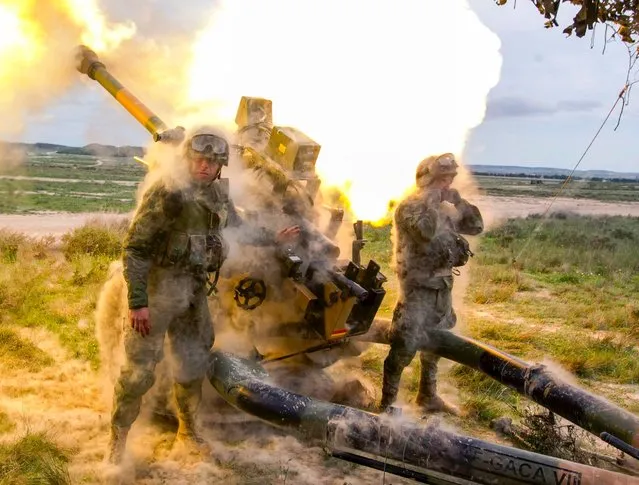
Spanish soldiers of the 7th Airborne Light Infantry Brigade “Galicia” fire a howitzer Light Gun L118 during maneuvers with other units in preparation to NATO's Very High Readiness Joint Task Force (VJTF) in Zaragoza, Spain, April 19, 2016. (Photo by Javier Cebollada/EPA)
Details
24 Dec 2016 09:49:00
Participants from a North Korea military band perform during the Spasskaya Tower international military music festival in Red Square in Moscow, Russia, Friday, August 23, 2019. (Photo by Alexander Zemlianichenko/AP Photo)

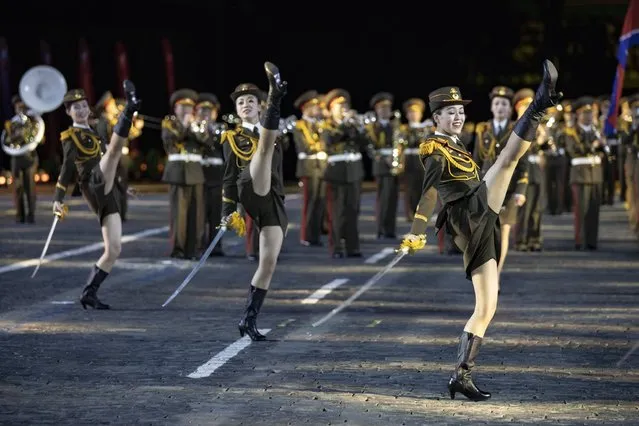
Participants from a North Korea military band perform during the Spasskaya Tower international military music festival in Red Square in Moscow, Russia, Friday, August 23, 2019. (Photo by Alexander Zemlianichenko/AP Photo)
Details
26 Aug 2019 00:05:00
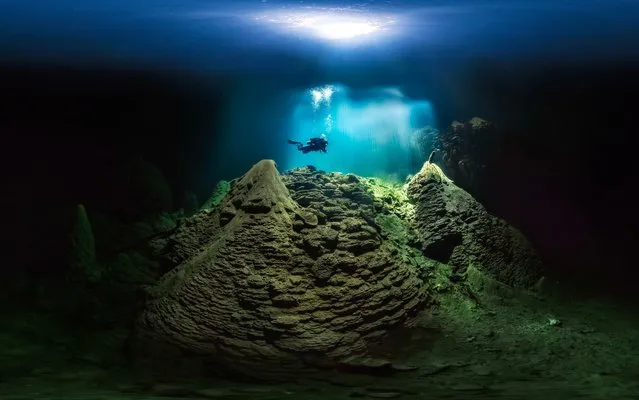
Cave Diver, Anhumas Abyss, Bonito, Brazil: The Anhumas Abyss is an underground cavern with a crystal-clear lake below, more than 260 feet (79 m) deep. A visitor must enter through a narrow opening at the top of the chamber and rappel into the cave. Snorkeling and scuba diving in the lake reveal amazing scenery. Distinctive, conical limestone stalagmites and stalactites occupy the lake and the surrounding area, some reaching 65 feet (20 m) high. “One must rappel about 235 feet (72 m) to get down into this deep lake. The photo was taken at a depth of 50 feet (15 m). It was a challenge to create the image because of the high contrast, plus the diver could not see into the darkness, making communication impossible”. (Photo by Marcio Cabral/Nature’s Best Photography Awards 2017)

Cave Diver, Anhumas Abyss, Bonito, Brazil: The Anhumas Abyss is an underground cavern with a crystal-clear lake below, more than 260 feet (79 m) deep. A visitor must enter through a narrow opening at the top of the chamber and rappel into the cave. Snorkeling and scuba diving in the lake reveal amazing scenery. Distinctive, conical limestone stalagmites and stalactites occupy the lake and the surrounding area, some reaching 65 feet (20 m) high. (Photo by Marcio Cabral/Nature’s Best Photography Awards 2017)
Details
26 Oct 2017 08:10:00
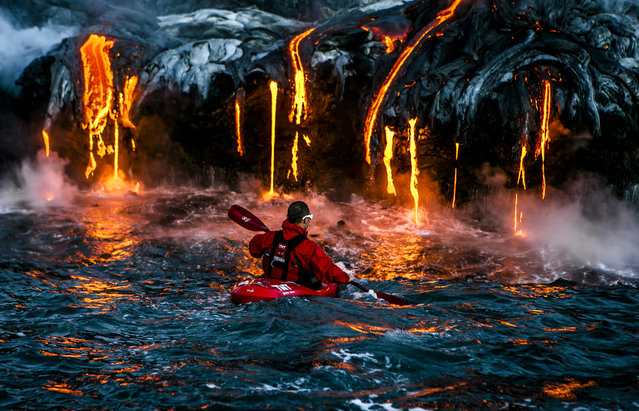
“Kilauea Rules”. The most extreme place we put ours kayakers to paddle till now. Photo location: Big Island, Hawaii. (Photo and caption by Alexandre Socci/National Geographic Photo Contest)

“Kilauea Rules”. The most extreme place we put ours kayakers to paddle till now. Photo location: Big Island, Hawaii. (Photo and caption by Alexandre Socci/National Geographic Photo Contest)
Details
20 Jun 2014 10:47:00
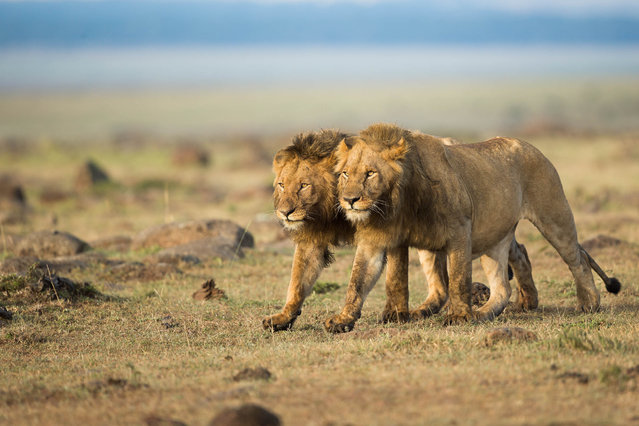
“Two Brothers”. We found about 20 lions eating a buffalo. When the male leaved the group we anticipated him to take photos. It is 8AM, light is perfect and the position too. The lion stops and looks down from the hill, another lion is coming up, it stiffens, I think that will be a fight, i'm tense, the camera is OK, the shots previously made perfect. Photo location: Masai Mara, Kenya. (Photo and caption by Massimo Mei/National Geographic Photo Contest)

“Two Brothers”. We found about 20 lions eating a buffalo. When the male leaved the group we anticipated him to take photos. It is 8AM, light is perfect and the position too. The lion stops and looks down from the hill, another lion is coming up, it stiffens, I think that will be a fight, i'm tense, the camera is OK, the shots previously made perfect. The two meet, looking directly into their eyes, they sniff, rub against their heads, the tension drops, they start walking with the same step as when they were puppies, they are two brothers. Photo location: Masai Mara, Kenya. (Photo and caption by Massimo Mei/National Geographic Photo Contest)
Details
02 Jul 2014 09:45:00