Loading...
Done
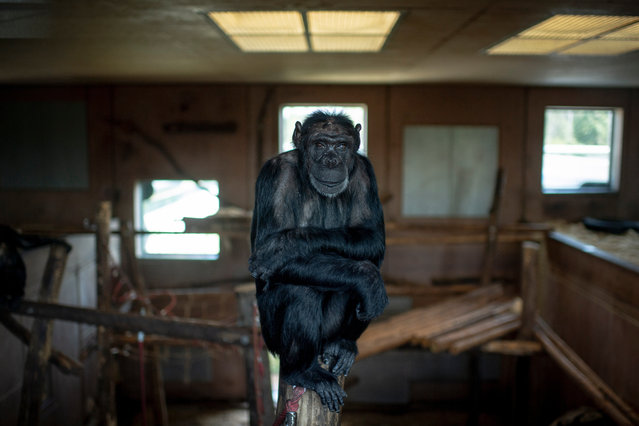
A chimpanzee looks in the direction of a camera at the Gut Aiderbichl Sanctuary for Traumatized Chimpanzees and other Primates in Gaenserndorf, near Vienna, 17 September 2018. 34 former laboratory chimpanzees of former Austrian pharmaceutical company Immuno AG spend their lives at the Gut Aiderbichl Sanctuary for Traumatized Chimpanzees and other Primates since 2009. U.S.-based Baxter International Inc. took over the Immuno AG in 1996, banned experiments with primates and rebuilt a former safari park for the Gut Aiderbichl Sanctuary for Traumatized Chimpanzees and other Primates. After three decades in captivity in too small cages, the chimpanzees, most of them came from Sierra Leone as cubs, have species-appropriate indoor and outdoor enclosures. The financial support by Baxter International Inc. and Austrian officials will end by 2019. (Photo by Christian Bruna/EPA/EFE)

A chimpanzee looks in the direction of a camera at the Gut Aiderbichl Sanctuary for Traumatized Chimpanzees and other Primates in Gaenserndorf, near Vienna, 17 September 2018. 34 former laboratory chimpanzees of former Austrian pharmaceutical company Immuno AG spend their lives at the Gut Aiderbichl Sanctuary for Traumatized Chimpanzees and other Primates since 2009. (Photo by Christian Bruna/EPA/EFE)
Details
23 Sep 2018 00:03:00
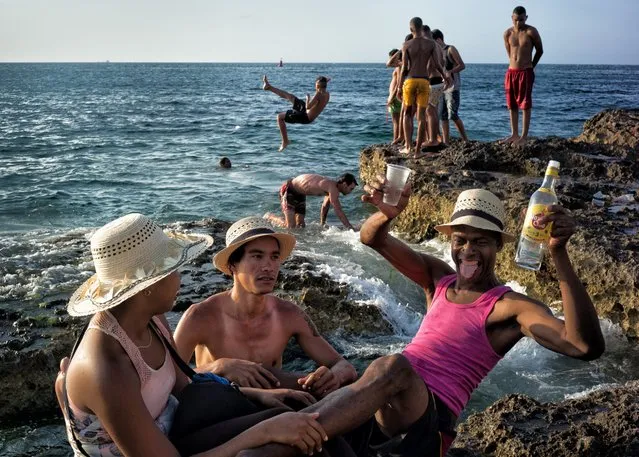
Saguy says that while portraits of Fidel Castro are still found everywhere, they coexist with plenty of foreign brands on subtle display: from Apple logo decals affixed to 1950s Chevys to young people wearing Adidas T-shirts and Converse shoes. Here: Several groups of locals relax on the Malecon in Old Havana, Cuba May 1, 2016. Some chat and drink rum while others dive into the warm Caribbean Sea. (Photo by Dotan Saguy)

Photographer Dotan Saguy visited Cuba expecting to find resentment toward Americans, but he says that, instead, “Every Cuban I met was warm and welcoming despite me being an American”. Here: Several groups of locals relax on the Malecon in Old Havana, Cuba May 1, 2016. Some chat and drink rum while others dive into the warm Caribbean Sea. (Photo by Dotan Saguy)
Details
27 May 2016 12:50:00
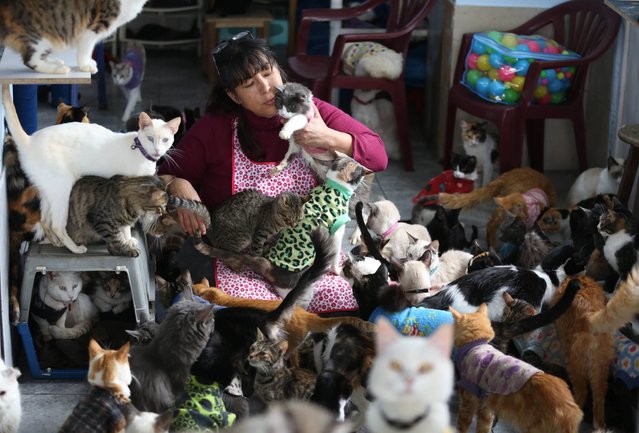
In this August 2, 2014 photo, Maria Torero, plays with a group of 175 cats with leukemia in her home in Lima, Peru. Torero says caring for cats with feline leukemia is her responsibility. Anybody else can care for healthy animals. (Photo by Martin Mejia/AP Photo)

“At her job, Maria Torero cares for sick human beings. At home, she lavishes love on slowly dying cats – 175 of them at last count. The 45-year-old nurse has turned her two-story, eight-room apartment into a hospice for cats with feline leukemia, scattering it with scores of feeding dishes and at least two dozen boxes litter boxes. Some have suggested she shelter healthy cats instead. “That's not my role”, she told The Associated Press. “I'm a nurse. My duty is to the cats that nobody cares about”. She said that “people don't adopt adult cats, especially if they are terminally ill”. – Franklin Briceno via Associated Press. (Photo by Martin Mejia/AP Photo)
Details
24 Aug 2014 09:28:00
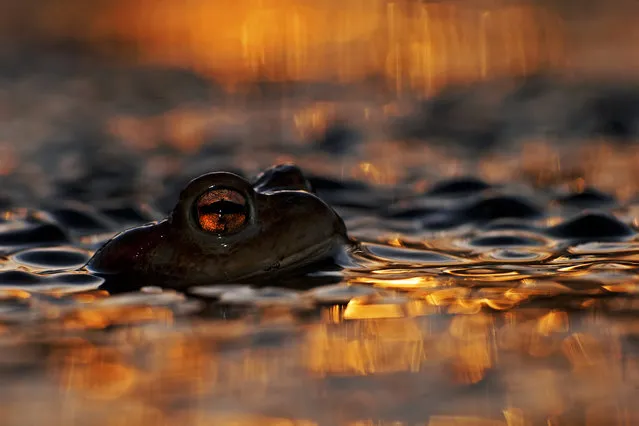
“Eye of a toad”. Animal Portraits, Łukasz Bożycki, Poland.  (Photo by Łukasz Bożycki)

“Eye of a toad”. Animal Portraits, Łukasz Bożycki, Poland. Early spring sees a pond near Łukasz’s home city of Warsaw, Poland, full of mating frogs and a few toads. On this March day, Łukasz shared the pond with them for an evening, sitting in the icy water in his chest-high waders, keeping as still as possible, despite the numbing cold, so that the amphibians could get used to him. “I wanted to find a fresh way of portraying the amphibians”, he says, “at water level”. Using a telephoto lens, he focused on one lone toad and waited for the sun to dip almost below the horizon before pressing the shutter, using flash to bring out the details in the shadow. His prize was “the glorious pool of sunset colour” and fiery glow of the toad’s eye. Nikon D80 + 70-300mm f4.5-5.6 lens + extension tube; 1/125 sec at f9 (-2.3 e/v); ISO 100; built-in flash. (Photo by Łukasz Bożycki)
Details
28 Aug 2013 11:45:00
A photographer has shot this series of scenic selfies – scaling freezing mountain tops to snap himself in front of stunning scenery. Paul Zizkas breath-taking work features himself in front of beautiful backdrops such as shimmering lakes, snowy mountains and vibrant auroras. He has travelled to a number of different locations worldwide including Canada, New Zealand, Niue the South Pacific and French Polynesia. (Photo by Paul Zizkas/Caters News)

A photographer has shot this series of scenic selfies – scaling freezing mountain tops to snap himself in front of stunning scenery. Paul Zizkas breath-taking work features himself in front of beautiful backdrops such as shimmering lakes, snowy mountains and vibrant auroras. He has travelled to a number of different locations worldwide including Canada, New Zealand, Niue the South Pacific and French Polynesia. Explorer Paul, from Banff, Alberta, Canada, saw his selfies go viral early in 2014 – and has now unveiled his latest work. He said: I find that sometimes including a person in a landscape scene adds to the photograph – that it conveys a different story. Here: lake Minnewanka, Banff National Park, Alberta, Canada. (Photo by Paul Zizkas/Caters News)
Details
14 Dec 2014 12:18:00
In this January 23, 2015 photo, Guillermo Luna Martinez, 36, carries freshly painted piñatas representing Disney's Frozen snowman character Olaf downstairs to where his wife Elvia Vicente Albarran will use paper to craft the character's eyes, teeth, and distinctive tuft of hair, at the family's workshop in the Iztapalapa neighborhood of Mexico City. (Photo by Rebecca Blackwell/AP Photo)

In this January 23, 2015 photo, Guillermo Luna Martinez, 36, carries freshly painted piñatas representing Disney's Frozen snowman character Olaf downstairs to where his wife Elvia Vicente Albarran will use paper to craft the character's eyes, teeth, and distinctive tuft of hair, at the family's workshop in the Iztapalapa neighborhood of Mexico City. Though Luna and his wife have chosen to work in the family business, they plan to let their children, Guillermo, 10, and Melissa, 9, decide for themselves. “Who knows if the business will last forever”, said Luna, “I'd prefer that they study and get a career, for them to have a better future”. (Photo by Rebecca Blackwell/AP Photo)
Details
01 Feb 2015 10:43:00
Senji Nakajima sleeps with his Love Doll “Saori” at Love Hotel on June 4, 2016 in Nagano, Japan. Senji Nakajima, 61 years old, lives with his life-size 'love doll' named “Saori” in his apartment in Tokyo, Japan. Nakajima, married with two children, who lives away from home for work, first started his life with Saori six years ago. At first, he used to imagine as if the doll was his first girl friend, and used it only for sexual purposes to fill the loneliness, but months later, he started to find Saori actually has an original personality. “She never betrays, not after only money. I'm tired of modern rational humans. They are heartless”, Nakajima says, “for me, she is more than a doll. Not just a silicon rubber. She needs much help, but still is my perfect partner who shares precious moments with me and enriches my life”. (Photo by Taro Karibe/Getty Images)

Senji Nakajima sleeps with his Love Doll “Saori” at Love Hotel on June 4, 2016 in Nagano, Japan. Senji Nakajima, 61 years old, lives with his life-size “love doll” named “Saori” in his apartment in Tokyo, Japan. Nakajima, married with two children, who lives away from home for work, first started his life with Saori six years ago. (Photo by Taro Karibe/Getty Images)
Details
07 Aug 2016 09:21:00
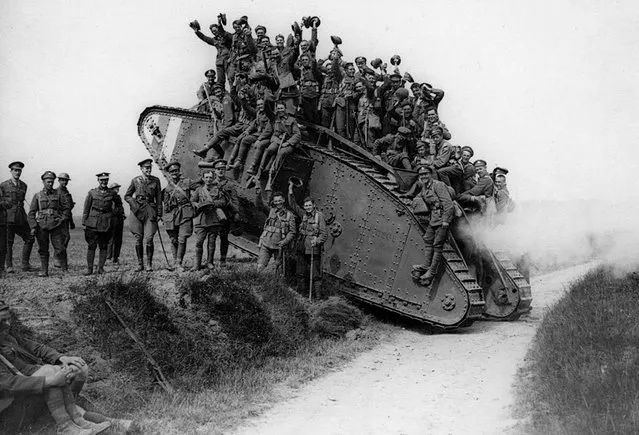
These black-and-white photos are taken from the new book “Armoured Warfare in the First World War 1916 – 1918” by Anthony Tucker-Jones and published by Pen & Sword Military. “Interestingly the British, French and Germans took completely different approaches with varying results”. The British military produced “Little Willie” in Autumn 1915 weighing 18 tonnes, which had a crew of two plus four gunners. “Inspired by a tracked artillery tractor “Little Willie” was referred to as a water tank – hence the name tank – to ensure secrecy”, said Anthony. “This led to the strange looking Mark I with its peculiar rhomboid shape, designed to cross trenches with guns in sponsons on either side. The Germans saw the tank as unchivalrous and were slow to grasp its utility. They favoured the Stormtrooper (specialist soldiers used to infiltrate enemy trenches) and artillery, not the tank”, said Anthony. “However, they didn’t hesitate to make use of captured British tanks. Although the tank helped secure victory and German soldiers dubbed it “Germany’s Downfall” the country was ultimately brought to its knees by the Allies blockade”. Here: British troops hitch a ride on a Mark IV after the massed tank fleet spearheading attack at Cambrai on November 20, 1917. (Photo by Anthony Tucker-Jones/Mediadrumworld.com)

These black-and-white photos are taken from the new book “Armoured Warfare in the First World War 1916 – 1918” by Anthony Tucker-Jones and published by Pen & Sword Military. Here: British troops hitch a ride on a Mark IV after the massed tank fleet spearheading attack at Cambrai on November 20, 1917. (Photo by Anthony Tucker-Jones/Mediadrumworld.com)
Details
23 Feb 2017 00:02:00