Loading...
Done
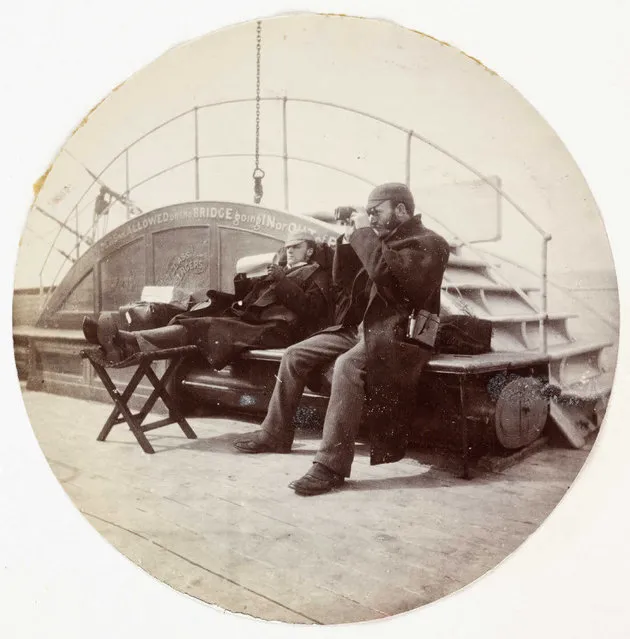
Two men on the deck of a ship, about 1890. (Photo by Collection of National Media Museum/Kodak Museum)

“Today, we take photography for granted. Anyone can take a photograph simply by pressing a button. Yet, it was not always so simple. The invention of photography was announced in 1839, but during its first fifty years taking a photograph was a complicated and expensive business. In 1888, all this was to change following the appearance of a camera that was to revolutionize photography. Popular photography can properly be said to have started 120 years ago with the introduction of the Kodak”. – The UK National Media Museum. Photo: Two men on the deck of a ship, about 1890. (Photo by Collection of National Media Museum/Kodak Museum)
Details
27 May 2014 10:31:00
1936:  Lucie Clayton instructs pupils in the art of correct posture by balancing a glass and book on their heads at her finishing school

Lucie Clayton instructs pupils in the art of correct posture by balancing a glass and book on their heads at her finishing school in Old Cavendish Street, London. (Photo by William Vanderson/Fox Photos/Getty Images). 25th November 1936
Details
06 Sep 2011 12:06:00
Afghan children wait as their mothers receive treatment at a USAID-funded health center

Afghan children wait as their mothers receive treatment at a USAID-funded health center on September 7, 2011 in Farza, Afghanistan. Almost 10 years after the 9/11 attacks and the U.S. invasion of Afghanistan, the U.S. government funds some of 500 Afghan health facilities nationwide, most run by non-governmental organizations contracted by the Afghan Ministry of Public Health. (Photo by John Moore/Getty Images)
Details
09 Sep 2011 09:54:00
Burdened with a shawl full of her belongings, a woman stops for a rest on the road between Julaca and Puno in Peru, 1955

Burdened with a shawl full of her belongings, a woman stops for a rest on the road between Julaca and Puno in Peru. (Photo by Three Lions/Getty Images). Circa 1955
Details
09 Aug 2011 11:48:00
Auxiliary Territorial Service (ATS) plotters at work at Coastal Artillery Headquarters in Dover, December 1942. (Photo by Ted Dearberg/IWM/PA Wire)

Auxiliary Territorial Service (ATS) plotters at work at Coastal Artillery Headquarters in Dover, December 1942. The Auxiliary Territorial Service was the women's branch of the British Army during the Second World War. It was formed on 9 September 1938, initially as a women's voluntary service, and existed until 1 February 1949, when it was merged into the Women's Royal Army Corps. The ATS had its roots in the Women's Auxiliary Army Corps (WAAC), which was formed in 1917 as a voluntary service. During the First World War its members served in a number of jobs including clerks, cooks, telephonists and waitresses. The WAAC was disbanded after four years in 1921. (Photo by Ted Dearberg/IWM/PA Wire)
Details
13 Jul 2017 07:52:00
Migrant children play with leaves during Christmas Eve at a shelter, as they travel with their parents as part of a caravan with humanitarian visas to transit throughout the country, in Monterrey, Mexico on December 24, 2021. (Photo by Daniel Becerril/Reuters)

Migrant children play with leaves during Christmas Eve at a shelter, as they travel with their parents as part of a caravan with humanitarian visas to transit throughout the country, in Monterrey, Mexico on December 24, 2021. (Photo by Daniel Becerril/Reuters)
Details
13 Jan 2022 07:47:00
A jockey falls from his buffalos during Barapan Kebo or buffalo races as part of the Moyo festival on September 30, 2014 in Sumbawa Island, West Nusa Tenggara, Indonesia. (Photo by Ulet Ifansasti/Getty Images)

A jockey falls from his buffalos during Barapan Kebo or buffalo races as part of the Moyo festival on September 30, 2014 in Sumbawa Island, West Nusa Tenggara, Indonesia. The traditional Buffalo races, known as Barapan Kebo, are held by Samawa tribes in muddy rice fields to celebrate and provide entertainment ahead of the annual planting season. Jockeys secure themselves on a wooden structure attached to the buffalo, and maneuver across the mud in a race to the finish line. The jockeys weild long sticks, in a similar style to jousting, and direct them towards targets called “Saka”. (Photo by Ulet Ifansasti/Getty Images)
Details
04 Oct 2014 11:58:00
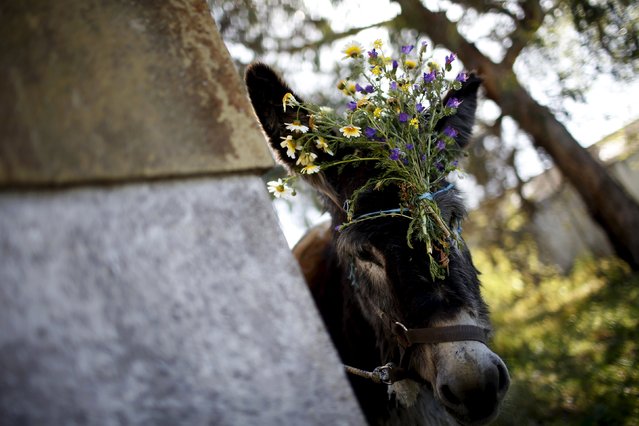
A donkey is seen before the start of the procession of the “Virgem da Atalaia” during Holy Week at Alcochete, near Lisbon April 5, 2015. (Photo by Rafael Marchante/Reuters)

A donkey is seen before the start of the procession of the “Virgem da Atalaia” during Holy Week at Alcochete, near Lisbon April 5, 2015. Women ride donkeys during the “Virgem da Atalaia” procession, that has been held annually for about 400 years. In the past, only single women rode the donkeys to ask for help from the Virgin to find a husband. (Photo by Rafael Marchante/Reuters)
Details
06 Apr 2015 09:43:00