Loading...
Done
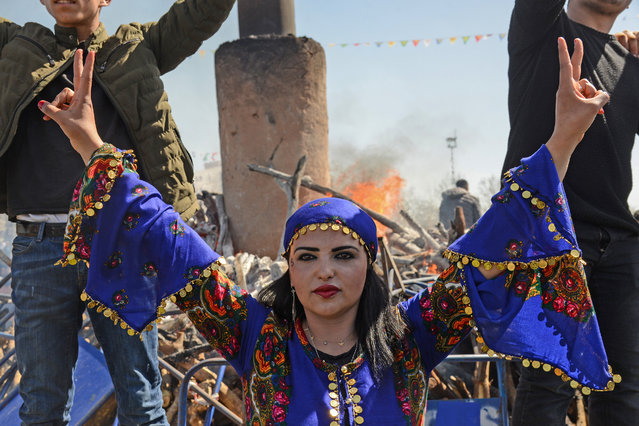
A young woman flashes the victory sign in front of a bonfire as Turkish Kurds gather during Newroz celebrations for the new year in Diyarbakir, southeastern Turkey, on March 21, 2018. Newroz (also known as Nawroz or Nowruz) is an ancient Persian festival, which is also celebrated by Kurdish people, marking the first day of spring, which falls on March 21. (Photo by Ilyas Akengin/AFP Photo)

A young woman flashes the victory sign in front of a bonfire as Turkish Kurds gather during Newroz celebrations for the new year in Diyarbakir, southeastern Turkey, on March 21, 2018. Newroz (also known as Nawroz or Nowruz) is an ancient Persian festival, which is also celebrated by Kurdish people, marking the first day of spring, which falls on March 21. (Photo by Ilyas Akengin/AFP Photo)
Details
23 Mar 2018 00:01:00
A woman poses for a picture as bunches of paprika hang on the walls of her house to dry in the village of Donja Lakosnica, Serbia October 6, 2016. Donja Lokosnica is the Serbian “capital of paprika”, since almost all of the 1300 inhabitants are involved in growing paprika. As autumn approaches, the whole village turns red, because of many threads of dried peppers, that hang around Lokosnica, waiting for their winter use. Each of these paprika threads is handmade, still dried according to traditional techniques, assisted solely by the sun and fresh air. (Photo by Marko Djurica/Reuters)

A woman poses for a picture as bunches of paprika hang on the walls of her house to dry in the village of Donja Lakosnica, Serbia October 6, 2016. Donja Lokosnica is the Serbian “capital of paprika”, since almost all of the 1300 inhabitants are involved in growing paprika. As autumn approaches, the whole village turns red, because of many threads of dried peppers, that hang around Lokosnica, waiting for their winter use. Each of these paprika threads is handmade, still dried according to traditional techniques, assisted solely by the sun and fresh air. (Photo by Marko Djurica/Reuters)
Details
08 Oct 2016 12:04:00
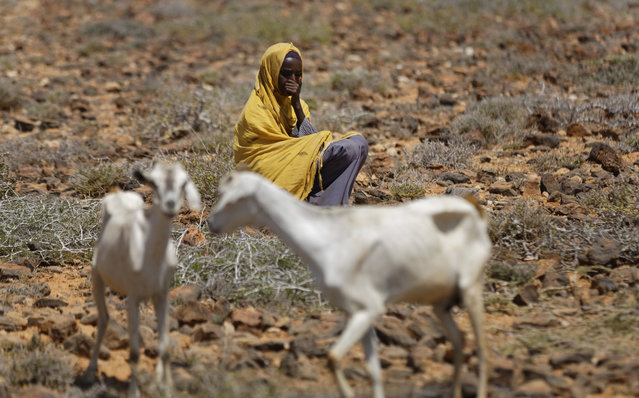
In this photo taken Wednesday, March 8, 2017, a woman herder sits with her goats in a remote desert area near Bandar Beyla in Somalia's semiautonomous northeastern state of Puntland. Somalia has declared the drought a national disaster, part of what the United Nations calls the largest humanitarian crisis since the world body was founded in 1945, and with animals being central to many the drought threatens their main sources of nutrition and survival. (Photo by Ben Curtis/AP Photo)

In this photo taken Wednesday, March 8, 2017, a woman herder sits with her goats in a remote desert area near Bandar Beyla in Somalia's semiautonomous northeastern state of Puntland. Somalia has declared the drought a national disaster, part of what the United Nations calls the largest humanitarian crisis since the world body was founded in 1945, and with animals being central to many the drought threatens their main sources of nutrition and survival. (Photo by Ben Curtis/AP Photo)
Details
15 Mar 2017 00:03:00
In this Thursday, February 14, 2019, photo, a Transformer's Bumblebee mascot helps a woman carries paper bags at a shopping mall in Handan in north China's Hebei province. U.S. and Chinese envoys are holding a second day of trade talks after the top economic adviser to President Donald Trump said he has yet to decide whether to go ahead with a March 2 tariff increase on imports from China. (Photo by Chinatopix via AP Photo)

In this Thursday, February 14, 2019, photo, a Transformer's Bumblebee mascot helps a woman carries paper bags at a shopping mall in Handan in north China's Hebei province. U.S. and Chinese envoys are holding a second day of trade talks after the top economic adviser to President Donald Trump said he has yet to decide whether to go ahead with a March 2 tariff increase on imports from China. (Photo by Chinatopix via AP Photo)
Details
15 Feb 2019 09:00:00
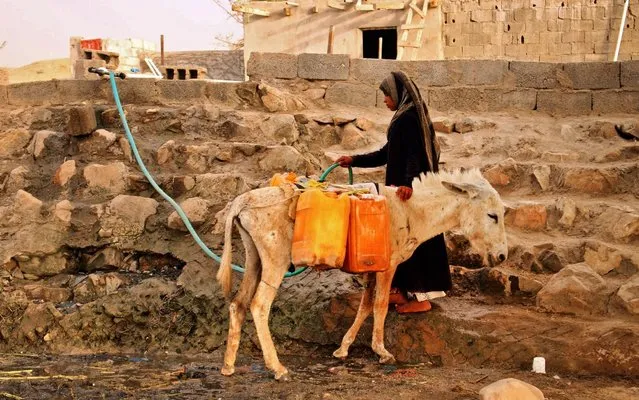
A displaced Yemeni woman from Hodeida fills water containers at a make-shift camp in a village in the northern district of Abs in the country's Hajjah province, on May 9, 2019. The Yemeni conflict has triggered what the United Nations describes as the world's worst humanitarian crisis, with 3.3 million people still displaced and 24.1 million in need of aid. (Photo by Essa Ahmed/AFP Photo)

A displaced Yemeni woman from Hodeida fills water containers at a make-shift camp in a village in the northern district of Abs in the country's Hajjah province, on May 9, 2019. The Yemeni conflict has triggered what the United Nations describes as the world's worst humanitarian crisis, with 3.3 million people still displaced and 24.1 million in need of aid. (Photo by Essa Ahmed/AFP Photo)
Details
13 May 2019 00:03:00
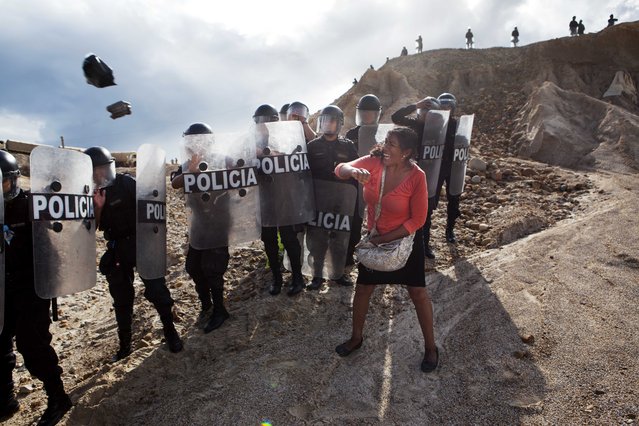
In this April 28, 2014 file photo, a woman throws a rock and a bag at police blocking her from getting home in the Huepetuhe district of the Madre de Dios region of Peru. Security forces began destroying illegal gold mining machinery in Peru's southeastern jungle region of Madre de Dios, as authorities began enforcing a ban on illegal mining. (Photo by Rodrigo Abd/AP Photo)

In this April 28, 2014 file photo, a woman throws a rock and a bag at police blocking her from getting home in the Huepetuhe district of the Madre de Dios region of Peru. Security forces began destroying illegal gold mining machinery in Peru's southeastern jungle region of Madre de Dios, as authorities began enforcing a ban on illegal mining. (Photo by Rodrigo Abd/AP Photo)
Details
16 Dec 2014 12:51:00
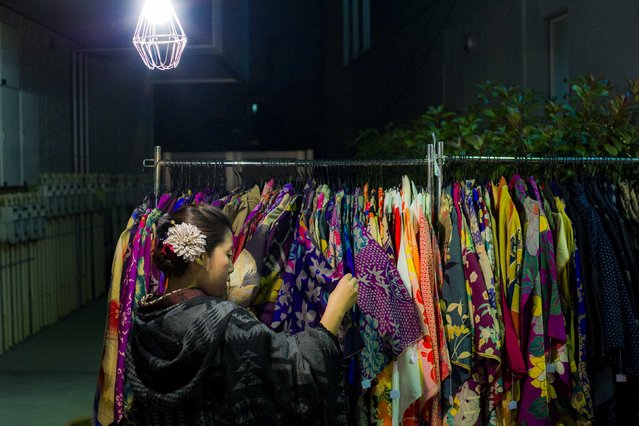
A woman browses through kimonos for sale at Boroichi flea market in Tokyo December 15, 2014. In the 16th century, Boroichi was a place for farmers to buy and sell rags, known as boro, for mending clothes and weaving sandals. Now in its 436th year, the original spirit lingers, with about 700 stands hawking fabric, used clothes and piles of rags. Others sell kitchen tools, pottery, seaweed and spices. (Photo by Thomas Peter/Reuters)

A woman browses through kimonos for sale at Boroichi flea market in Tokyo December 15, 2014. In the 16th century, Boroichi was a place for farmers to buy and sell rags, known as boro, for mending clothes and weaving sandals. Now in its 436th year, the original spirit lingers, with about 700 stands hawking fabric, used clothes and piles of rags. Others sell kitchen tools, pottery, seaweed and spices. About 200,000 people flock to the market, which is only open for four mid-winter days a year – two in December and two in January. (Photo by Thomas Peter/Reuters)
Details
19 Dec 2014 12:50:00

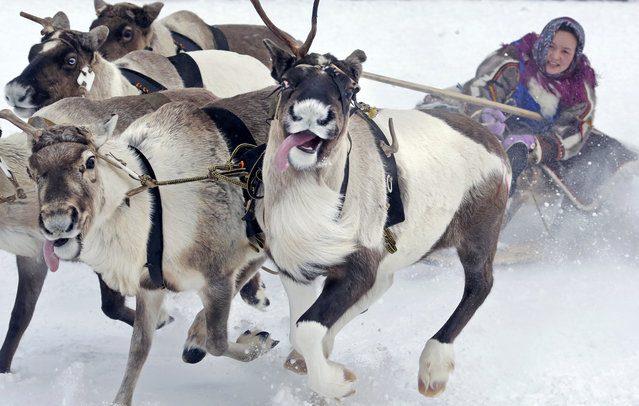
In this photo taken on Sunday, March 15, 2015, a Nenets woman rides steers a sled during a reindeer race at the Reindeer Herder's Day in the city of Nadym, in Yamal-Nenets Region, 2500 kilometers (about 1553 miles) northeast of Moscow, Russia. For the indigenous nomadic Nenets people, the Reindeer Herder's Day offers a chance to show their prowess in wrestling, high jumps and other traditional local sports, but, above all, reindeer races. (Photo by Dmitry Lovetsky/AP Photo)

In this photo taken on Sunday, March 15, 2015, a Nenets woman rides steers a sled during a reindeer race at the Reindeer Herder's Day in the city of Nadym, in Yamal-Nenets Region, 2500 kilometers (about 1553 miles) northeast of Moscow, Russia. For the indigenous nomadic Nenets people, the Reindeer Herder's Day offers a chance to show their prowess in wrestling, high jumps and other traditional local sports, but, above all, reindeer races. (Photo by Dmitry Lovetsky/AP Photo)
Details
24 Mar 2015 10:36:00