Loading...
Done
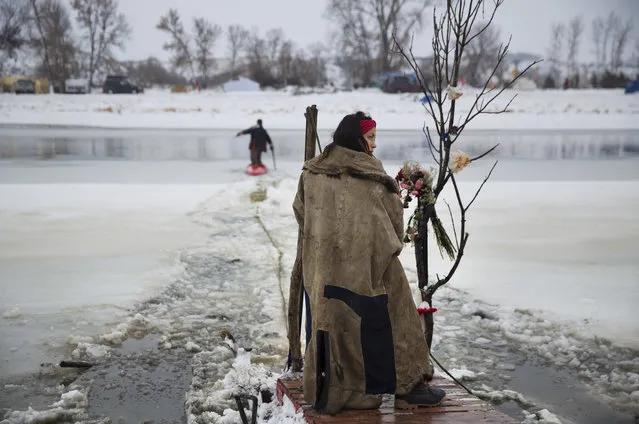
In this Thursday, December 1, 2016 photo, Cat Bigney, part of the Oglala Native American tribe, waits on the shore of the Cannonball river for travelers to arrive by canoe at the Oceti Sakowin camp where people have gathered to protest the Dakota Access oil pipeline in Cannon Ball, N.D. So far, those at the camp have shrugged off the heavy snow, icy winds and frigid temperatures. But if they defy next week's government deadline to abandon the camp, demonstrators know the real deep freeze lies ahead. Life-threatening wind chills and towering snow drifts could mean the greatest challenge is simple survival. (Photo by David Goldman/AP Photo)

In this Thursday, December 1, 2016 photo, Cat Bigney, part of the Oglala Native American tribe, waits on the shore of the Cannonball river for travelers to arrive by canoe at the Oceti Sakowin camp where people have gathered to protest the Dakota Access oil pipeline in Cannon Ball, N.D. So far, those at the camp have shrugged off the heavy snow, icy winds and frigid temperatures. But if they defy next week's government deadline to abandon the camp, demonstrators know the real deep freeze lies ahead. Life-threatening wind chills and towering snow drifts could mean the greatest challenge is simple survival. (Photo by David Goldman/AP Photo)
Details
06 Dec 2016 10:22:00
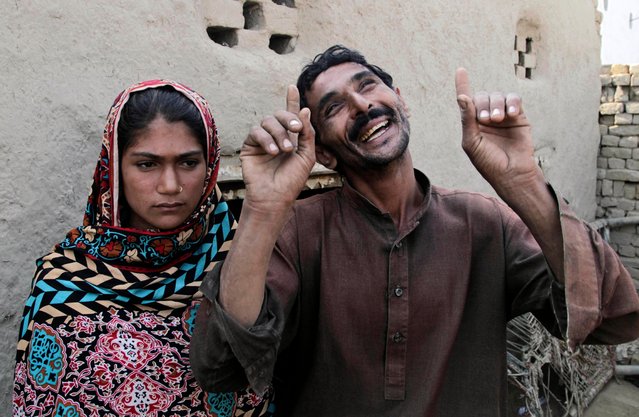
In this Tuesday, December 20, 2016 photo, Mohammad Ramzan, right, reacts while talking to The Associated Press with his young bride Saima in Jampur, Pakistan. Saima was given as a bride to the older man by her father so he could marry the groom’s sister, a practice of exchanging girls that is entrenched in conservative regions of Pakistan. It even has its own name in Urdu: Watta Satta, “give and take”. A mix of interests – family obligations, desire for sons, a wish to hand off a girl to a husband – can lead to a young teen in an a marriage she never sought. (Photo by K.M. Chaudhry/AP Photo)

In this Tuesday, December 20, 2016 photo, Mohammad Ramzan, right, reacts while talking to The Associated Press with his young bride Saima in Jampur, Pakistan. Saima was given as a bride to the older man by her father so he could marry the groom’s sister, a practice of exchanging girls that is entrenched in conservative regions of Pakistan. It even has its own name in Urdu: Watta Satta, “give and take”. A mix of interests – family obligations, desire for sons, a wish to hand off a girl to a husband – can lead to a young teen in an a marriage she never sought. (Photo by K.M. Chaudhry/AP Photo)
Details
31 Dec 2016 10:08:00
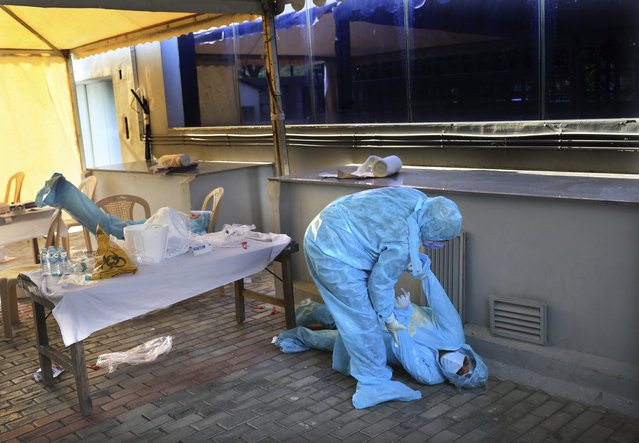
In this April 27, 2020 photo, a health worker helps another as she fainted because of exhaustion and long working hours during a swab test drive for COVID 19, in New Delhi, India. Two and a half months of nationwide lockdown kept numbers of infections relatively low in India. But with restrictions easing in recent weeks, cases have shot up, raising questions about whether authorities have done enough to avert catastrophe. Half of Delhi’s 8,200 hospital beds dedicated to COVID-19 patients are already full and officials are projecting more than half a million cases in the city alone by July 31. (Photo by Manish Swarup/AP Photo)

In this April 27, 2020 photo, a health worker helps another as she fainted because of exhaustion and long working hours during a swab test drive for COVID 19, in New Delhi, India. Two and a half months of nationwide lockdown kept numbers of infections relatively low in India. But with restrictions easing in recent weeks, cases have shot up, raising questions about whether authorities have done enough to avert catastrophe. Half of Delhi’s 8,200 hospital beds dedicated to COVID-19 patients are already full and officials are projecting more than half a million cases in the city alone by July 31. (Photo by Manish Swarup/AP Photo)
Details
08 Jan 2021 00:01:00
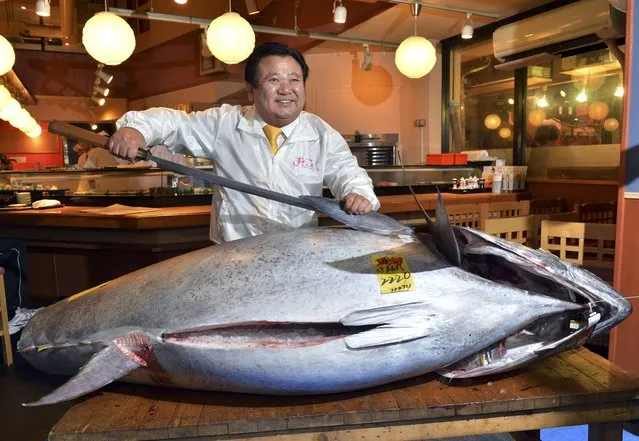
President of sushi restaurant chain Sushi-Zanmai, Kiyoshi Kimura, displays a 222kg bluefin tuna at his main restaurant near Tokyo's Tsukiji fish market on January 5, 2013. The bluefin tuna was traded at 155.4 million yen (1.77 million USD) at the wholesale market, smashing a previous record. (Photo by Yoshikazu Tsuno/AFP Photo)

Japanese businessman Kiyoshi Kimura has paid 1.38 million euros ($1.76 million, or 155.4 million yen) for a blue fin tuna – more than three times the previous high – which he also set one year ago. The 222-kilogram fish will be served to Kimura’s customers. Blue fin tuna is annually sold in a traditional New Year’s auction. Japan consumes 80 percent blue fin tuna caught worldwide.

Photo: President of sushi restaurant chain Sushi-Zanmai, Kiyoshi Kimura, displays a 222kg bluefin tuna at his main restaurant near Tokyo's Tsukiji fish market on January 5, 2013. The bluefin tuna was traded at 155.4 million yen (1.77 million USD) at the wholesale market, smashing a previous record. (Photo by Yoshikazu Tsuno/AFP Photo)
Details
06 Jan 2013 13:26:00
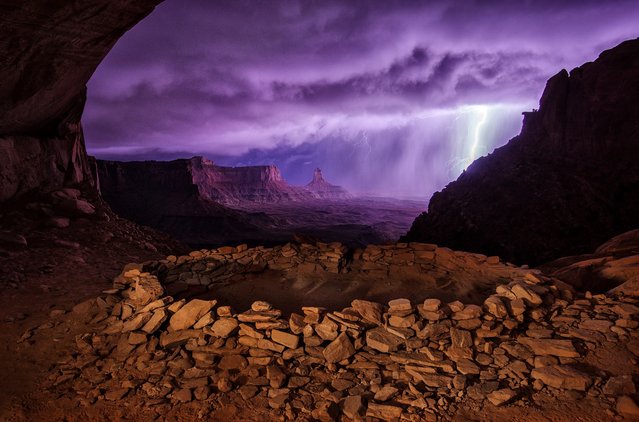
Second Place Winner: “Thunderstorm at False Kiva”. I hiked out to these ruins at night hoping to photograph them with the Milky Way, but instead a thunderstorm rolled through, creating this dramatic image. – Max Seigal. (Photo and caption by Max Seigal/National Geographic Traveler Photo Contest)

Second Place Winner: “Thunderstorm at False Kiva”. I hiked out to these ruins at night hoping to photograph them with the Milky Way, but instead a thunderstorm rolled through, creating this dramatic image. – Max Seigal. National Geographic Traveler Director of Photography Dan Westergren, one of this year's judges, shares his thoughts on the second place winner: “This photo combines two different scenes into one: the small kiva in a cliff dwelling and the grand vista of Canyonlands National Park across the valley. I really like the two different color palettes – warm inside and purple outside. This two-for-one scene was caused by the lightning storm outside the dwelling, which lit up the landscape like it was a huge electronic flash. Looking at this picture I can imagine what a wonderful sight it must have been for the ancient people who lived here. It doesn't seem too amazing now in our modern world, but might have been mind-blowing for the prehistoric residents”. Location: Utah. (Photo and caption by Max Seigal/National Geographic Traveler Photo Contest)
Details
02 Aug 2013 06:16:00
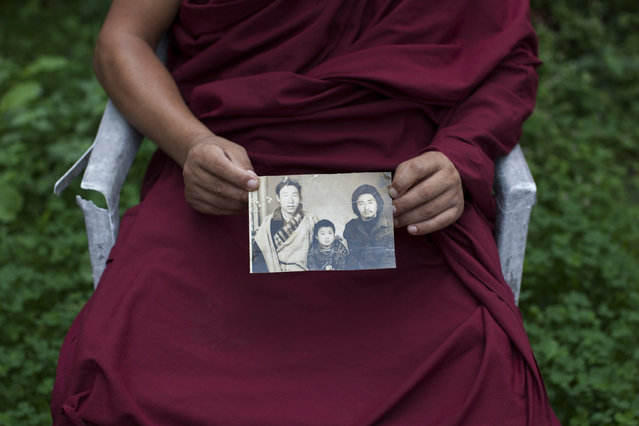
In this Saturday, September 27, 2014 photo, Tibetan monk Dorjee, 38, displays a photograph of his father, left, and himself, center, taken in Tibet, in Dharamsala, India. Dorjee said he held back his tears when he spoke with his parents on the phone after a separation period of 27 years. He exchanged a few words with his father but said his mother fainted on hearing his voice. (Photo by Tsering Topgyal/AP Photo)

“When I was 8 years old, my parents paid a smuggler to take me across the Himalayas, a weekslong walk over the mountains from Tibet to India. It was a trek that tens of thousands of other Tibetans have taken since the Dalai Lama fled a failed 1959 uprising against Chinese rule. My parents must have had their reasons to send me here; they must have had the best of intentions. But 18 years later, I still don't know why they did it. They are not political people. They are small farmers who raise barley and a few yak in a rural area not far from Lhasa, the Tibetan capital. I have not seen them since I left...”. – Tsering Topgyal via The Associated Press. (Photo by Tsering Topgyal/AP Photo)
Details
05 Nov 2014 12:27:00
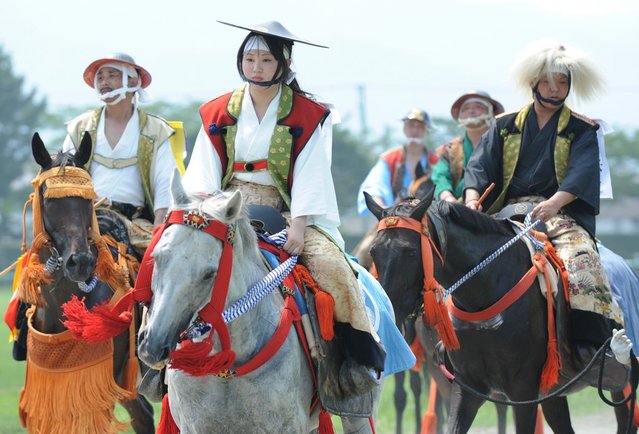
A young woman (C) clad in samurai costume leads other local poeple as she rides her horse during a parade at the annual Soma Nomaoi festival in Minamisoma, Fukushima Prefecture, on July 28, 2012.  The traditional full-scale festival kicked off for the first time after the accident of the Fukushima Dai-ichi Nuclear Power Plant following the massive earthquake and the tsunami on March 11, 2011. (Photo by Toru Yamanaka/AFP Photo)

Soma-Nomaoi is a festival that recreates a battle scene from more than 1,000 years ago. It is annually held for 4 days from July 22 to 25 in Haramachi City, Fukushima Prefecture, in the eastern part of Japan. In this historical event, 600 mounted samurai in traditional Japanese armor, with long swords at their side and ancestral flagstaffs streaming from their backs, ride across open fields. Soma-Nomaoi has been designated an Important Intangible Folk Cultural Property.

Photo: A young woman (C) clad in samurai costume leads other local poeple as she rides her horse during a parade at the annual Soma Nomaoi festival in Minamisoma, Fukushima Prefecture, on July 28, 2012. The traditional full-scale festival kicked off for the first time after the accident of the Fukushima Dai-ichi Nuclear Power Plant following the massive earthquake and the tsunami on March 11, 2011. (Photo by Toru Yamanaka/AFP Photo)
Details
02 Aug 2012 12:59:00
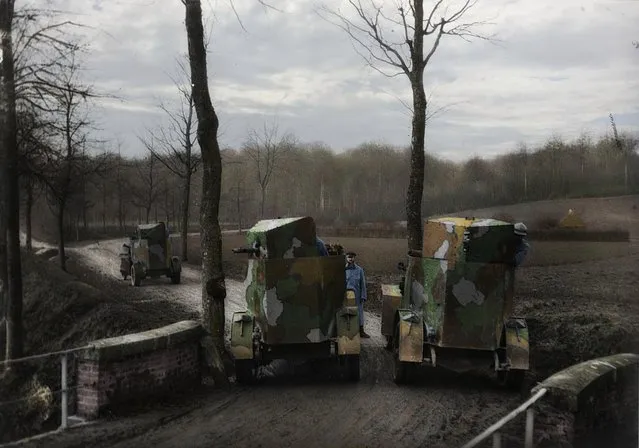
The expertly colourised shots were brought to life by French bank technician, Frédéric Duriez (51). The images were provided by the Valois collection which belongs to the BDIC. “By colourising these photos, I reduce the time that separates us today from this conflict”, said Frédéric. “A black and white photo does not attract the attention of young people, if you colour it, then people will look at it with curiosity. After this, we see the greater the misery and distress of these French fighters”. The total number of casualties in WW1 was more that 38 million. By the end of the war, over eight-million men had been called up to fight in the French army. France suffered 4.2 million casualties during the war with 1.3 million people dead. Here: Car cannon sections in firing position, Auxi-le-Château. (Photo by Frédéric Duriez/BDIC/Mediadrumworld.com)

The expertly colourised shots were brought to life by French bank technician, Frédéric Duriez (51). The images were provided by the Valois collection which belongs to the BDIC. “By colourising these photos, I reduce the time that separates us today from this conflict”, said Frédéric. Here: Car cannon sections in firing position, Auxi-le-Château. (Photo by Frédéric Duriez/BDIC/Mediadrumworld.com)
Details
03 May 2017 08:41:00