Loading...
Done


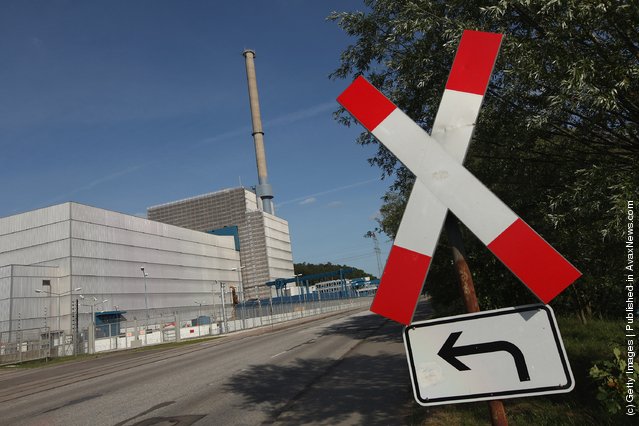
A sign marks a railway crossing next to the troubled Kruemmel nuclear power plant on June 2, 2011 in Geesthacht, Germany. The German government recently announced it will phase out the country's 17 remaining nuclear reactors by 2022 in a policy initiative that represents a radical reversal from its previous policy and was sparked by the disaster at Fukushima. Kruemmel went into operation in 1983 but was taken offline following a fire in 2007. (Photo by Sean Gallup/Getty Images)
Details
03 Jun 2011 09:12:00


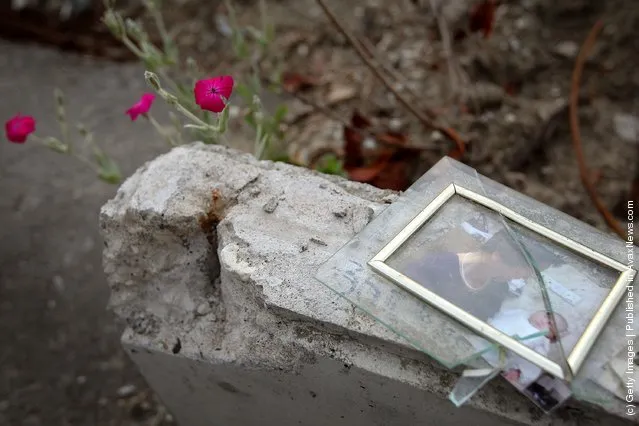
A broken picture frame is left in the tsunami-hit Arahama area, three months and two days after the magnitude 9.0 earthquake and subsequent tsunami on June 13, 2011 in Sendai, Miyagi, Japan. Japanese government has been struggling to deal with the earthquake and tsunami as well as the troubled Fukushima Daiichi Nuclear Power Plant. The fear on outbreak of virus infectious disease are mounting due to the humid rainy season on the corner and delay of the clearing the debris. (Photo by Kiyoshi Ota/Getty Images)
Details
14 Jun 2011 09:23:00
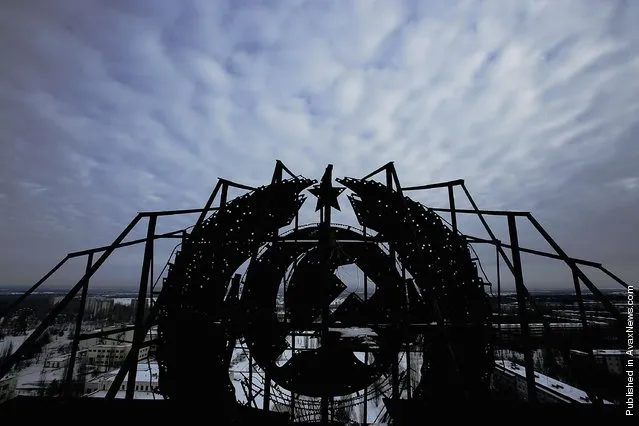
Chernobyl

Scaffolding holding a remnant of the Soviet Union, the hammer and sickle, is seen on a rooftop of an abandoned building in the town of Pripyat on January 25, 2006 near Chernobyl, Ukraine. The town of Pripyat, deserted since the 1986 catastrophe, once housed 30,000 people, the majority of being workers from the Chernobyl Nuclear Power Plant. Days after the catastrophe the inhabitants were relocated to other locations in the Soviet Union. The town of Pripyat has remained uninhabited since. Prypyat and the surrounding area will not be safe for human habitation for several centuries. Scientists estimate that the most dangerous radioactive elements will take up to 900 years to decay sufficiently to render the area safe.
Details
14 Mar 2011 10:20:00


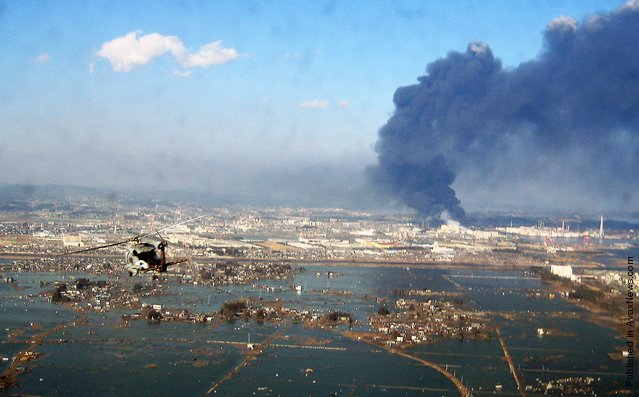
“With a fourth explosion rocking the Fukushima nuclear plant on Tuesday, danger of the spent nuke fuel pool boiling and radiation levels at the facility's gate increasing hundredfold, fears of a meltdown in Japan skyrocket”. – Russia Today

Photo: In this handout image provided by U.S. Navy, an aerial view of tsunami and earthquake damage is seen from an SH-60B helicopter assigned to the Chargers of Helicopter Antisubmarine Squadron (HS) 14 from Naval Air Facility Atsugi March 12, 2011 seen from the air of Sendai, Japan. (Photo by U.S. Navy via Getty Images)
Details
16 Mar 2011 10:19:00
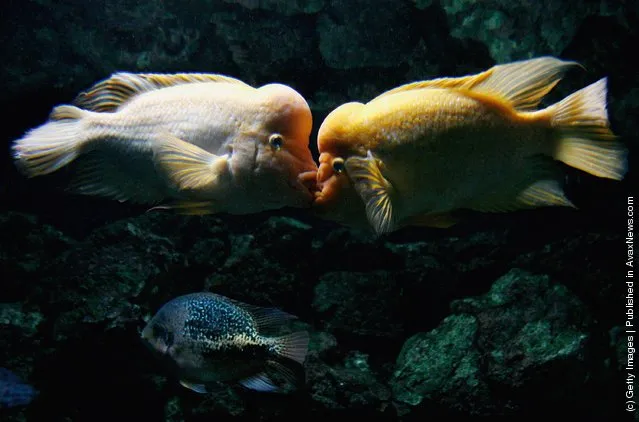
Midas Cichlid a.k.a. Amphilophus Citrinellus

“Amphilophus citrinellus is a large cichlid fish endemic to the San Juan River and adjacent watersheds in Costa Rica and Nicaragua. In the aquarium trade A. citrinellus is often sold under the trade name of Midas cichlid. A. citrinellus are omnivorous and their diet consists of plant material, molluscs and smaller fish”. – Wikipedia

Photo: Two Midas Cichlid (lat: amphilophus citrinellus) fish are seen in an aquarium at Hellabrunn zoo on December 23, 2009 in Munich, Germany. (Photo by Alexandra Beier/Getty Images)
Details
17 Aug 2011 11:29:00
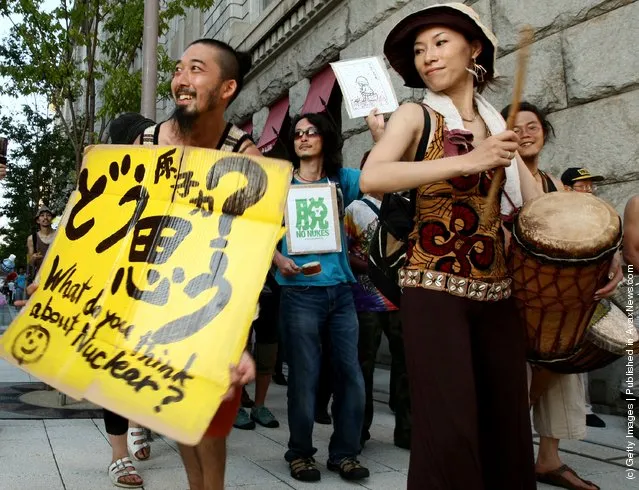
Anti-nuclear activists demonstrate during a Say to Goodbye to Nuclear Energy protest in Kobe, Japan

Anti-nuclear activists demonstrate during a “Say to Goodbye to Nuclear Energy” protest on September 11, 2011 in Kobe, Japan. Japan is marking sixth months since a magnitude 9.0 earthquake struck Japan offshore on March 11 at 2:46pm local time, triggering a tsunami wave of up to ten metres which engulfed large parts of north-eastern Japan and also damaged the Fukushima nuclear plant, causing the worst nuclear crisis in decades. The current number of dead and missing is reportedly estimated to be 22,900. (Photo by Buddhika Weerasinghe/Getty Images)
Details
12 Sep 2011 10:16:00
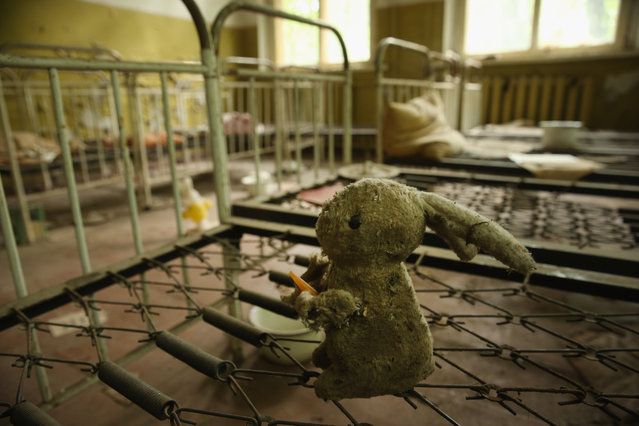
A stuffed rabbit doll sits among children's beds standing in the abandoned kindergarten of Kopachi village located inside the Chernobyl Exclusion Zone on September 29, 2015 near Chornobyl, Ukraine. Kopachi, a village that before 1986 had a population of 1,114, lies only a few kilometers south of the former Chernobyl nuclear power plant, where in 1986 workers inadvertantly caused reactor number four to explode, creating the worst nuclear accident in history. Radiation fallout was so high that authorities bulldozed and buried all of Kopachi's structures except for the kindergarten. (Photo by Sean Gallup/Getty Images)

A stuffed rabbit doll sits among children's beds standing in the abandoned kindergarten of Kopachi village located inside the Chernobyl Exclusion Zone on September 29, 2015 near Chornobyl, Ukraine. Kopachi, a village that before 1986 had a population of 1,114, lies only a few kilometers south of the former Chernobyl nuclear power plant, where in 1986 workers inadvertantly caused reactor number four to explode, creating the worst nuclear accident in history. (Photo by Sean Gallup/Getty Images)
Details
27 Apr 2016 09:28:00
Royal sacred white oxen are offered food to consult the oracles during the Royal Ploughing Ceremony at the Royal Ground, Sanam Luang near the Grand Palace in Bangkok, Thailand, 09 May 2016. The ancient Brahmin rite is of great importance to the country's farmers. Thousands of farmers converge in Bangkok for the annual event, which is believed to assure a successful planting season and an abundance of crops. (Photo by Rungroj Yongrit/EPA)

Royal sacred white oxen are offered food to consult the oracles during the Royal Ploughing Ceremony at the Royal Ground, Sanam Luang near the Grand Palace in Bangkok, Thailand, 09 May 2016. The ancient Brahmin rite is of great importance to the country's farmers. Thousands of farmers converge in Bangkok for the annual event, which is believed to assure a successful planting season and an abundance of crops. This year the sacred oxen ate paddy, sesame seeds, water and liquor which according to traditional soothsayers predicts that the country will have abundant food, sufficient water for agriculture as well as communication and foreign trade will improve leading to the prosperous economy. (Photo by Rungroj Yongrit/EPA)
Details
10 May 2016 13:11:00