Loading...
Done
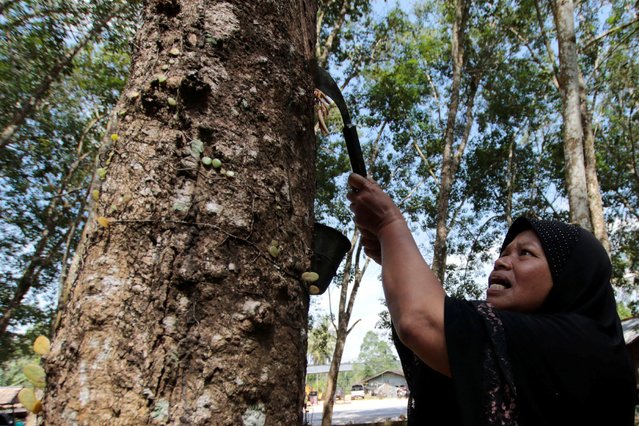
A woman works in a rubber plantation in Yala province, southern Thailand, January 30, 2017. (Photo by Surapan Boonthanom/Reuters)

A woman works in a rubber plantation in Yala province, southern Thailand, January 30, 2017. Thai rubber exporters say they have enough of the commodity in stockpiles to ensure only minimal disruption to scheduled shipments in the wake of deadly floods in key growing regions. (Photo by Surapan Boonthanom/Reuters)
Details
02 Feb 2017 05:08:00
Undated handout photo issued by Take a View of the winner of the Adobe Prize of the Landscape Photographer of the Year Awards, The Daymark, Brixham, Devon, England by Will Milner (lives Oxfordshire). Issue date: Monday October 15, 2018. (Photo by Will Milner/PA Wire)

Undated handout photo issued by Take a View of the winner of the Adobe Prize of the Landscape Photographer of the Year Awards, The Daymark, Brixham, Devon, England by Will Milner (lives Oxfordshire). Issue date: Monday October 15, 2018. (Photo by Will Milner/PA Wire Press Association)
Details
11 Dec 2018 00:03:00
Artists wearing Japanese traditional clown masks march during the First Konpira Festival at Kotohiragu shrine in Tokyo Wednesday, January 10, 2018. The shrine is dedicated to sailors and seafaring. (Photo by Eugene Hoshiko/AP Photo)

Artists wearing Japanese traditional clown masks march during the First Konpira Festival at Kotohiragu shrine in Tokyo Wednesday, January 10, 2018. The shrine is dedicated to sailors and seafaring. (Photo by Eugene Hoshiko/AP Photo)
Details
30 Jan 2018 06:32:00
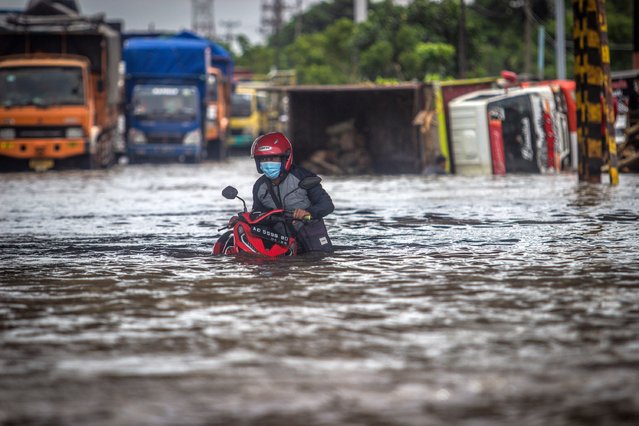
A resident pushes their motorbike through flood waters caused by torrential rain in Semarang, central Java, Indonesia on February 23, 2021. (Photo by W.F. Sihardian/NurPhoto/Rex Features/Shutterstock)

A resident pushes their motorbike through flood waters caused by torrential rain in Semarang, central Java, Indonesia on February 23, 2021. (Photo by W.F. Sihardian/NurPhoto/Rex Features/Shutterstock)
Details
11 Mar 2021 09:49:00
Drivers push cars to gas station during “oil crisis”, Roslindale, Boston, Massachusetts, 1973. (Photo by Spencer Grant/Getty Images)

Drivers push cars to gas station during “oil crisis”, Roslindale, Boston, Massachusetts, 1973. (Photo by Spencer Grant/Getty Images)
Details
18 Nov 2021 08:30:00
Breeder of baby goat Mohammad Hasan Narejo and a child show ears of 2-month-old female baby goat named Simbi in Karachi, Pakistan on June 07, 2023. Simbi has the world's longest ears which are 55 cm. (Photo by Sabir Mazhar/Anadolu Agency via Getty Images)

Breeder of baby goat Mohammad Hasan Narejo and a child show ears of 2-month-old female baby goat named Simbi in Karachi, Pakistan on June 07, 2023. Simbi has the world's longest ears which are 55 cm. (Photo by Sabir Mazhar/Anadolu Agency via Getty Images)
Details
17 Jun 2023 03:14:00
A decades-old television. (Photo by Mark C. O'Flaherty)

The official name for this tiny speck of land – the size of 12 football pitches – is Hashima, but few call it that. In English, its most commonly used name means “Battleship Island” and, viewed from a certain angle offshore, its silhouette is uncannily dreadnought in nature. It was a mining facility until 1974, when it was abandoned to the elements, before partially reopening as a tourist attraction in 2009. Photo: A decades-old television. (Photo by Mark C. O'Flaherty)
Details
15 Jun 2014 11:24:00
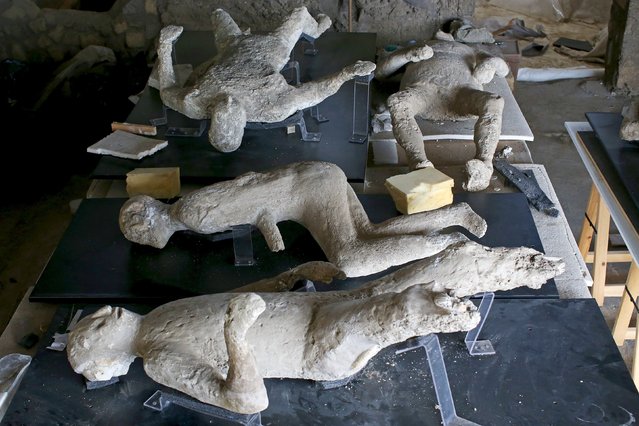
Plaster cast moulds of victims of the Mount Vesuvius eruption lie on a display table in a laboratory at Pompeii October 13, 2015. An expert team made up of archaeologists, radiologists, orthodontists and anthropologists began on September 2015 to use CAT scan technology (computerised axial tomography) to peer inside the plaster cast moulds of Pompeii's victims, in a study that has added more detail to previous findings. (Photo by Alessandro Bianchi/Reuters)

Plaster cast moulds of victims of the Mount Vesuvius eruption lie on a display table in a laboratory at Pompeii October 13, 2015. An expert team made up of archaeologists, radiologists, orthodontists and anthropologists began on September 2015 to use CAT scan technology (computerised axial tomography) to peer inside the plaster cast moulds of Pompeii's victims, in a study that has added more detail to previous findings. A 16-layer scan had to be used in order to penetrate the hardened plaster but the results showed up impressive skeletal remains and near perfect teeth. (Photo by Alessandro Bianchi/Reuters)
Details
22 Oct 2015 08:02:00