Loading...
Done
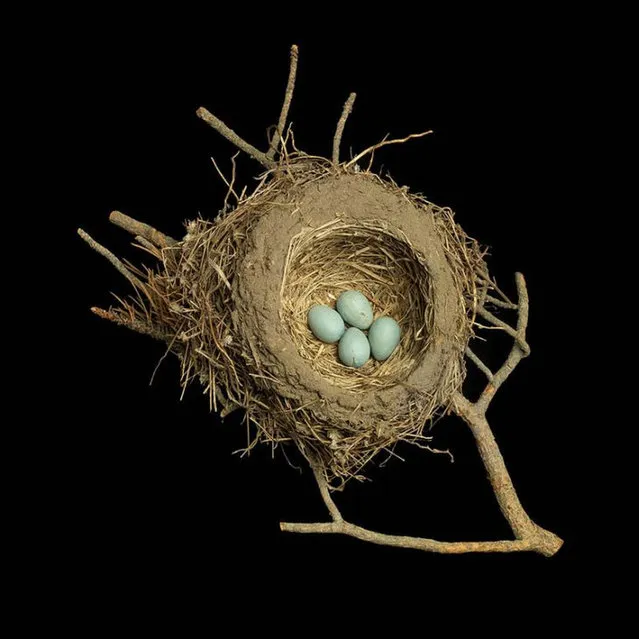
Bird Nest By Sharon Beals

Sharon Beals is a San Francisco based photographer who has photographed nest and eggs specimens collected over the last two centuries at The California Academy of Sciences, The Museum of Vertebrate Zoology, and The Western Foundation of Vertebrate Zoology. While few nests are collected today, these nests and eggs are used for research, providing important information about their builder’s habitats, DNA, diseases and other survival issues.
Details
20 Aug 2013 09:49:00
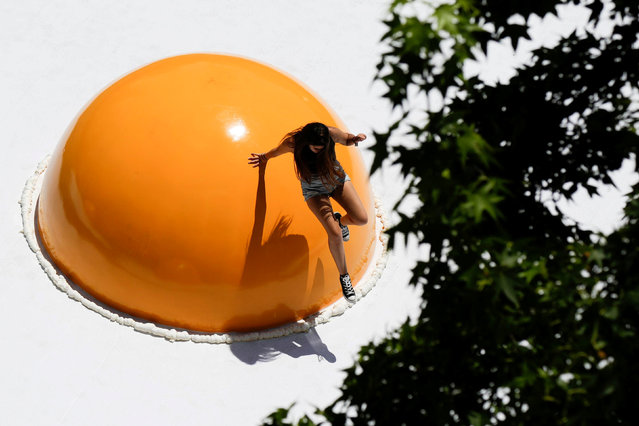
A woman jumps on a giant fried egg art installation as part of “Hecho en Casa” (Made at home) urban artwork festival in downtown Santiago, Chile, November 8, 2016. (Photo by Pablo Sanhueza/Reuters)

A woman jumps on a giant fried egg art installation as part of “Hecho en Casa” (Made at home) urban artwork festival in downtown Santiago, Chile, November 8, 2016. (Photo by Pablo Sanhueza/Reuters)
Details
09 Nov 2016 06:44:00
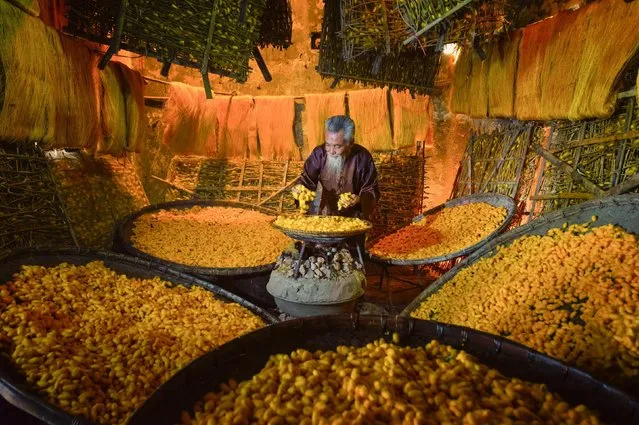
Thousands of bright yellow silkworm cocoons are dried in huge clay bowls in the village of Hong Ly, northern Vietnam in July 2022. Silk fibres are produced by silkworms when they spin themselves into a cocoon on their journey to becoming a silkmoth. The ultra-soft fibres are harvested from the cocoon in their raw state by being boiled in hot water. (Photo by Prabu Mohan/Solent News)

Thousands of bright yellow silkworm cocoons are dried in huge clay bowls in the village of Hong Ly, northern Vietnam in July 2022. Silk fibres are produced by silkworms when they spin themselves into a cocoon on their journey to becoming a silkmoth. The ultra-soft fibres are harvested from the cocoon in their raw state by being boiled in hot water. (Photo by Prabu Mohan/Solent News)
Details
31 Jul 2022 05:59:00
Agence SEARCH

Another step further into the world of lattice shell structures: From Buckminster Fuller to Massimiliano Fuksas and James Law’s ‘Cybertecture Egg’, Agence SEARCH express their fascination by experimenting with the retail world proposing their version of ‘Cybertecture Egg’ for the interior of Beaugrenelle Shopping Mall without modifying the existing architecture. Thus the visitor’s first perception goes beyond the scale of the building, to encompass its referential universe, its status, and its identity.
Details
09 Jun 2015 10:30:00
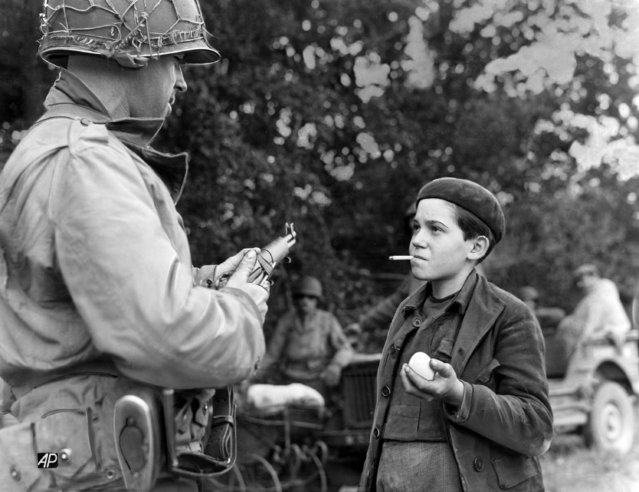
Pfc. Remy Bouchard swaps a cigarette for an egg with a French Orphan near La Haye Du Puits, France on July 18, 1944, which was captured by American forces. The boy is only twelve years old. (Photo by Hugh Broderick/AP Photo)

Pfc. Remy Bouchard swaps a cigarette for an egg with a French Orphan near La Haye Du Puits, France on July 18, 1944, which was captured by American forces. The boy is only twelve years old. (Photo by Hugh Broderick/AP Photo)
Details
04 Aug 2017 09:02:00
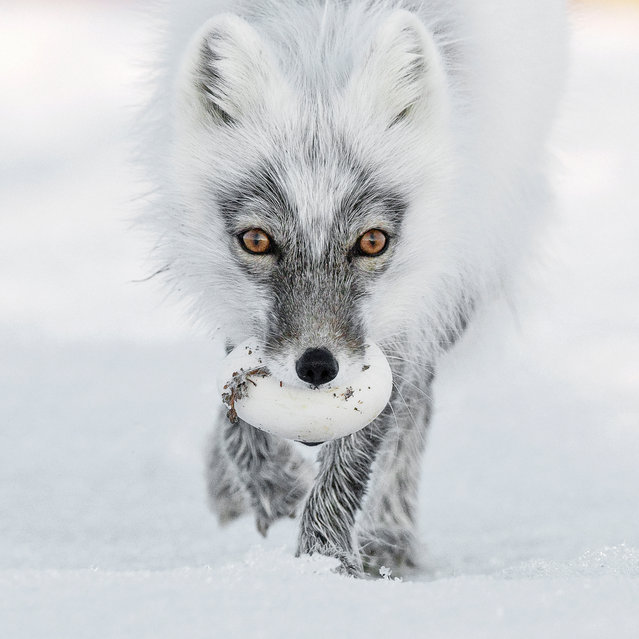
Arctic treasure by Sergey Gorshkov (Russia). An arctic fox carries its egg trophy from a raid on a snow goose nest and heads for a suitable burial spot. Finalist 2017, Animal Portraits. (Photo by  Sergey Gorshkov/2017 Wildlife Photographer of the Year)

Arctic treasure by Sergey Gorshkov (Russia). An arctic fox carries its egg trophy from a raid on a snow goose nest and heads for a suitable burial spot. Finalist 2017, Animal Portraits. (Photo by Sergey Gorshkov/2017 Wildlife Photographer of the Year)
Details
12 Sep 2017 09:33:00
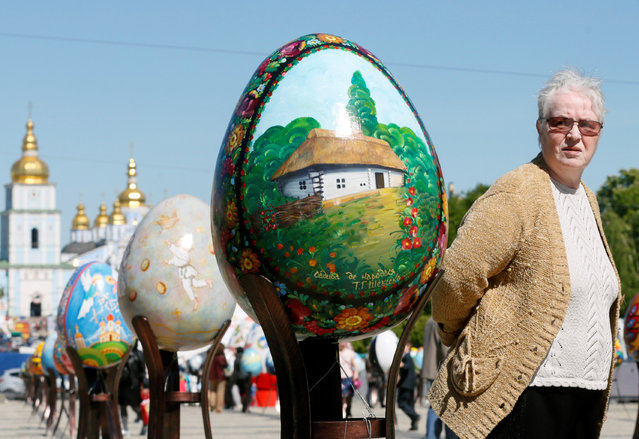
A woman looks at traditional Ukrainian Easter eggs “Pysanka”, installed as part of the upcoming celebrations of Easter, in central Kiev, Ukraine, April 29, 2016. A pysanka is a Ukrainian Easter egg, decorated with traditional Ukrainian folk designs using a wax-resist (batik) method. The word pysanka comes from the verb pysaty, “to write”, as the designs are not painted on, but written with beeswax. Many other eastern European ethnic groups decorate eggs using wax resist for Easter. These include the Belarusians, Bulgarians, Croats, Czechs, Hungarians, Lithuanians, Poles, Romanians, Serbs, Slovaks, Slovenes and Sorbs. (Photo by Valentyn Ogirenko/Reuters)

A woman looks at traditional Ukrainian Easter eggs “Pysanka”, installed as part of the upcoming celebrations of Easter, in central Kiev, Ukraine, April 29, 2016. A pysanka is a Ukrainian Easter egg, decorated with traditional Ukrainian folk designs using a wax-resist (batik) method. The word pysanka comes from the verb pysaty, “to write”, as the designs are not painted on, but written with beeswax. Many other eastern European ethnic groups decorate eggs using wax resist for Easter. These include the Belarusians, Bulgarians, Croats, Czechs, Hungarians, Lithuanians, Poles, Romanians, Serbs, Slovaks, Slovenes and Sorbs. (Photo by Valentyn Ogirenko/Reuters)
Details
30 Apr 2016 09:00:00
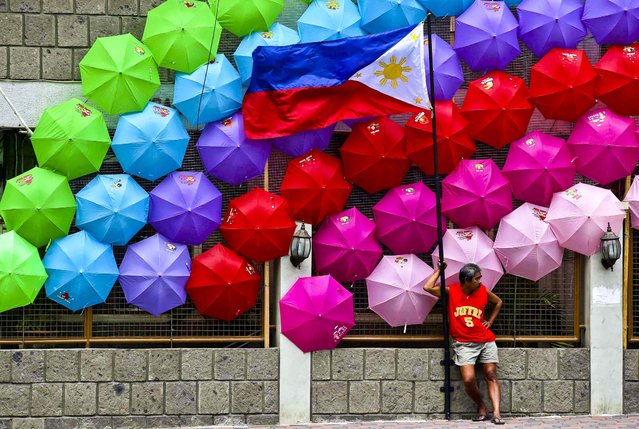
A man stands beside the Philippine flag as colorful umbrellas adorn a village hall in suburban San Juan, east of Manila, Philippines, on June 27, 2013. (Photo by Aaron Favila/Associated Press)

A man stands beside the Philippine flag as colorful umbrellas adorn a village hall in suburban San Juan, east of Manila, Philippines, on June 27, 2013. (Photo by Aaron Favila/Associated Press)
Details
29 Jun 2013 12:02:00