Loading...
Done
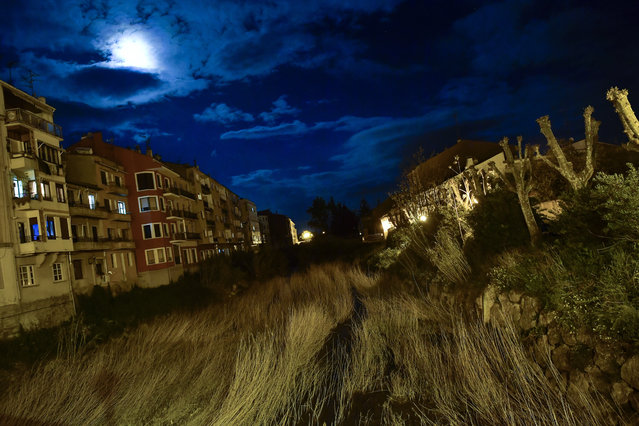
A moon light illuminates the sky through the clouds over a large line of grass between some home houses in the small village of Tafalla, northern Spain, Tuesday, May 1, 2018. (Photo by Alvaro Barrientos/AP Photo)

A moon light illuminates the sky through the clouds over a large line of grass between some home houses in the small village of Tafalla, northern Spain, Tuesday, May 1, 2018. (Photo by Alvaro Barrientos/AP Photo)
Details
25 Sep 2018 00:05:00


Defined according to wikipedia it is “a recent and informal geologic chronological term that serves to mark the evidence and extent of human activities that have had a significant global impact on the Earth’s ecosystems. The term was coined by ecologist Eugene Stoermer but has been widely popularized by the Nobel Prize-winning atmospheric chemist Paul Crutzen.”

The images here where created by Felix Pharand-Deschenes depicting how various human influences, from road and rail, to internet cables and airlines create significant patterns covering the Earth. What can we learn from these patterns in how they are influencing the environment
Details
19 Aug 2012 10:40:00
Japanese children wear loincloths as they splash about in freezing cold water during Saidaiji Naked Festival, at Saidaiji Temple

“A Hadaka Matsuri (“Naked Festival”) is a type of Japanese festival, or matsuri, in which participants wear a minimum amount of clothing; usually just a Japanese loincloth (called fundoshi), sometimes with a short happi coat, and rarely completely naked. Whatever the clothing, it is considered to be above vulgar, or everyday, undergarments, and on the level of holy Japanese shrine attire. Naked festivals are held in dozens of places throughout Japan every year, usually in the summer or winter. The most famous festival is held in Okayama, where the festival originated. Every year, over 9,000 men participate in this festival”. – Wikipedia

Photo: Japanese men wear loincloths as they splash about in freezing cold water during Saidaiji Naked Festival, at Saidaiji Temple on February 18, 2012 in Okayama, Japan. (Photo by Buddhika Weerasinghe/Getty Images)
Details
19 Feb 2012 12:18:00
Robert Rickhoff  By "Out Of Place"

German artist Robert Rickhoff re-interprets the idea of public space with humor through a series of digitally manipulated photographs in a project entitled “out of place”. Rickhoff augments scenes within a seemingly commonplace environment to depict impractical yet lighthearted situations – including a playground slippery dip facing towards a busy road to a speed bump placed in an unassuming residential street that is actually a daredevil ramp. the visualizations are subtle yet provocative, forcing the audience to look twice to notice the unusual setting infused with tongue-in-cheek wit.
Details
17 Feb 2013 11:43:00
Faces In Places Part2

Angry Mop

See also: Faces in Places
Details
25 Oct 2013 11:14:00
Lightning over Mow Cop Castle which is a folly at Mow Cop in the civil parish of Odd Rode, Cheshire, UK on August 13, 2020, as thunderstorms continue during the current heatwave. (Photo by Lee Scally/Bav Media)

Lightning over Mow Cop Castle which is a folly at Mow Cop in the civil parish of Odd Rode, Cheshire, UK on August 13, 2020, as thunderstorms continue during the current heatwave. (Photo by Lee Scally/Bav Media)
Details
14 Nov 2020 00:03:00
Sydney Dims For Earth Hour

The Sydney Skyline is seen before the lights are switched off for Earth Hour on March 26, 2011 in Sydney, Australia. Earth Hour encourages individuals around the world to turn off their lights for one hour at 20:30 local time on March 26, 2011 to take a stand against climate change. The largest Earth Hour was in 2010 when 128 countries participated.
Details
26 Mar 2011 14:54:00
Upper Atmosphere Research Satellite (UARS)

In this artist illustration handout from the National Aeronautics and Space Administration (NASA), the Upper Atmosphere Research Satellite (UARS) is seen. According to NASA, the 12,500 pound satellite will fall from orbit into earth's atmosphere anytime between September 22 through 24. It is estimated that the space craft will break up into about 100 pieces, with an estimated 26 of which could hit the earth over a possible 500 mile debris field. (Illustration by NASA via Getty Images)
Details
21 Sep 2011 10:49:00