Loading...
Done
A humanoid robot named “Robi” sits during a promotional event for the launch of a weekly Robi Magazine in Tokyo, Japan, 20 January 2015. Created by roboticist Tomotaka Takahashi, the 34-centimeter tall humanoid robot can recognize and respond to more than 200 words and phrases, walk and dance. (Photo by Franck Robichon/EPA)

A humanoid robot named “Robi” sits during a promotional event for the launch of a weekly Robi Magazine in Tokyo, Japan, 20 January 2015. Created by roboticist Tomotaka Takahashi, the 34-centimeter tall humanoid robot can recognize and respond to more than 200 words and phrases, walk and dance. Parts of the robot will be put on sale in a weekly magazine to be fully assembled with 70 issues. (Photo by Franck Robichon/EPA)
Details
21 Jan 2015 13:19:00
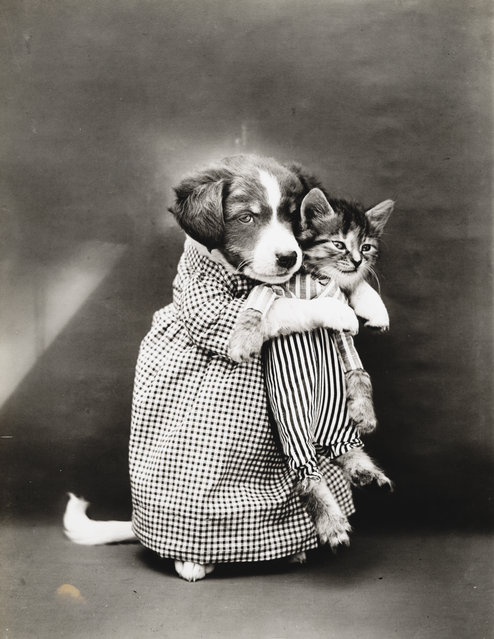
Photograph shows a puppy holding a kitten, 1914. (Photo by Harry Whittier Frees/Library of Congress)

“Harry Whittier Frees (1879–1953) was an American photographer who created novelty postcards and children's books based on his photographs of animals. He dressed the animals and posed them in human situations with props, often with captions; these can be seen as progenitors of modern lolcats”. – Wikipedia. Photo: “The nurse”. Photograph shows a puppy holding a kitten, 1914. (Photo by Harry Whittier Frees/Library of Congress)

P.S. All pictures are presented in high resolution. To see Hi-Res images – just TWICE click on any picture. In other words, click small picture – opens the BIG picture. Click BIG picture – opens VERY BIG picture (if available; this principle works anywhere on the site AvaxNews).
Details
28 Mar 2014 11:20:00
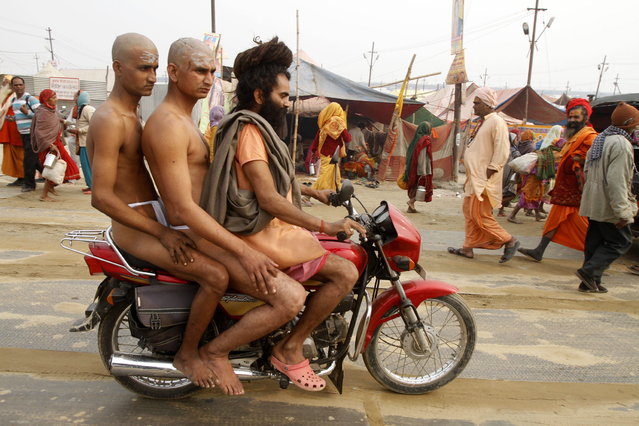
Two Hindu holy men of the Juna Akhara sect  are being take on a motorcycle by their teacher as they got delayed for a rituals that are believed to rid them of all ties in this life and dedicate themselves to serving God as a “Naga” or naked holy men, at Sangam, the confluence of the Ganges and Yamuna River during the Maha Kumbh festival in Allahabad, India, Wednesday, February 6, 2013. (Photo by Rajesh Kumar Singh/AP Photo)

Two Hindu holy men of the Juna Akhara sect are being take on a motorcycle by their teacher as they got delayed for a rituals that are believed to rid them of all ties in this life and dedicate themselves to serving God as a “Naga” or naked holy men, at Sangam, the confluence of the Ganges and Yamuna River during the Maha Kumbh festival in Allahabad, India, Wednesday, February 6, 2013. The significance of nakedness is that they will not have any worldly ties to material belongings, even something as simple as clothes. This ritual that transforms selected holy men to Naga can only be done at the Kumbh festival. (Photo by Rajesh Kumar Singh/AP Photo)
Details
07 Feb 2013 10:11:00
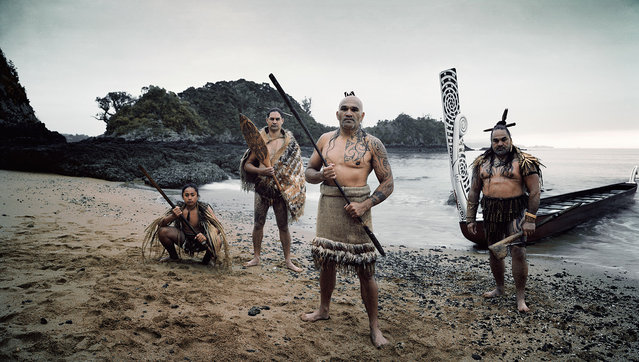
Maori  People New Zealand

The long and intriguing story of the origine of the indigenous Maori people can be traced back to the 13th century, the mythical homeland Hawaiki, Eastern Polynesia. Due to centuries of isolation, the Maori established a distinct society with characteristic art, a separate language and unique mythology. Defining aspects of Maori traditional culture include art, dance, legends, tattoos and community. While the arrival of European colonists in the 18th centure had a profound impact on the Maori way of life, many aspects of traditional society have survived into the 21th century.
Details
11 Mar 2014 14:40:00
Online hostess Xianggong (L) and other hostesses check their pictures as they gather around the photographer while taking part in a football-themed photoshoot at a photography studio in Beijing March 4, 2015. (Photo by Jason Lee/Reuters)

Online hostess Xianggong (L) and other hostesses check their pictures as they gather around the photographer while taking part in a football-themed photoshoot at a photography studio in Beijing March 4, 2015. In China's online hostessing world, men find virtual company and the women can find riches. Xianggong is one of more than 10,000 hostesses on the internet site bobo.com, a live broadcasting web platform where anyone can record themselves singing, playing piano, dancing or just chatting. (Photo by Jason Lee/Reuters)
Details
17 Apr 2015 10:06:00
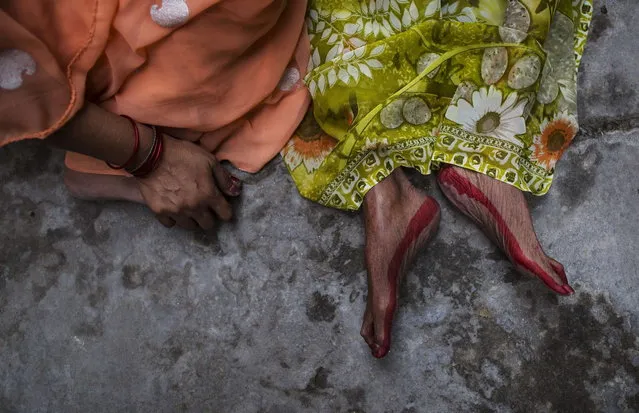
A relative (L) of Champa Devi, 88, sits next to her body, minutes after her death at Mukti Bhavan (Salvation House) at Varanasi, in the northern Indian state of Uttar Pradesh, June 21, 2014. (Photo by Danish Siddiqui/Reuters)

A relative (L) of Champa Devi, 88, sits next to her body, minutes after her death at Mukti Bhavan (Salvation House) at Varanasi, in the northern Indian state of Uttar Pradesh, June 21, 2014. The city of Varanasi, on the banks of the River Ganges, is widely considered Hinduism's holiest city and many Hindus believe that dying there and having their remains scattered in the Ganges allows their soul to escape a cycle of death and rebirth, attaining “moksha” or salvation. “Mukti Bhavan” or “Salvation House”, is a charity-run hostel that caters for people who wish to come to Varanasi to die. Guests can normally stay up to two weeks after which, if they haven't yet passed away, they are gently asked to leave. (Photo by Danish Siddiqui/Reuters)
Details
24 Jul 2014 12:32:00
Records Motion In Light By Stephen Orlando

The mystifying flow of motion. We can rarely appreciate its beauty. Though there are ways to capture it on film, allowing us to marvel at its complexity. Stephen Orlando is a photographer who takes pleasure highlighting the magnificence of aquatic sports by using the brilliance of light. The beauty of the images that he creates comes not only from the composition of the photo, but also from the way Stephen managed to show the color transitions between each stroke of the kayaker. Even the rapids do not stand in the way of the marvelous dance of light. (Photo by Stephen Orlando)
Details
21 Dec 2014 10:57:00
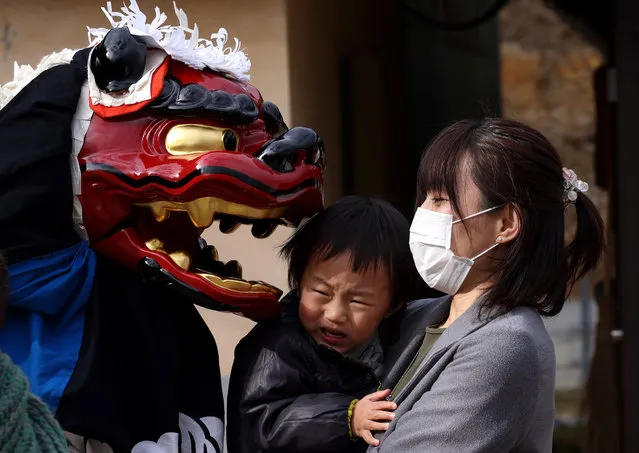
A performer wearing a lion mask performs the Ise Daikagura lion dance at the remote village of Yamanawa on February 08, 2021 in Ryuo, Japan. Ise Daikagura is a group of traditional Lion Dance performers who pray in front of farmers houses and businesses for good grain harvests and disease-free lives. Performers play sacred music using drums and flutes with two lion mask dancers. A lion mask is considered a symbol of God, who enters the house and performs in front of the Shinto God, a statue placed inside the house, mostly in the kitchen. These prayers are called “Kamodo Barai”. After the prayers, they are gifted with money, rice, sake and Japanese sweets from the householders. A group can travel for more than one hundred days to thousands of households and businesses throughout rural-villages in western Japan, and pray to those who are unable to visit the country’s most sacred shrine, the Grand Ise Shrine in Mie Prefecture. The group started its performance in the Edo era between 1603 to 1868 according to Japanese history. The Japanese government designated it as an important folk cultural national property in 1981. (Photo by Buddhika Weerasinghe/Getty Images)

A performer wearing a lion mask performs the Ise Daikagura lion dance at the remote village of Yamanawa on February 08, 2021 in Ryuo, Japan. Ise Daikagura is a group of traditional Lion Dance performers who pray in front of farmers houses and businesses for good grain harvests and disease-free lives. (Photo by Buddhika Weerasinghe/Getty Images)
Details
18 Feb 2021 09:27:00