Loading...
Done
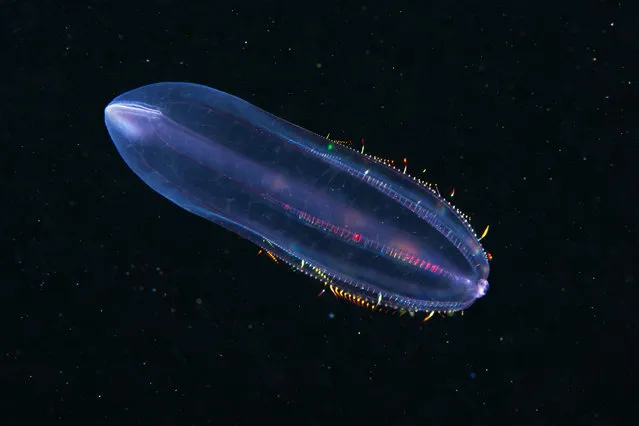
A Comb jelly – Beroe cucumis. (Photo by Alexander Semenovs/Caters News)

Underwater photographer Alexander Semenovs has snapped some of the most stunning, fragile life forms anywhere on planet Earth. Shot in deep, dark conditions, the images continue to provide an insight into what lies beneath, with glowing creatures appearing a lot like aliens in the pitch-black water. Semenovs has shot the likes of bioluminescent jellyfish, aggressive-looking worms and many species that leave a lot to the imagination. The 30-year-old from Moscow does the majority of his work in the White Sea, near the Arctic Circle. Here: A Comb jelly – Beroe cucumis. (Photo by Alexander Semenovs/Caters News)
Details
23 Nov 2015 08:06:00


For a long time the laws of Canada have explicitly banned gambling in any form. This may be the reason why the country does not have so many gambling establishments as the USA - but their quality surely makes up for the quantity. The first Canadian casino was opened in Dawson City, Yukon, in 1972 - it was the first one after gambling has been banned in the country in 1892. The Diamond Tooth Gertie's Gambling Casino did not operate for long, though. The first permanent commercial casino was opened in 1989, and it was the first of many - there are currently 75 casinos operating on Canadian soil.
Details
16 Sep 2014 12:19:00
Funny Necklace By Takayuki Fukusawa

Fukusawa Takayuki is a Japanese designer, whose life’s goal is to brighten up the people's mood through his creations. His latest project sure does the job. In this project he created a number of figurine-pendants called the “Tanima Diver”. When worn by a woman with full breasts, it looks like the figurine is making a dive into her cleavage. Though only the most outgoing of girls will allow herself to wear such a necklace, it will surely bring a wide smile to the face of any man. (Photo by Takayuki Fukusawa)
Details
18 Nov 2014 11:10:00


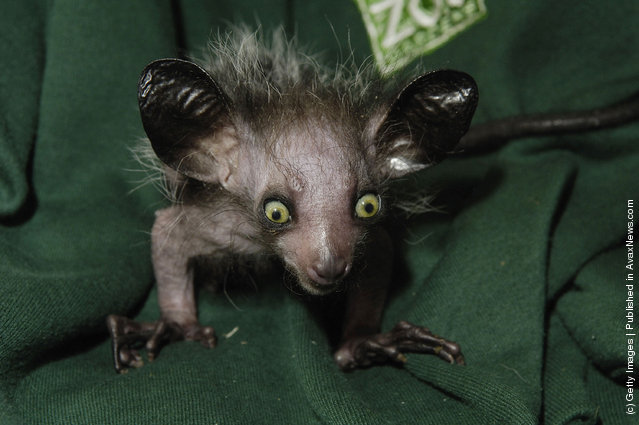
“The aye-aye (Daubentonia madagascariensis) is a lemur, a strepsirrhine primate native to Madagascar that combines rodent-like teeth and a special thin middle finger to fill the same ecological niche as a woodpecker. It is the world's largest nocturnal primate, and is characterized by its unusual method of finding food; it taps on trees to find grubs, then gnaws holes in the wood and inserts its narrow middle finger to pull the grubs out. The only other animal species known to find food in this way is the striped possum. From an ecological point of view the aye-aye fills the niche of a woodpecker as it is capable of penetrating wood to extract the invertebrates within”. – Wikipedia

Photo: In this handout image from Bristol Zoo is seen the first captive bred aye-aye in the UK named “Kintana” (meaning star in Malagasy) April 15, 2005 at Bristol Zoo Gardens, England. The zoo announced today only the second baby aye-aye to be hand-reared in the world (the first was in Jersey Zoo) and has now made his first public appearance since his birth on 11 February 2005. (Photo by Rob Cousins/Bristol Zoo via Getty Images)
Details
13 Apr 2011 13:33:00
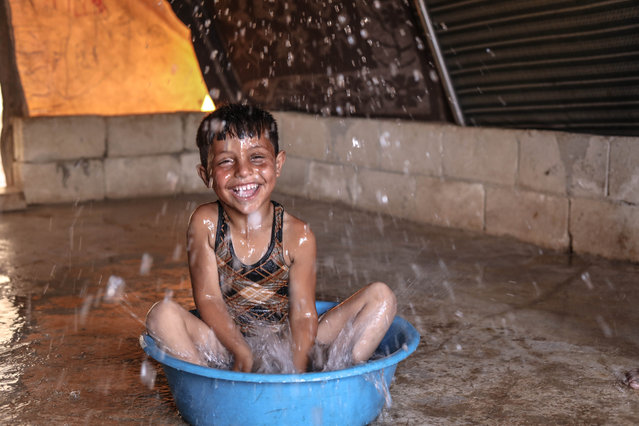
A child sitting in a washbowl filled with water cools himself as civilians struggle with protecting themselves from the dangers of extreme heat at the refugee camp, in Idlib, Syria on July 13, 2023. The civilians, who fled from the attacks of the Syrian Army, live under harsh conditions without infrastructure and electricity while the temperature reaches 47 Celsius in the region. (Photo by Izzeddin Kasim/Anadolu Agency via Getty Images)

A child sitting in a washbowl filled with water cools himself as civilians struggle with protecting themselves from the dangers of extreme heat at the refugee camp, in Idlib, Syria on July 13, 2023. The civilians, who fled from the attacks of the Syrian Army, live under harsh conditions without infrastructure and electricity while the temperature reaches 47 Celsius in the region. (Photo by Izzeddin Kasim/Anadolu Agency via Getty Images)
Details
02 Aug 2023 03:13:00
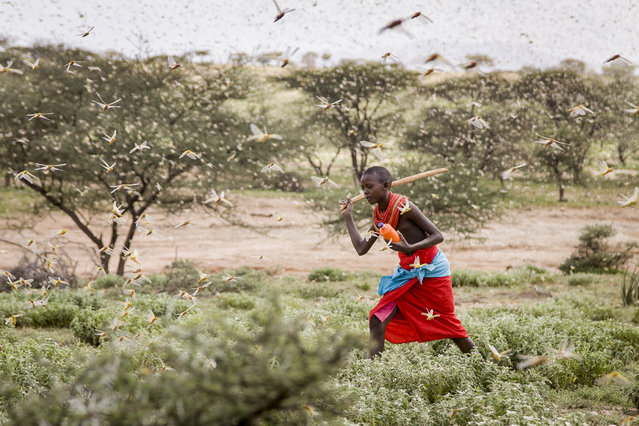
In this photo taken Thursday, January 16, 2020, a Samburu boy uses a wooden stick to try to swat a swarm of desert locusts filling the air, as he herds his camel near the village of Sissia, in Samburu county, Kenya. The most serious outbreak of desert locusts in 25 years is spreading across East Africa and posing an unprecedented threat to food security in some of the world's most vulnerable countries, authorities say, with unusual climate conditions partly to blame. (Photo by Patrick Ngugi/AP Photo)

In this photo taken Thursday, January 16, 2020, a Samburu boy uses a wooden stick to try to swat a swarm of desert locusts filling the air, as he herds his camel near the village of Sissia, in Samburu county, Kenya. The most serious outbreak of desert locusts in 25 years is spreading across East Africa and posing an unprecedented threat to food security in some of the world's most vulnerable countries, authorities say, with unusual climate conditions partly to blame. (Photo by Patrick Ngugi/AP Photo)
Details
19 Jan 2020 00:07:00
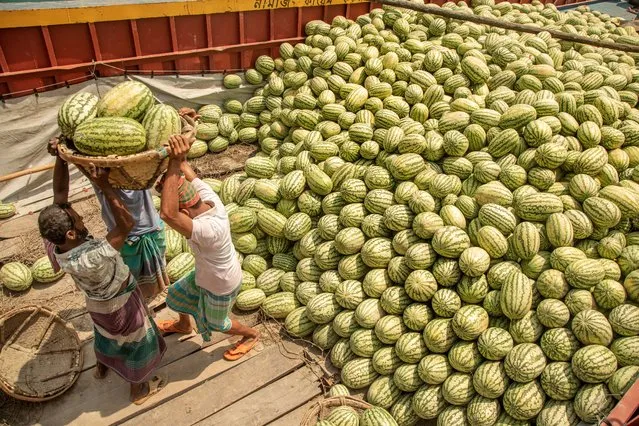
Bangladeshi laborers unload watermelons from a boat at the Buriganga River in Dhaka, Bangladesh, 03 April 2024. Watermelon is in harvesting season and is filling the city markets as it arrives from the southern part of Bangladesh. According to the Department of Agriculture Extension (DAE), Barishal has set an ambitious goal to expand watermelon cultivation to 54,002 hectares across six high-yielding districts in the division, which is 14 percent higher than last year. (Photo by Monirul Alam/EPA/EFE)

Bangladeshi laborers unload watermelons from a boat at the Buriganga River in Dhaka, Bangladesh, 03 April 2024. Watermelon is in harvesting season and is filling the city markets as it arrives from the southern part of Bangladesh. According to the Department of Agriculture Extension (DAE), Barishal has set an ambitious goal to expand watermelon cultivation to 54,002 hectares across six high-yielding districts in the division, which is 14 percent higher than last year. (Photo by Monirul Alam/EPA/EFE)
Details
19 Apr 2024 00:22:00
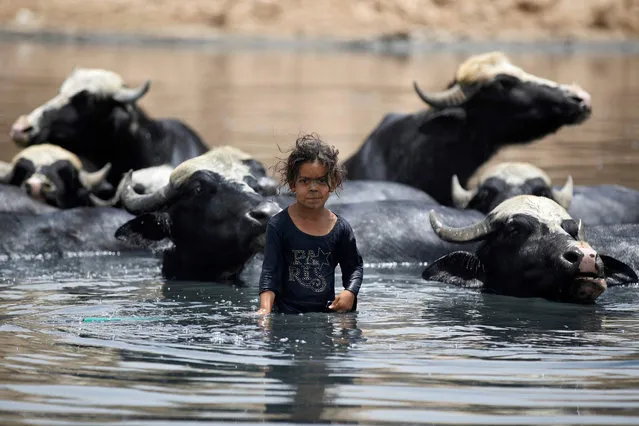
A young Iraqi shepherdess cools down buffaloes in wastewater filling the dried-up Diyala river which was a tributary of the Tigris, in the Al-Fadiliyah district east of Baghdad, on June 26, 2022. Iraq's drought reflects a decline in the level of waterways due to the lack of rain and lower flows from upstream neighboring countries Iran and Turkey. (Photo by Ahmad Al-Rubaye/AFP Photo)

A young Iraqi shepherdess cools down buffaloes in wastewater filling the dried-up Diyala river which was a tributary of the Tigris, in the Al-Fadiliyah district east of Baghdad, on June 26, 2022. Iraq's drought reflects a decline in the level of waterways due to the lack of rain and lower flows from upstream neighboring countries Iran and Turkey. (Photo by Ahmad Al-Rubaye/AFP Photo)
Details
07 Jul 2022 04:21:00