Loading...
Done
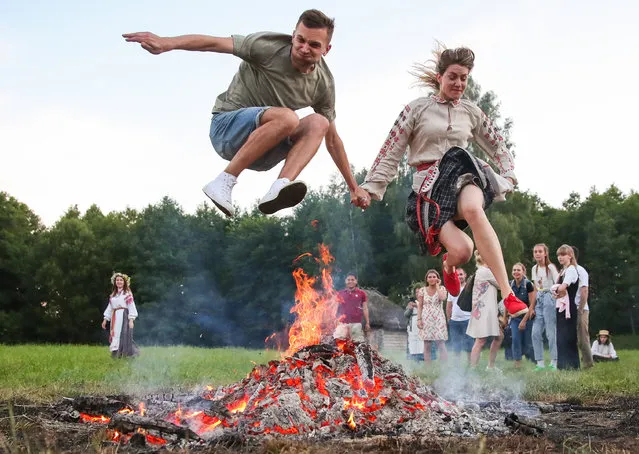
A man and a woman jump over a bonfire during Ivan Kupala Day celebrations held by the Belarusian State Museum of Folk Architecture and Rural Lifestyle in the village of Ozertso near Minsk, Belarus on July 4, 2020. Ivan Kupala Day, also known as Ivana-Kupala or Kupala Night, is a traditional pagan holiday celebrated in eastern Slavic cultures. Various rituals are traditionally performed on Kupala Night, including making flower wreaths, fortune-telling, jumping over bonfires, and burning a wheel-like effigy symbolizing the sun. (Photo by Natalia Fedosenko/TASS)

A man and a woman jump over a bonfire during Ivan Kupala Day celebrations held by the Belarusian State Museum of Folk Architecture and Rural Lifestyle in the village of Ozertso near Minsk, Belarus on July 4, 2020. Ivan Kupala Day, also known as Ivana-Kupala or Kupala Night, is a traditional pagan holiday celebrated in eastern Slavic cultures. Various rituals are traditionally performed on Kupala Night, including making flower wreaths, fortune-telling, jumping over bonfires, and burning a wheel-like effigy symbolizing the sun. (Photo by Natalia Fedosenko/TASS)
Details
07 Jul 2020 00:07:00
People remove mud and rocks from their house after a massive landslide in Chosica, March 24, 2015. Seven people were killed and more were feared dead in Peru after a massive landslide buried parts of a town amid heavy rains, authorities said on Tuesday. Six were missing and 25 injured in the disaster in Chosica, some 30 kilometers (18.6 miles) east of Lima, said Alfredo Murgueytio, the head of the National Civil Defense Institute, Indeci. (Photo by Mariana Bazo/Reuters)

People remove mud and rocks from their house after a massive landslide in Chosica, March 24, 2015. Seven people were killed and more were feared dead in Peru after a massive landslide buried parts of a town amid heavy rains, authorities said on Tuesday. Six were missing and 25 injured in the disaster in Chosica, some 30 kilometers (18.6 miles) east of Lima, said Alfredo Murgueytio, the head of the National Civil Defense Institute, Indeci. (Photo by Mariana Bazo/Reuters)
Details
25 Mar 2015 11:45:00
Kew Gardens employee Lauren Bird Royal examines the flowering of the Titan Arum lily at the Botanical Gardens

“The titan arum or Amorphophallus titanum (from Ancient Greek amorphos, “without form, misshapen” + phallos, “phallus”, and titan, “giant”) is a flowering plant with the largest unbranched inflorescence in the world. The titan arum's inflorescence is not as large as that of the Talipot palm, Corypha umbraculifera, but the inflorescence of the Talipot palm is branched rather than unbranched”. – Wikipedia

Photo: Kew Gardens employee Lauren Bird Royal examines the flowering of the Titan Arum lily at the Botanical Gardens at Kew on September 30, 2005 in London, England. For the first time in horticultural history, the Titan Arum lily can be seen at all three active stages in its lifecycle – in flower, fruit and leaf.The flowering corm is nearly three metres tall and weighs 91kg and is very rarely seen outside of the rainforests of Sumatra, Indonesia. (Photo by Scott Barbour/Getty Images)
Details
20 Sep 2011 11:13:00


“The Ainu (アイヌ?), also called Aynu, Aino (アイノ), and in historical texts Ezo (蝦夷), are indigenous people or groups in Japan and Russia. Historically they spoke the Ainu language and related varieties and lived in Hokkaidō, the Kuril Islands, and much of Sakhalin. Most of those who identify themselves as Ainu still live in this same region, though the exact number of living Ainu is unknown. This is due to ethnic issues in Japan resulting in those with Ainu backgrounds hiding their identities and confusion over mixed heritages. In Japan, because of intermarriage over many years with Japanese, the concept of a 'pure Ainu' ethnic group is no longer feasible. Official estimates of the population are of around 25,000, while the unofficial number is upwards of 200,000 people”. – Wkipedia

Photo: A captive bear drinking from a large bottle held by an Ainu tribeswoman. (Photo by Evans/Three Lions/Getty Images). Circa 1955
Details
24 Mar 2011 14:01:00
A model wears a creation from the Triya summer collection during Fashion Rio in Rio de Janeiro, Brazil, Friday, April 19, 2013. (Photo by Felipe Dana/AP Photo)

Felipe Dana discovered photography at age 15 when he started working as an assistant for event and commercial photographers. At the close of 2009, he decided to focus his career solely on photojournalism. Dana has focused his work on documenting the consequences of social changes in slums due to upcoming major sports events scheduled for 2014 and 2016 in Rio de Janeiro, where he currently lives and works as a staff photographer for The Associated Press. Photo: A model wears a creation from the Triya summer collection during Fashion Rio in Rio de Janeiro, Brazil, Friday, April 19, 2013. (Photo by Felipe Dana/AP Photo)
Details
15 May 2014 07:29:00
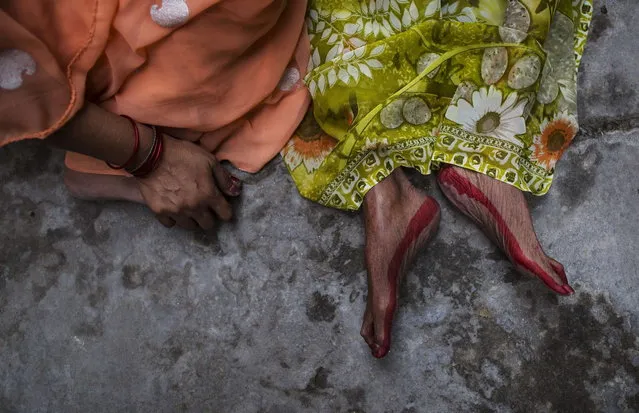
A relative (L) of Champa Devi, 88, sits next to her body, minutes after her death at Mukti Bhavan (Salvation House) at Varanasi, in the northern Indian state of Uttar Pradesh, June 21, 2014. (Photo by Danish Siddiqui/Reuters)

A relative (L) of Champa Devi, 88, sits next to her body, minutes after her death at Mukti Bhavan (Salvation House) at Varanasi, in the northern Indian state of Uttar Pradesh, June 21, 2014. The city of Varanasi, on the banks of the River Ganges, is widely considered Hinduism's holiest city and many Hindus believe that dying there and having their remains scattered in the Ganges allows their soul to escape a cycle of death and rebirth, attaining “moksha” or salvation. “Mukti Bhavan” or “Salvation House”, is a charity-run hostel that caters for people who wish to come to Varanasi to die. Guests can normally stay up to two weeks after which, if they haven't yet passed away, they are gently asked to leave. (Photo by Danish Siddiqui/Reuters)
Details
24 Jul 2014 12:32:00
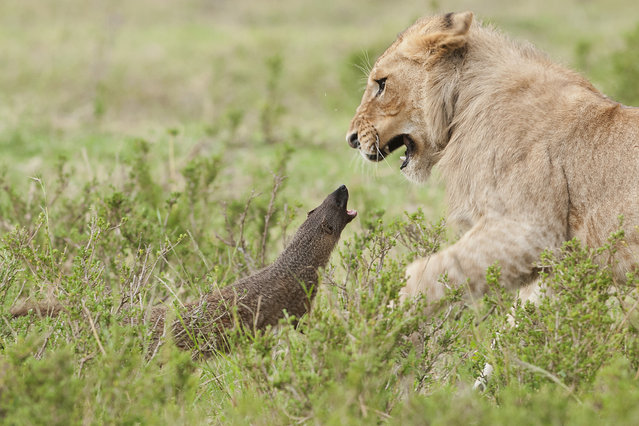
A mongoose growls at a startled lion on September 10, 2011 in Maasai Mara, Kenya. Four lions were left with their tails between their legs when a mongoose bravely took on the predators. Despite being under two feet tall, the aggressive mongoose growled at the felines and even bit one on the nose. (Photo by Jerome Guillaumot/Barcroft Media)

A mongoose growls at a startled lion on September 10, 2011 in Maasai Mara, Kenya. Four lions were left with their tails between their legs when a mongoose bravely took on the predators. Despite being under two feet tall, the aggressive mongoose growled at the felines and even bit one on the nose. The shocking fight, which was photographed in 2011 but has just been released, began in the Masaai Mara National Park, Kenya, when photographer Jerome Guillaumot came across four young lions surrounding the terrified marsh mongoose. The lions chased the mongoose into a hole in the ground but the small animal reemerged to fight the predators once again before running for cover. (Photo by Jerome Guillaumot/Barcroft Media)
Details
03 Sep 2014 10:33:00
Negin Ekhpulwak, leader of the Zohra orchestra, an ensemble of 35 women, practises on a piano at Afghanistan's National Institute of Music, in Kabul, Afghanistan April 9, 2016. (Photo by Ahmad Masood/Reuters)

Negin Ekhpulwak, leader of the Zohra orchestra, an ensemble of 35 women, practises on a piano at Afghanistan's National Institute of Music, in Kabul, Afghanistan April 9, 2016. Playing instruments was banned under Taliban rule in Afghanistan, and even today, many conservative Muslims frown on most forms of music. Living in an orphanage in the capital, Kabul, 19-year-old Negin Ikhpolwak leads an ensemble of 35 women that plays both Western and Afghan musical instruments. In a country notorious internationally for harsh restrictions on women in most areas of life, Negin's story highlights a double challenge. (Photo by Ahmad Masood/Reuters)
Details
19 Apr 2016 13:47:00