Loading...
Done
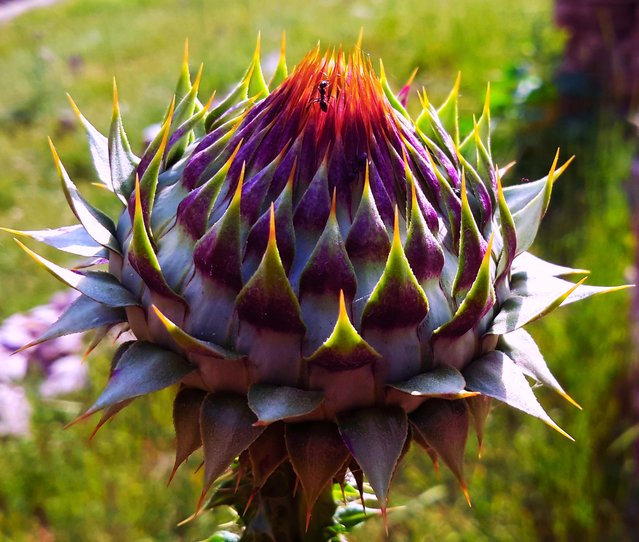
Flowers In The Wild By Adnan Mirani

The Plants like flower grow up in the wild. Spring 2014 near Paveh, Kermanshah, Iran
Details
23 Jul 2014 12:13:00
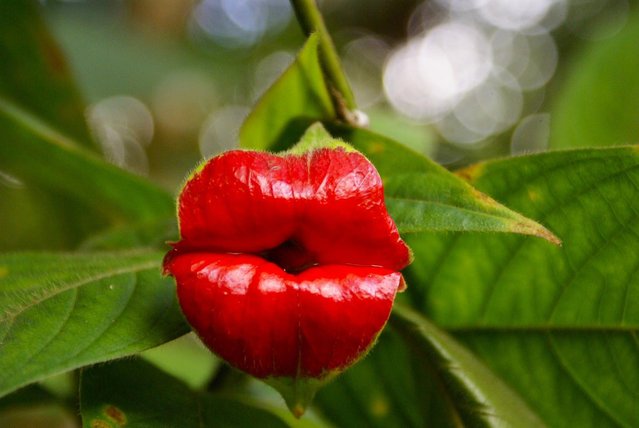
A Kiss From Mother Nature - Psychotria Elata

Psychotria is a genus containing some 1900 species within the plant family Rubiaceae. Members of the genus are small understorey trees in tropical forests. The former genus Cephaelis is considered a synomym of Psychotria.
Details
28 May 2013 10:07:00
Chernobyl

Scaffolding holding a remnant of the Soviet Union, the hammer and sickle, is seen on a rooftop of an abandoned building in the town of Pripyat on January 25, 2006 near Chernobyl, Ukraine. The town of Pripyat, deserted since the 1986 catastrophe, once housed 30,000 people, the majority of being workers from the Chernobyl Nuclear Power Plant. Days after the catastrophe the inhabitants were relocated to other locations in the Soviet Union. The town of Pripyat has remained uninhabited since. Prypyat and the surrounding area will not be safe for human habitation for several centuries. Scientists estimate that the most dangerous radioactive elements will take up to 900 years to decay sufficiently to render the area safe.
Details
14 Mar 2011 10:20:00


“With a fourth explosion rocking the Fukushima nuclear plant on Tuesday, danger of the spent nuke fuel pool boiling and radiation levels at the facility's gate increasing hundredfold, fears of a meltdown in Japan skyrocket”. – Russia Today

Photo: In this handout image provided by U.S. Navy, an aerial view of tsunami and earthquake damage is seen from an SH-60B helicopter assigned to the Chargers of Helicopter Antisubmarine Squadron (HS) 14 from Naval Air Facility Atsugi March 12, 2011 seen from the air of Sendai, Japan. (Photo by U.S. Navy via Getty Images)
Details
16 Mar 2011 10:19:00
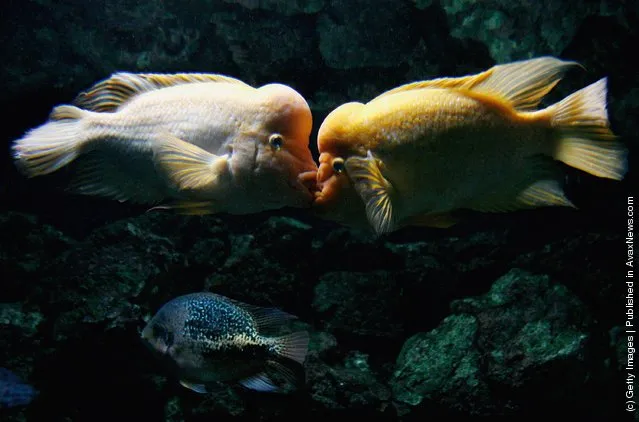
Midas Cichlid a.k.a. Amphilophus Citrinellus

“Amphilophus citrinellus is a large cichlid fish endemic to the San Juan River and adjacent watersheds in Costa Rica and Nicaragua. In the aquarium trade A. citrinellus is often sold under the trade name of Midas cichlid. A. citrinellus are omnivorous and their diet consists of plant material, molluscs and smaller fish”. – Wikipedia

Photo: Two Midas Cichlid (lat: amphilophus citrinellus) fish are seen in an aquarium at Hellabrunn zoo on December 23, 2009 in Munich, Germany. (Photo by Alexandra Beier/Getty Images)
Details
17 Aug 2011 11:29:00
Anti-nuclear activists demonstrate during a Say to Goodbye to Nuclear Energy protest in Kobe, Japan

Anti-nuclear activists demonstrate during a “Say to Goodbye to Nuclear Energy” protest on September 11, 2011 in Kobe, Japan. Japan is marking sixth months since a magnitude 9.0 earthquake struck Japan offshore on March 11 at 2:46pm local time, triggering a tsunami wave of up to ten metres which engulfed large parts of north-eastern Japan and also damaged the Fukushima nuclear plant, causing the worst nuclear crisis in decades. The current number of dead and missing is reportedly estimated to be 22,900. (Photo by Buddhika Weerasinghe/Getty Images)
Details
12 Sep 2011 10:16:00
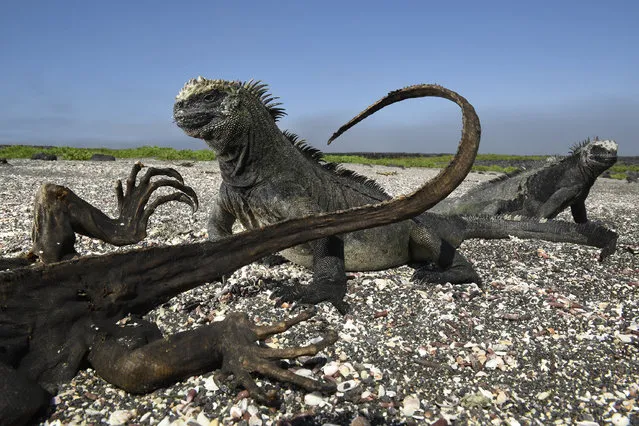
Galapagos – Rocking the Cradle: Four major ocean currents converge along the Galapagos archipelago, creating the conditions for an extraordinary diversity of animal life, April 25, 2016. The islands are home to at least 7,000 flora and fauna species, of which 97 percent of the reptiles, 80 percent of the land birds, 50 percent of the insects and 30 percent of the plants are endemic. The local ecosystem is highly sensitive to the changes in temperature, rainfall and ocean currents that characterize the climatic events known as El Niño and La Niña. These changes cause marked fluctuations in weather and food availability. Many scientists expect the frequency of El Niño and La Niña to increase as a result of climate change, making the Galapagos a possible early-warning location for its effects. (Photo by Thomas P. Peschak for National Geographic/World Press Photo)

Galapagos – Rocking the Cradle: Four major ocean currents converge along the Galapagos archipelago, creating the conditions for an extraordinary diversity of animal life, April 25, 2016. The islands are home to at least 7,000 flora and fauna species, of which 97 percent of the reptiles, 80 percent of the land birds, 50 percent of the insects and 30 percent of the plants are endemic. (Photo by Thomas P. Peschak for National Geographic/World Press Photo)
Details
16 Apr 2018 00:01:00
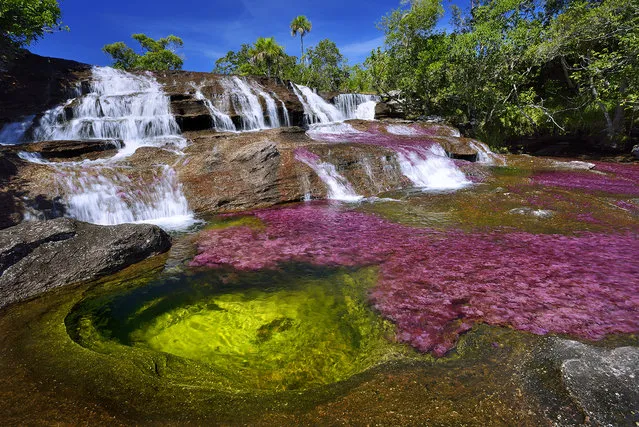
A waterfall is seen at the end of the rainy season, in August, when the water level finally decreases, in the Cano Cristales RIver in the Sierra de la Macarena in Colombia. It has become covered with a bright pink endemic aquatic plant, Macarenia Clavigera. (Photo by Olivier Grunewald)

“El rio mas bonito del Mundo”, the most beautiful river of the world, the “River of five colors”, the “Rainbow River”, or even the “Escaped from Paradise”, are the shimmering appellations that Colombians give to Cano Cristales, a small stream located in the heart of the Macarena National Park, 150 km (93 miles) south of Bogota. Photo: A waterfall is seen at the end of the rainy season, in August, when the water level finally decreases, in the Cano Cristales RIver in the Sierra de la Macarena in Colombia. It has become covered with a bright pink endemic aquatic plant, Macarenia Clavigera. (Photo by Olivier Grunewald)
Details
25 Mar 2014 15:15:00