Loading...
Done


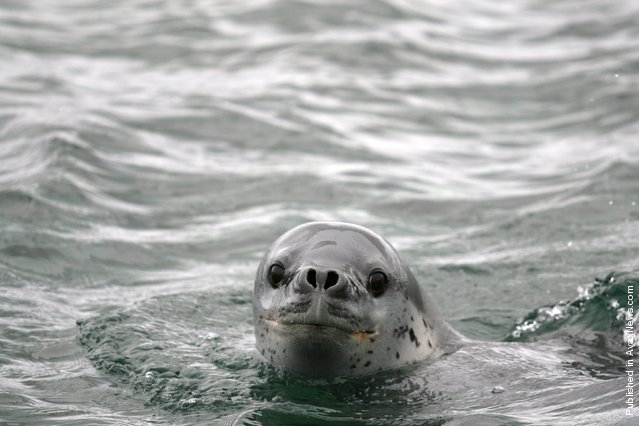
“The leopard seal (Hydrurga leptonyx), also referred to as the sea leopard, is the second largest species of seal in the Antarctic (after the southern elephant seal). It is most common in the southern hemisphere along the coast of Antarctica and on most sub-Antarctic islands, but can also be found on the coasts of southern Australia, Tasmania, South Africa, New Zealand, Lord Howe Island, Tierra del Fuego, the Cook Islands, and the Atlantic coast of South America. It can live twenty-six years, possibly more. Orcas and large sharks are the only natural predators of leopard seals”. – Wikipedia

Photo by: Gilad Rom; Source: Flickr
Details
13 Nov 2011 11:24:00
A contestant performs in wooden Pujllay dance shoes known as “ojotas”, in a contest to elect the Queen of Great Power, in La Paz, Bolivia, Friday, May 24, 2019. (Photo by Juan Karita/AP Photo)

A contestant performs in wooden Pujllay dance shoes known as “ojotas”, in a contest to elect the Queen of Great Power, in La Paz, Bolivia, Friday, May 24, 2019. The largest religious festival in the Andes choses its queen in a tight contest to head the Festival of the Lord Jesus of the Great Power, mobilizing thousands of dancers and more than 4,000 musicians into the streets of La Paz. (Photo by Juan Karita/AP Photo)
Details
27 May 2019 00:01:00


“The Daleks are a fictional extraterrestrial race of genetically manipulated mutants from the British science fiction television series Doctor Who. Various storylines portray them as having had every emotion removed except hate, leaving them with a desire to purge the Universe of all non-Dalek life. Collectively they are the greatest enemies of the series' protagonist, the Time Lord known as the Doctor. Their famous catchphrase is “Exterminate!”, with each syllable individually synthesised in a frantic electronic voice” – Wikipedia

Photo: Max Hardy, aged 6, stands by a street sign from the Doctor Who Experience as Dalek, from the cult television show Doctor Who watches him on April 16, 2011 in London, England. The Doctor Who Experience Exhibition is currently running at Kensington Olympia Two, celebrating the science fiction programme that was originally screened in 1963. (Photo by Matthew Lloyd/Getty Images for BBC Worldwide)
Details
04 May 2011 10:47:00
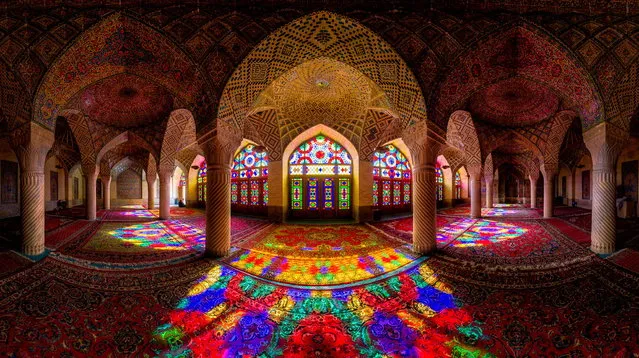
The Nasir Al-Mulk Mosque

The Nasīr al-Mulk Mosque or Pink Mosque is a traditional mosque in Shiraz, Iran, located in Goade-e-Araban place (near the famous Shah Cheragh mosque). The mosque was built during the Qājār era, and is still in use under protection by Nasir al Mulk's Endowment Foundation. It was built by the order of Mirza Hasan Ali Nasir al Molk, one of the lords of the Qajar Dynasty, in 1876 and was finished in 1888. The designers were Muhammad Hasan-e-Memar and Muhammad Reza Kashi Paz-e-Shirazi. The mosque extensively uses colored glass in its facade, and displays other traditional elements such as panj kāseh-i (five concaves) in its design, it is also named in popular culture as Pink Mosque due to the usage of beautiful pink color tiles for its interior design.
Details
26 Mar 2014 14:04:00
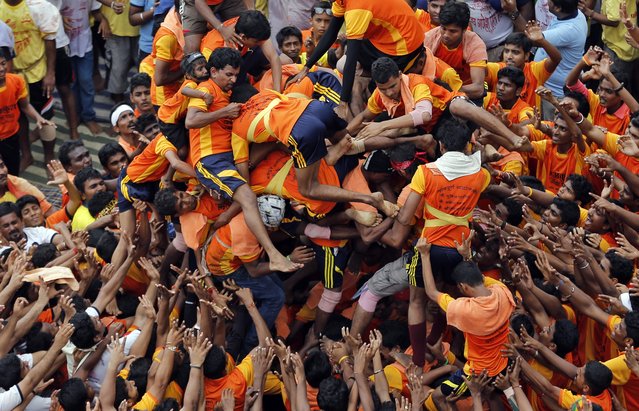
People fall down as they try to form a human pyramid to break the “Dahi handi”, an earthen pot filled with curd, an integral part of celebrations to mark Janmashtami in Mumbai, India, Monday, August 18, 2014. (Photo by Rafiq Maqbool/AP Photo)

People fall down as they try to form a human pyramid to break the “Dahi handi”, an earthen pot filled with curd, an integral part of celebrations to mark Janmashtami in Mumbai, India, Monday, August 18, 2014. Hindu devotees take part in the celebration in which an earthen pot is suspended high above the ground and groups of young men and children form a human pyramid to reach the pot and break it. The festival celebrates the birth of Hindu god Lord Krishna, one of the most popular gods in Hinduism. (Photo by Rafiq Maqbool/AP Photo)
Details
21 Aug 2014 09:38:00
An Indian artist gives the finishing touches to a figure of the elephant-headed Hindu god Ganesha at a workshop ahead of the Ganesh Chaturthi festival in New Delhi on September 15, 2015. (Photo by Sajjad Hussain/AFP Photo)

An Indian artist gives the finishing touches to a figure of the elephant-headed Hindu god Ganesha at a workshop ahead of the Ganesh Chaturthi festival in New Delhi on September 15, 2015. The idol is meant for the forthcoming festival Ganesha Chaturthi, a ten-day long event which is celebrated all over India. During the Ganpati festival, that is celebrated as the birthday of Lord Ganesha, idols of the Hindu deity are worshipped at hundreds of pandals or makeshift tents before they are immersed into water bodies. This year, the festival starts on 17 September 2015. (Photo by Sajjad Hussain/AFP Photo)
Details
17 Sep 2015 10:38:00
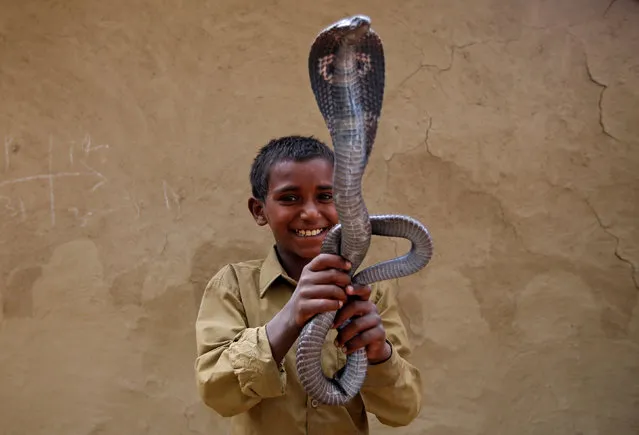
Ravi Nath poses for a photograph with a cobra snake in Jogi Dera (Snake charmers settlement), in the village of Baghpur, in the central state of Uttar Pradesh, India November 10, 2016. (Photo by Adnan Abidi/Reuters)

Ravi Nath poses for a photograph with a cobra snake in Jogi Dera (Snake charmers settlement), in the village of Baghpur, in the central state of Uttar Pradesh, India November 10, 2016. An ancient tribe of snake charmers, known as Saperas, have thrived over the generations by catching venomous snakes and making them dance to their music. Snakes are revered by Hindus in India and snake charmers are considered the followers of Lord Shiva, the blue-skinned Hindu god who is usually portrayed wearing a king cobra around his neck. (Photo by Adnan Abidi/Reuters)
Details
26 Jan 2017 13:06:00
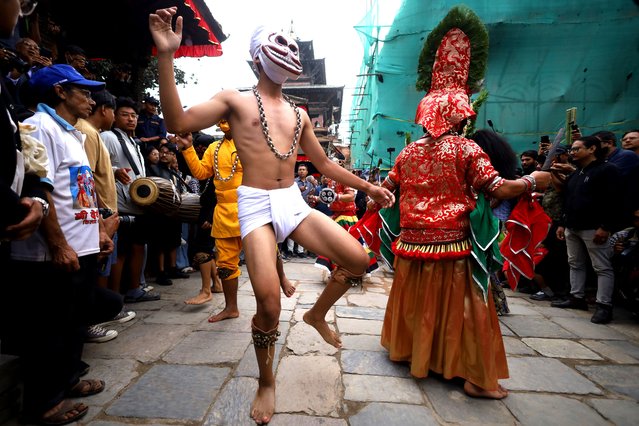
Masked dancers perform a ritualistic dance at Kathmandu Durbar Square during the procession of erecting a sacred pole locally called “Ya: Shi”, marking the formal start of Indra Jatra dedicated to rain god Indra in Kathmandu, Nepal, on September 15, 2024. The festival lasts for eight days with singing, mask dancing, and other rituals. Indra Jatra festival falls on the fourth day of the waxing moon in the month of Bhadra as per the lunar calendar. Legends say that the Indra Jatra festival observes the victory of the gods over the demons to release Jayanta, the son of Lord Indra. Indra, the god of rain, is worshiped in this festival primarily celebrated by the Newar communities following both Hinduism and Buddhism. (Photo by Subaas Shrestha/NurPhoto/Rex Features/Shutterstock)

Masked dancers perform a ritualistic dance at Kathmandu Durbar Square during the procession of erecting a sacred pole locally called “Ya: Shi”, marking the formal start of Indra Jatra dedicated to rain god Indra in Kathmandu, Nepal, on September 15, 2024. (Photo by Subaas Shrestha/NurPhoto/Rex Features/Shutterstock)
Details
24 Sep 2024 03:27:00