Loading...
Done
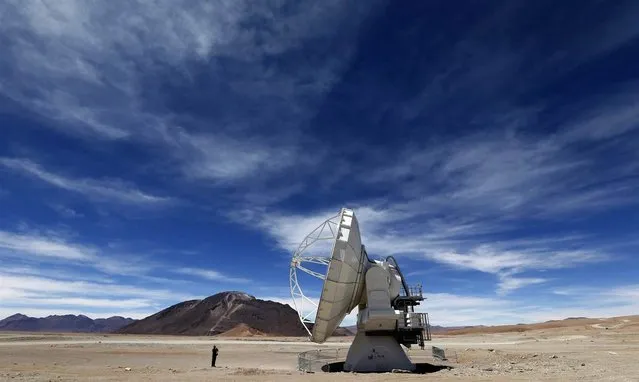
A man takes a photo of a radio antenna that's part of the Atacama Large Milimeter Array Observatory on March 12, 2013 at Llano de Chajnantor, about 43 miles (70 kilometers) from San Pedro de Atacama, Chile. The $1.5 billion ALMA facility, which had its official inauguration on March 13, is considered the world's most expensive ground-based observatory. (Photo by Felipe Trueba/EPA)

A man takes a photo of a radio antenna that's part of the Atacama Large Milimeter Array Observatory on March 12, 2013 at Llano de Chajnantor, about 43 miles (70 kilometers) from San Pedro de Atacama, Chile. The $1.5 billion ALMA facility, which had its official inauguration on March 13, is considered the world's most expensive ground-based observatory. (Photo by Felipe Trueba/EPA)
Details
03 Apr 2013 09:25:00
Tourists look at other festival-goers playing in the mud during the Boryeong Mud Festival at Daecheon beach in Boryeong, about 190 km (118 miles) southwest of Seoul, July 19, 2013. About 2 to 3 million domestic and international tourists visit the beach during the annual mud festival, according to the festival organisers. (Photo by Lee Jae-Won/Reuters)

Tourists look at other festival-goers playing in the mud during the Boryeong Mud Festival at Daecheon beach in Boryeong, about 190 km (118 miles) southwest of Seoul, July 19, 2013. About 2 to 3 million domestic and international tourists visit the beach during the annual mud festival, according to the festival organisers. (Photo by Lee Jae-Won/Reuters)
Details
21 Jul 2013 10:57:00
On August 31, 2012, a long filament of solar material that had been hovering in the sun's atmosphere, the corona, erupted out into space at 4:36 p.m. EDT. The coronal mass ejection, or CME, traveled at over 900 miles per second. The CME did not travel directly toward Earth, but did connect with Earth's magnetic environment, or magnetosphere, causing aurora to appear on the night of Monday, September 3. (Photo by NASA/GSFC/SDO)

On August 31, 2012, a long filament of solar material that had been hovering in the sun's atmosphere, the corona, erupted out into space at 4:36 p.m. EDT. The coronal mass ejection, or CME, traveled at over 900 miles per second. The CME did not travel directly toward Earth, but did connect with Earth's magnetic environment, or magnetosphere, causing aurora to appear on the night of Monday, September 3. (Photo by NASA/GSFC/SDO via The Atlantic)
Details
14 Sep 2012 09:01:00
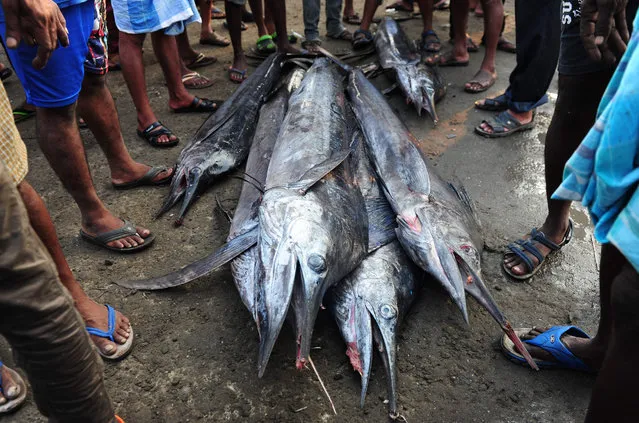
Indian men stand around sword fish for sale at a harbour a harbour in Chennai on June 5, 2016, as fishermen return with their catch after a 45-day fishing ban on the east coast of India. Authorities in the southern Indian state of Tamil Nadu had imposed a 45-day ban on fishing by mechanised vessels to protect marine life, with only “country boats” operating within five nautical miles off the coast. (Photo by Arun Sankar/AFP Photo)

Indian men stand around sword fish for sale at a harbour a harbour in Chennai on June 5, 2016, as fishermen return with their catch after a 45-day fishing ban on the east coast of India. Authorities in the southern Indian state of Tamil Nadu had imposed a 45-day ban on fishing by mechanised vessels to protect marine life, with only “country boats” operating within five nautical miles off the coast. (Photo by Arun Sankar/AFP Photo)
Details
06 Jun 2016 11:24:00
Brave slackliners have been pictured walking the ropes above Rio de Janeiro, Brazil on August 15, 2016, with the half a mile drop showing the city in all its glory. The stunning shots show the daredevils tread across an eighty-two-foot-long high line on Pedra da Gvea mountain with an amazing sunrise illuminating the city landscape behind. (Photo by Rafael Moura/Caters News Agency)

Brave slackliners have been pictured walking the ropes above Rio de Janeiro, Brazil on August 15, 2016, with the half a mile drop showing the city in all its glory. The stunning shots show the daredevils tread across an eighty-two-foot-long high line on Pedra da Gvea mountain with an amazing sunrise illuminating the city landscape behind. (Photo by Rafael Moura/Caters News Agency)
Details
25 Aug 2016 09:55:00
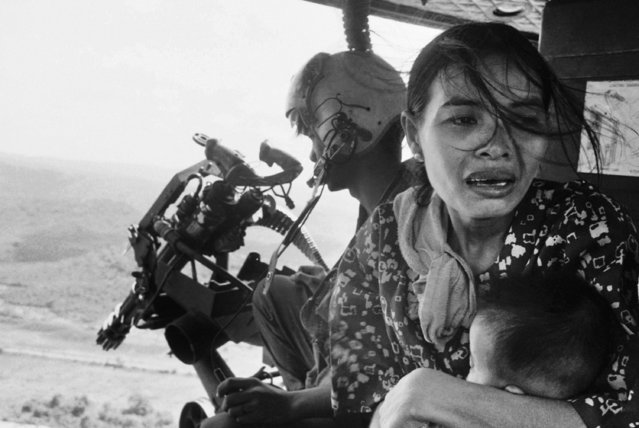
In this March 22, 1975 file photo, a refugee clutches a baby as a government helicopter gunship carries them away near Tuy Hoa, Vietnam, 235 miles northeast of Saigon. They were among thousands fleeing from Communist advances. (Photo by Nick Ut/AP Photo)

In this March 22, 1975 file photo, a refugee clutches a baby as a government helicopter gunship carries them away near Tuy Hoa, Vietnam, 235 miles northeast of Saigon. They were among thousands fleeing from Communist advances. AP Photographer Nick Ut will be retiring from the AP in March 2017 after 51 years of taking photographs from the front lines of the Vietnam War to the red carpets of Hollywood. (Photo by Nick Ut/AP Photo)
Details
14 Mar 2017 00:02:00
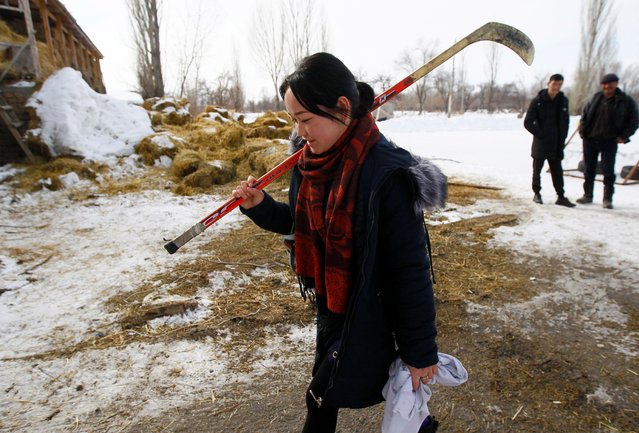
A member of Kyrgyzstan's first female hockey team arrives for a training session in the village of Otradnoye, Kyrgyzstan on February 4, 2020. Based in the remote village of Otradnoe, 249 miles (400 kilometres) east of the country's capital Bishkek, the team comprises of around 15 girls from a local school and uses a flooded allotment to train on during the winter months. (Photo by Vladimir Pirogov/Reuters)

A member of Kyrgyzstan's first female hockey team arrives for a training session in the village of Otradnoye, Kyrgyzstan on February 4, 2020. Based in the remote village of Otradnoe, 249 miles (400 kilometres) east of the country's capital Bishkek, the team comprises of around 15 girls from a local school and uses a flooded allotment to train on during the winter months. (Photo by Vladimir Pirogov/Reuters)
Details
12 Feb 2020 00:01:00
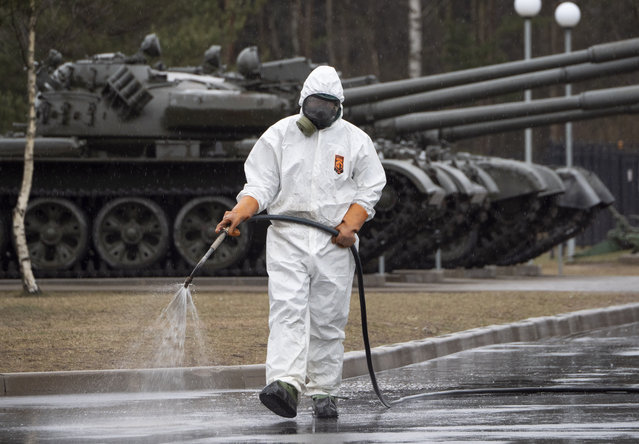
A specialist from a local veterinary service wears a protective suit as sprays disinfectant near Russian tanks displayed at area near Proryv (The Breakthrough) museum dedicated to the breakthrough of the Siege of Leningrad during World WarII near Kirovsk, about 30 kilometres (19 miles) east of St.Petersburg, Russia, Thursday, April 2, 2020. (Photo by Dmitri Lovetsky/AP Photo)

A specialist from a local veterinary service wears a protective suit as sprays disinfectant near Russian tanks displayed at area near Proryv (The Breakthrough) museum dedicated to the breakthrough of the Siege of Leningrad during World WarII near Kirovsk, about 30 kilometres (19 miles) east of St.Petersburg, Russia, Thursday, April 2, 2020. (Photo by Dmitri Lovetsky/AP Photo)
Details
13 Apr 2020 00:01:00