Loading...
Done
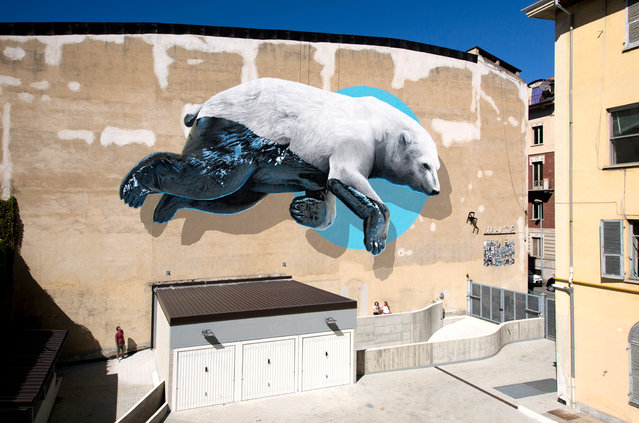
A polar bear whose bottom half is caked in oily black gunk. A whale wrapped in striped fabric: a pseudo straightjacket. These are the messes climate change leaves behind, the things we know are happening but often don’t have the opportunity to see with our own eyes. Swiss street art duo Christian Rebecchi and Pablo Togni, otherwise known as NeverCrew, met in art school when they were 15 and started making work together soon after. As a team, the artists adorn the world with eye-popping and gut-wrenching images depicting the consequences of humanity’s actions on earth. Here: “Black machine” mural painting and installation on the Colosseo theater in Turin, Italy, in September 2015. (Photo by NeverCrew/The Huffington Post)

A polar bear whose bottom half is caked in oily black gunk. A whale wrapped in striped fabric: a pseudo straightjacket. These are the messes climate change leaves behind, the things we know are happening but often don’t have the opportunity to see with our own eyes. Swiss street art duo Christian Rebecchi and Pablo Togni, otherwise known as NeverCrew, met in art school when they were 15 and started making work together soon after. As a team, the artists adorn the world with eye-popping and gut-wrenching images depicting the consequences of humanity’s actions on earth. (Photo by NeverCrew/The Huffington Post)
Details
13 Aug 2016 11:09:00
Animal Architects Bowerbirds Design

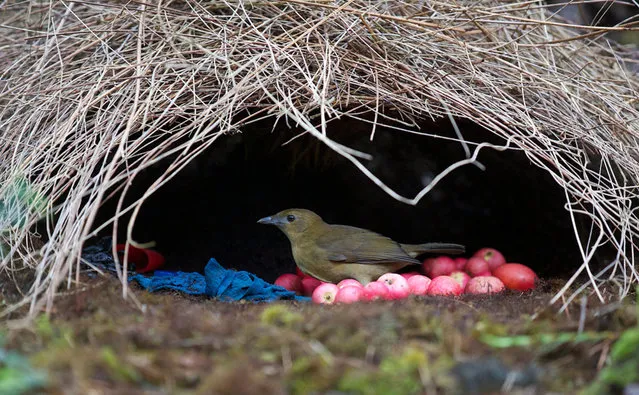
Turkeys strut, peacocks preen, and bowerbirds design. Of all the strange things that male birds do to attract a mate, the bowerbird's ritual is the only one that could make it into the MoMA. They use two distinct types of "architecture" and have a keen eye for color as well.
Details
05 Mar 2014 12:45:00
May. (Photo by Ami Vitale/2021 Lavazza Calendar)

With the world feeling more distant than ever, photographers were this year called on to translate their vision of the new humanity into images seen through their own eyes. Here: May. (Photo by Ami Vitale/2021 Lavazza Calendar)
Details
16 Nov 2020 00:03:00


Is it worth eating live beings? This is a philosophical question: the history of our species and the ontology of being are saying that it's more likely yes, and on the other hand your mind and empathy are more likely to be against this idea. Or at least like in this Korean clip – eat, but with tears in your eyes.
Details
05 Jan 2019 13:13:00


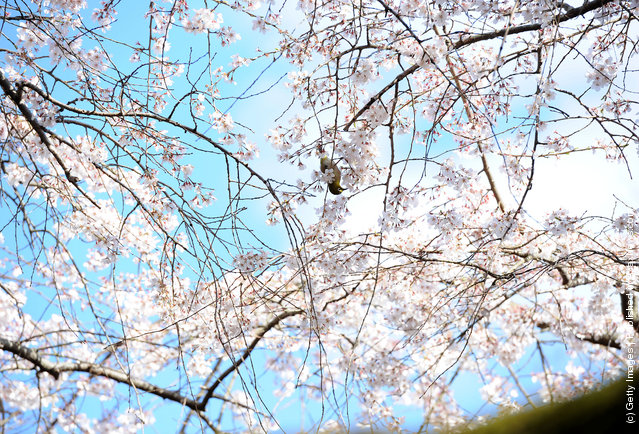
A Japanese white-eye is seen on a branch of cherry blossoms at Kyoto Imperial Palace on March 26, 2010 in Kyoto, Japan. (Photo by Akihiro I/Getty Images)
Details
26 Mar 2011 11:11:00
A young Chinese girl kicks during a kung-fu class at Ritan Park on June 11, 2016 in Beijing, China. Ritan, meaning “sun altar”, is among the oldest parks in Beijing, built in the early 1500s during the Ming dynasty for the emperor to make sacrifices to the sun. Less than half a kilometer square, Ritan these days is considered an oasis of green space in a sprawling city of skyscrapers, notorious air pollution, and a population of over 20 million people. Most Chinese live in small apartments with no access to gardens, leaving parks as a welcome haven for people, especially the elderly, to exercise, socialize, or enjoy a degree of privacy. (Photo by Kevin Frayer/Getty Images)

A young Chinese girl kicks during a kung-fu class at Ritan Park on June 11, 2016 in Beijing, China. Ritan, meaning “sun altar”, is among the oldest parks in Beijing, built in the early 1500s during the Ming dynasty for the emperor to make sacrifices to the sun. (Photo by Kevin Frayer/Getty Images)
Details
14 Jun 2016 13:01:00
Luling, Louisiana US. New evidence contradicts previous claims of the relative safety of glyphosate, the world’s most widely used herbicide, which is manufactured here. It is often used in conjunction with seeds that have been genetically modified to tolerate its application, meaning that anyone consuming these crops is eating a genetically modified plant, and whatever residue of the pesticide that remains. (Photo by J. Henry Fair/Industrial Scars/Papadakis Publisher)

Luling, Louisiana, US. New evidence contradicts previous claims of the relative safety of glyphosate, the world’s most widely used herbicide, which is manufactured here. It is often used in conjunction with seeds that have been genetically modified to tolerate its application, meaning that anyone consuming these crops is eating a genetically modified plant, and whatever residue of the pesticide that remains. (Photo by J. Henry Fair/Industrial Scars/Papadakis Publisher)
Details
25 Oct 2016 10:40:00
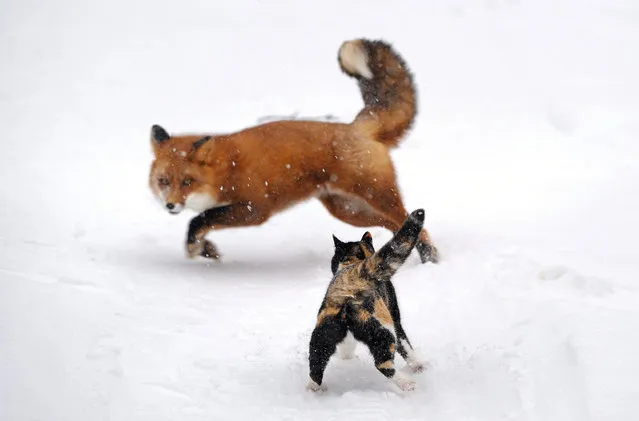
Respect, Kronotsky nature reserve, Russia. The photographer’s cat, Ryska – her name means little lynx in Russian – stands outside their cabin and with aggressive posturing warns off a fox. In winter, foxes would regularly visit the cabin searching for food. If one peered in at the window, possible when the snow was deep, Ryska would sit on the other side, fur raised, and growl. When outside, she would hold her ground. The foxes were not always frightened and so encounters could be a sort of dance. (Photo by Igor Shpilenok/Unforgettable Behaviour/NHM)

Respect, Kronotsky nature reserve, Russia. The photographer’s cat, Ryska – her name means little lynx in Russian – stands outside their cabin and with aggressive posturing warns off a fox. In winter, foxes would regularly visit the cabin searching for food. If one peered in at the window, possible when the snow was deep, Ryska would sit on the other side, fur raised, and growl. When outside, she would hold her ground. The foxes were not always frightened and so encounters could be a sort of dance. (Photo by Igor Shpilenok/Unforgettable Behaviour/NHM)
Details
08 Apr 2017 09:14:00