Loading...
Done
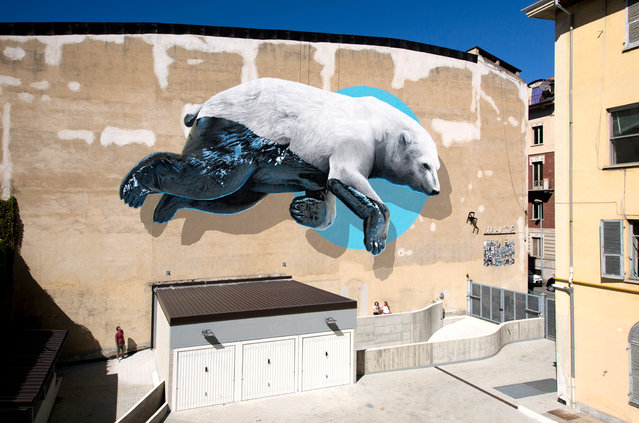
A polar bear whose bottom half is caked in oily black gunk. A whale wrapped in striped fabric: a pseudo straightjacket. These are the messes climate change leaves behind, the things we know are happening but often don’t have the opportunity to see with our own eyes. Swiss street art duo Christian Rebecchi and Pablo Togni, otherwise known as NeverCrew, met in art school when they were 15 and started making work together soon after. As a team, the artists adorn the world with eye-popping and gut-wrenching images depicting the consequences of humanity’s actions on earth. Here: “Black machine” mural painting and installation on the Colosseo theater in Turin, Italy, in September 2015. (Photo by NeverCrew/The Huffington Post)

A polar bear whose bottom half is caked in oily black gunk. A whale wrapped in striped fabric: a pseudo straightjacket. These are the messes climate change leaves behind, the things we know are happening but often don’t have the opportunity to see with our own eyes. Swiss street art duo Christian Rebecchi and Pablo Togni, otherwise known as NeverCrew, met in art school when they were 15 and started making work together soon after. As a team, the artists adorn the world with eye-popping and gut-wrenching images depicting the consequences of humanity’s actions on earth. (Photo by NeverCrew/The Huffington Post)
Details
13 Aug 2016 11:09:00
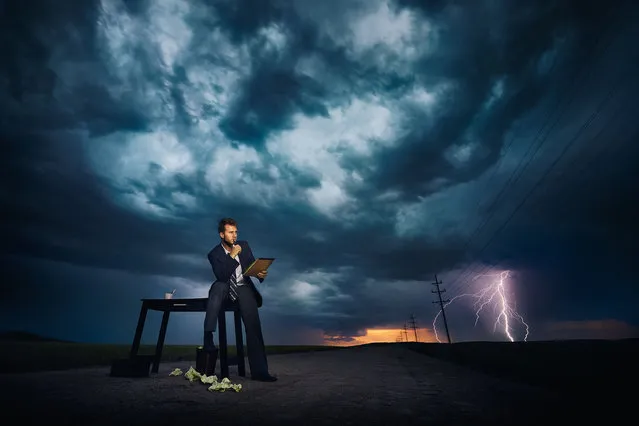
A thrill-seeking snapper has shot a powerful series of images featuring people carrying out everyday chores in front of giant storms. Benjamin Von Wong's surreal scenes include individuals ironing, barbecuing, playing video games and even sitting on the toilet – seemingly unaware of the threatening situations approaching. Here: Models pose in front of a storm in Cheyenne Wyoming. (Photo by Benjamin Von Wongs/Caters News)

A thrill-seeking snapper has shot a powerful series of images featuring people carrying out everyday chores in front of giant storms. Benjamin Von Wong's surreal scenes include individuals ironing, barbecuing, playing video games and even sitting on the toilet – seemingly unaware of the threatening situations approaching. The project was initiated to raise awareness about climate change, and the the storms appearing across six different states in the U.S. Von Wong, 29, started the project in Colorado, before traveling to South Dakota, Wyoming, Montana, North Dakota and Nebraska for the unusual images. Here: Models pose in front of a storm in Cheyenne Wyoming. (Photo by Benjamin Von Wongs/Caters News)
Details
08 Dec 2015 08:02:00
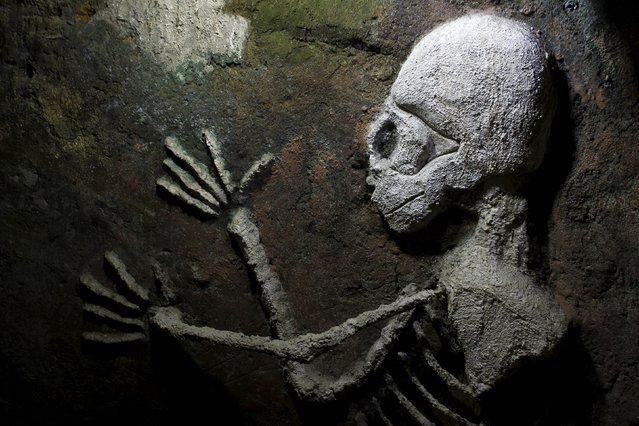
A figure of a skeleton is seen painted in a hallway of the house built underground by Manuel Barrantes in San Isidro de Perez Zeledon, Costa Rica, March 14, 2016. (Photo by Juan Carlos Ulate/Reuters)

A figure of a skeleton is seen painted in a hallway of the house built underground by Manuel Barrantes in San Isidro de Perez Zeledon, Costa Rica, March 14, 2016. Barrantes started digging through red soil and volcanic rock on his farm 12 years ago to build his subterranean house, between 15 and 63 feet (4.57 and 19.2m) underground. The dwelling, which Barrantes says provides a peaceful and comfortable home for him and his family away from noise pollution and the effects of climate change, now covers about 2,000 square feet (185.8 square metres). (Photo by Juan Carlos Ulate/Reuters)
Details
17 Mar 2016 15:34:00
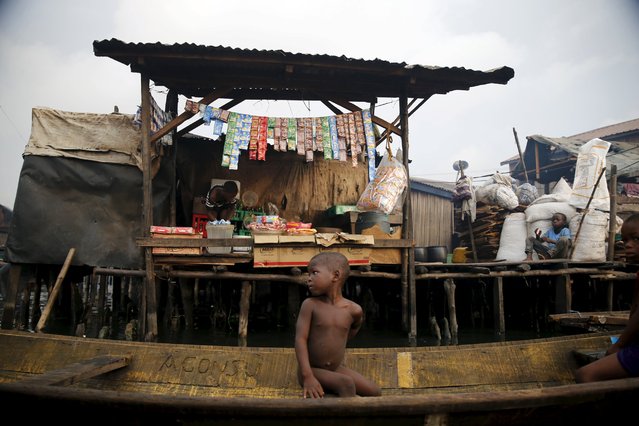
A boy sits in a canoe in front of a shed built on a raft in the Makoko fishing community on the Lagos Lagoon, Nigeria February 29, 2016. Makoko, a vast slum of houses on stilts in a Lagos lagoon, now boasts a new school – pyramid-shaped, floating and capable of withstanding the waterways' extreme weather, it is a beacon of hope for the nearly 100,000 Nigerians who live there.  (Photo by Akintunde Akinleye/Reuters)

A boy sits in a canoe in front of a shed built on a raft in the Makoko fishing community on the Lagos Lagoon, Nigeria February 29, 2016. In Makoko, a sprawling slum of Nigeria's megacity Lagos, a floating school capable of holding up to a hundred pupils has since November brought free education to the waterways known as the Venice of Lagos. It offers the chance of social mobility for youngsters who, like most of the city's 21 million inhabitants, lack a reliable electricity and water supply and whose water-based way of life is threatened by climate change as well as rapid urbanisation. (Photo by Akintunde Akinleye/Reuters)
Details
05 Mar 2016 12:01:00
A model wears a creation from the Triya summer collection during Fashion Rio in Rio de Janeiro, Brazil, Friday, April 19, 2013. (Photo by Felipe Dana/AP Photo)

Felipe Dana discovered photography at age 15 when he started working as an assistant for event and commercial photographers. At the close of 2009, he decided to focus his career solely on photojournalism. Dana has focused his work on documenting the consequences of social changes in slums due to upcoming major sports events scheduled for 2014 and 2016 in Rio de Janeiro, where he currently lives and works as a staff photographer for The Associated Press. Photo: A model wears a creation from the Triya summer collection during Fashion Rio in Rio de Janeiro, Brazil, Friday, April 19, 2013. (Photo by Felipe Dana/AP Photo)
Details
15 May 2014 07:29:00
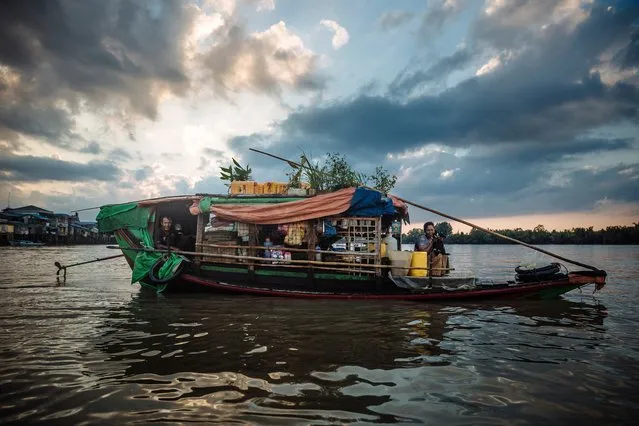
Tin and Naing win live on a small boat which they sail throughout the Delta region in Myanmar. The former gardeners once had a home on land but it was destroyed when a powerful cyclone ravaged the area in 2008. Since then, the couple have not been able to afford to rebuild their home, so they live on the boat from which they sell fish paste to make a living. (Photo by Muse Mohammed/IOM)

The ferocity of crises worldwide is forcing a record number of people to flee their homes, seeking some form of safety within their own country or across international borders. There are 65.3 million displaced people worldwide, including 21.3 million refugees. Most have lost their homes to armed conflict or natural disasters but other factors, such as extreme poverty and climate change, also drive displacement. The International Organisation for Migration commissioned photojournalist Muse Mohammed to document the plight of the displaced. (Photo by Muse Mohammed/IOM)
Details
02 Jan 2017 12:04:00
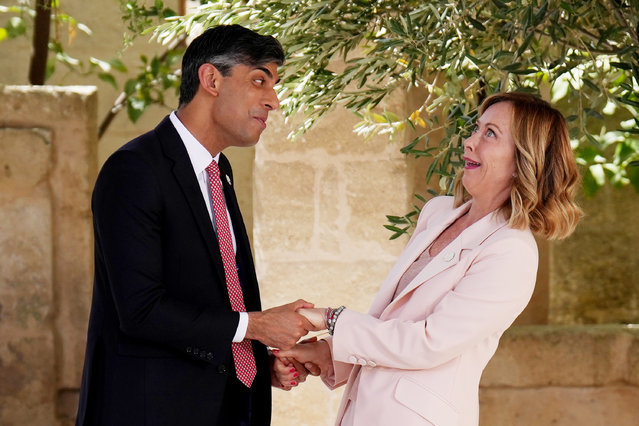
British Prime Minister Rishi Sunak is greeted by Italian Prime Minister Giorgia Meloni during a welcome ceremony on day one of the 50th G7 summit at Borgo Egnazia on June 13, 2024 in Fasano, Italy. The G7 summit in Puglia, hosted by Italian Prime Minister Giorgia Meloni, the seventh held in Italy, gathers leaders from the seven member states, the EU Council, and the EU Commission. Discussions will focus on topics including Africa, climate change, development, the Middle East, Ukraine, migration, Indo-Pacific economic security, and artificial intelligence. (Photo by Christopher Furlong/Getty Images)

British Prime Minister Rishi Sunak is greeted by Italian Prime Minister Giorgia Meloni during a welcome ceremony on day one of the 50th G7 summit at Borgo Egnazia on June 13, 2024 in Fasano, Italy. The G7 summit in Puglia, hosted by Italian Prime Minister Giorgia Meloni, the seventh held in Italy, gathers leaders from the seven member states, the EU Council, and the EU Commission. (Photo by Christopher Furlong/Getty Images)
Details
16 Jun 2024 06:00:00
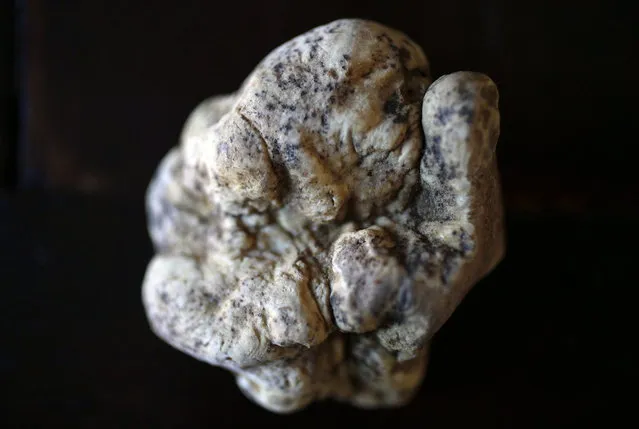
A truffle is seen on a table in Alba, north-western Italy November 11, 2013. Located in the heart of the Langhe – the hilly southern area of Italy's northwestern Piedmont region – Alba is the country's capital of white truffles, a variety of the prized fungus which grows underground. Truffles are found two to eight inches (5-20cm) below the ground near the roots of trees. (Photo by Stefano Rellandini/Reuters)

A truffle is seen on a table in Alba, north-western Italy November 11, 2013. Located in the heart of the Langhe – the hilly southern area of Italy's northwestern Piedmont region – Alba is the country's capital of white truffles, a variety of the prized fungus which grows underground. Truffles are found two to eight inches (5-20cm) below the ground near the roots of trees. They give off an odour which lasts for a limited period of time and can be detected with the assistance of well-trained dogs and experienced hunters. Output of white truffles, which are not cultivated and only grow naturally in forests, has fallen in Italy over the past few years, largely because climate change has brought a damaging mix of drought and torrential rains. (Photo by Stefano Rellandini/Reuters)
Details
31 Dec 2013 11:22:00