Loading...
Done
People exercise in Primrose Hill in London, Britain, 20 March 2025. The first day of spring in the UK astronomically occurs on the vernal equinox where earth's axis is not tilted towards or away from the sun, resulting in an equal amount of day and night on all latitudes. (Photo by Neil Hall/EPA/EFE)

People exercise in Primrose Hill in London, Britain, 20 March 2025. The first day of spring in the UK astronomically occurs on the vernal equinox where earth's axis is not tilted towards or away from the sun, resulting in an equal amount of day and night on all latitudes. (Photo by Neil Hall/EPA/EFE)
Details
10 Apr 2025 03:03:00
A Nepalese woman pours milk as she offers prayers to the setting Sun on the banks of the Bagmati River during the Chhath Puja festival in Kathmandu, Nepal, Sunday, November 6, 2016. During Chhath, an ancient Hindu festival, rituals are performed to thank the Sun God for sustaining life on earth. (Photo by Niranjan Shrestha/AP Photo)

A Nepalese woman pours milk as she offers prayers to the setting Sun on the banks of the Bagmati River during the Chhath Puja festival in Kathmandu, Nepal, Sunday, November 6, 2016. During Chhath, an ancient Hindu festival, rituals are performed to thank the Sun God for sustaining life on earth. (Photo by Niranjan Shrestha/AP Photo)
Details
08 Nov 2016 11:30:00
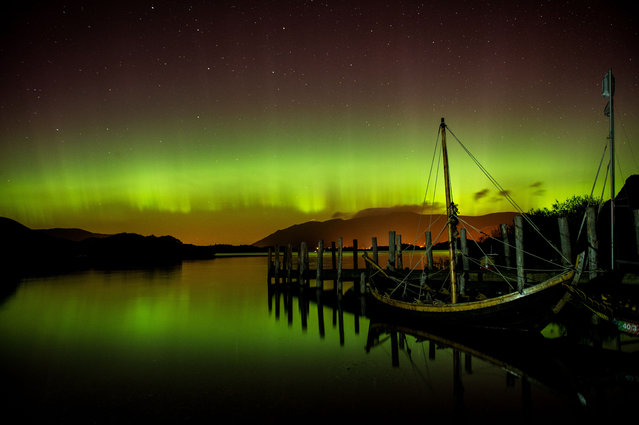
The aurora borealis, or the northern lights occur over Derwentwater, near Keswick, England, Thursday October 8, 2015. The northern lights are the result of collisions between gaseous particles in the Earth's atmosphere with charged particles released from the sun. (Photo by Owen Humphreys/PA via AP Photo)

The aurora borealis, or the northern lights occur over Derwentwater, near Keswick, England, Thursday October 8, 2015. The northern lights are the result of collisions between gaseous particles in the Earth's atmosphere with charged particles released from the sun. (Photo by Owen Humphreys/PA Wire via AP Photo)
Details
15 Oct 2015 08:06:00
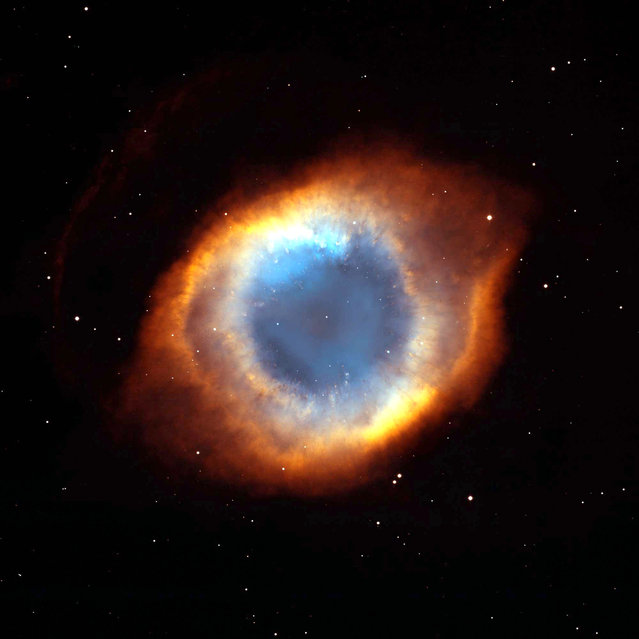
A coil-shaped Helix Nebula showing a fine web of filamentary “bicycle-spoke” features embedded in the colorful red and blue ring of gas. At 650 light-years away, the Helix is one of the nearest planetary nebulae to Earth. A planetary nebula is the glowing gas around a dying, Sun-like star. (Photo by Reuters/NASA)

A coil-shaped Helix Nebula showing a fine web of filamentary “bicycle-spoke” features embedded in the colorful red and blue ring of gas. At 650 light-years away, the Helix is one of the nearest planetary nebulae to Earth. A planetary nebula is the glowing gas around a dying, Sun-like star. (Photo by Reuters/NASA)
Details
22 Oct 2014 14:01:00
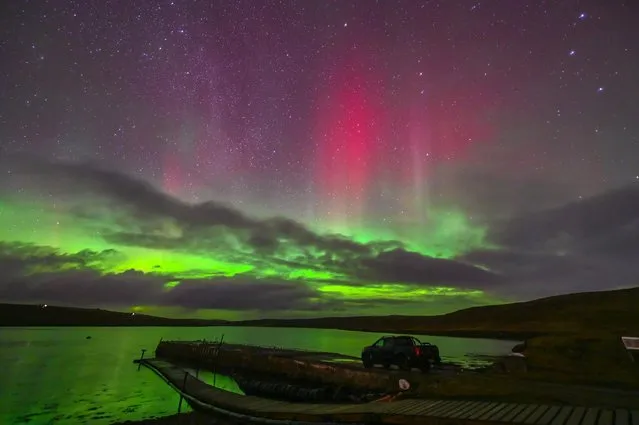
The northern lights as seen from from Yell in the Shetland Islands, Scotland on January 15, 2023. The aurora borealis is caused by collisions between electrically charged particles released from the sun that enter the Earth’s atmosphere and collide with gases such as oxygen and nitrogen. (Photo by Ryan Nisbet/Capture Media Agency)

The northern lights as seen from from Yell in the Shetland Islands, Scotland on January 15, 2023. The aurora borealis is caused by collisions between electrically charged particles released from the sun that enter the Earth’s atmosphere and collide with gases such as oxygen and nitrogen. (Photo by Ryan Nisbet/Capture Media Agency)
Details
23 Feb 2023 04:42:00
English social media influencer Grace Keeling, aka GK Barry, won over jungle viewers on I'm A Celeb with her down-to-earth personality to finish in fifth place. Grace went from being a normal student to having more than 4 million followers on TikTok. (Photo by Mark Hayman)

English social media influencer Grace Keeling, aka GK Barry, won over jungle viewers on I'm A Celeb with her down-to-earth personality to finish in fifth place. Grace went from being a normal student to having more than 4 million followers on TikTok. (Photo by Mark Hayman)
Details
02 Feb 2025 04:05:00
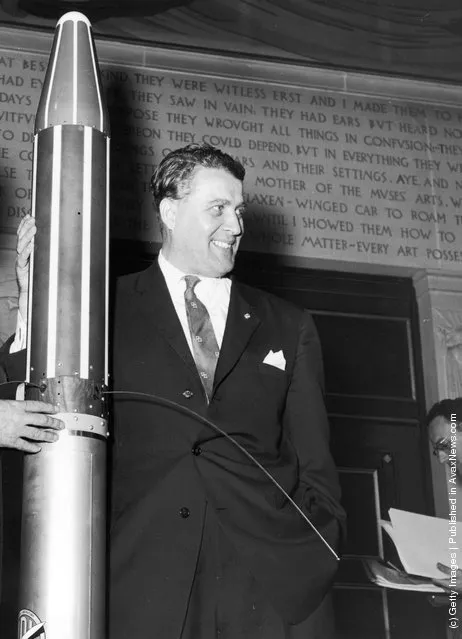
German-born American engineer Dr Wernher von Braun (1912 - 1977) with a model of the Explorer orbiting space satellite which he designed, 1958

“Wernher Magnus Maximilian Freiherr von Braun (March 23, 1912 – June 16, 1977) was a German-born rocket scientist, aerospace engineer, space architect, and one of the leading figures in the development of rocket technology in Nazi Germany during World War II and, subsequently, the United States”. – Wikipedia

Photo: German-born American engineer Dr. Wernher von Braun with a model of the Explorer orbiting space satellite which he designed. (Photo by Keystone/Getty Images). 1958
Details
22 Mar 2012 11:18:00
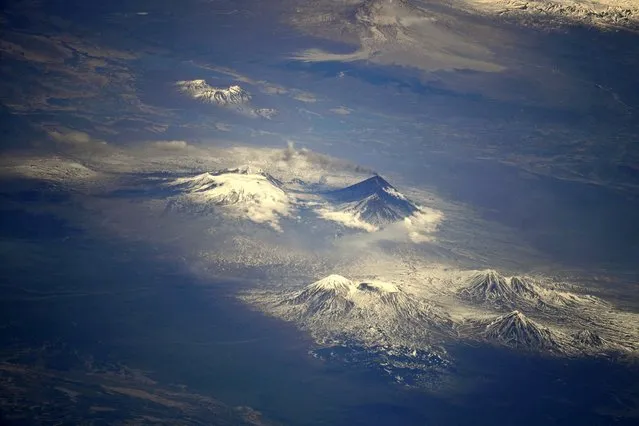
Kamchatka

Kamchatka

Oleg Valeriyevich Kotov was born October 27, 1965, in Simferopol, Crimean oblast in Ukrainian SSR. After a career as a physican assigned to space program, he joined the Russian cosmonaut corps. He has flown two long duration spaceflight on the International Space Station logging just short of a year in space. Kotov is currently assigned to the Soyuz TMA-10M/Expedition 37/Expedition 38 long duration spaceflight scheduled for 2013-2014.
Details
03 Apr 2015 09:25:00