Loading...
Done
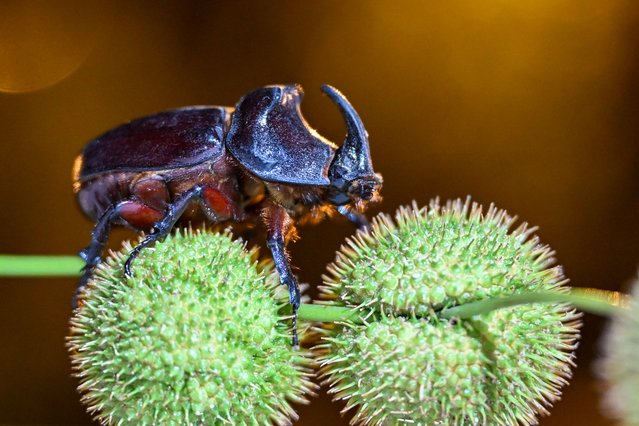
A “Rhino Beetle” (Oryctes nasicornis) is seen in Edremit, Van, Turkiye on August 2, 2024. Named “Rhino Beetle” due to the horn on its head, this beetle is commonly found in moist areas across Europe and Turkiye. (Photo by Ozkan Bilgin/Anadolu via Getty Images)

A “Rhino Beetle” (Oryctes nasicornis) is seen in Edremit, Van, Turkiye on August 2, 2024. Named “Rhino Beetle” due to the horn on its head, this beetle is commonly found in moist areas across Europe and Turkiye. (Photo by Ozkan Bilgin/Anadolu via Getty Images)
Details
24 Aug 2024 04:43:00
A girls’ Friday night out on the town, in Bristol, England, 2009. As in most big cities in the UK, around the weekend you see women with very minimal clothing on, wandering around regardless of the temperature. (Photo by Martin Parr/Magnum Photos)

A girls’ Friday night out on the town, in Bristol, England, 2009. As in most big cities in the UK, around the weekend you see women with very minimal clothing on, wandering around regardless of the temperature. (Photo by Martin Parr/Magnum Photos)
Details
26 Oct 2025 05:28:00
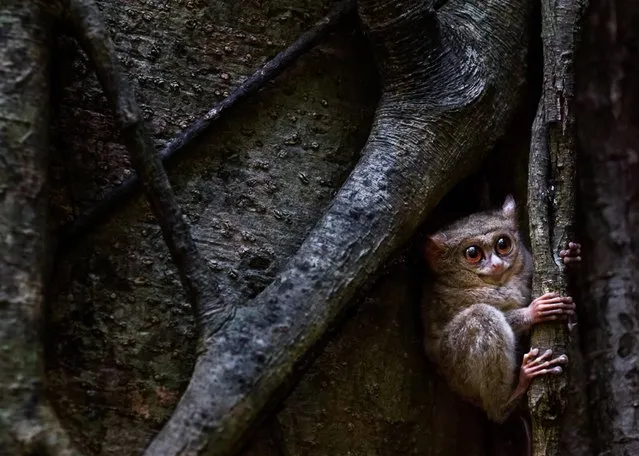
“Spectral Tarsier”. Tangkoko, Northern Sulawesi, Indonesia: Spectral tarsier by Wolfgang Weinhardt. (Photo and caption by Wolfgang Weinhardt/UK Society of Biology Photography Award 2014)

From rural life in India to a chick growing inside its embryo and a sea turtle eating a purple jellyfish, the Society of Biology has released their stunning photography competition shortlist. Here: “Spectral Tarsier”. Tangkoko, Northern Sulawesi, Indonesia: Spectral tarsier by Wolfgang Weinhardt. (Photo and caption by Wolfgang Weinhardt/UK Society of Biology Photography Award 2014)
Details
06 Oct 2014 09:20:00
“The Skeleton Krewe 2013 – Manning”. (Kevin O'Mara)

“The Skeleton Krewe was founded in 1999 by Christopher Kirsch. Inspired by the early days of Carnival before tractors and floats replaced walking processions, the Krewe has become one of New Orleans' premier marching clubs. The Krewe began actively marching as a small group of friends, but has grown to 40 active members”. – The Skeleton Krewe. Photo: “The Skeleton Krewe 2013 – Manning”. (Photo by Kevin O'Mara)
Details
29 Oct 2013 11:56:00
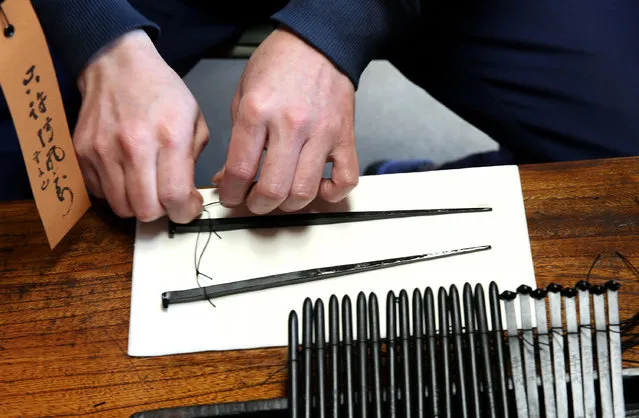
Myouchin Munehisa, 44, as he finishes Hibashi iron bells made of iron on a production line at Myochin Honpo shop on April 25, 2014 in Himeji, Japan. (Photo by Buddhika Weerasinghe/Getty Images)

Myouchin Munehisa, 44, as he finishes Hibashi iron bells made of iron on a production line at Myochin Honpo shop on April 25, 2014 in Himeji, Japan. Myochin family's iron business, started in the Heian period (794-1185) of Japan as an armor and helmet maker, shifted as the needs of people changed in the course of history. (Photo by Buddhika Weerasinghe/Getty Images)
Details
27 Apr 2014 06:29:00
An amazing example of his mixed style. (Photo by Jay Freestyle/360 Media Solutions)

Tattooist Jay Freestyle, who is based in Amsterdam, creates what only can be described as works of art that last forever on his clients' skin. His style is freehand – without any sketch or stencil and he inks the incredible drawings straight onto body parts. They might look expertly planned, but the swashes of colour, detailed line work and geometric shapes are all the result of some clever improvisation. Photo: An amazing example of his mixed style. (Photo by Jay Freestyle/360 Media Solutions)
Details
26 May 2014 13:54:00
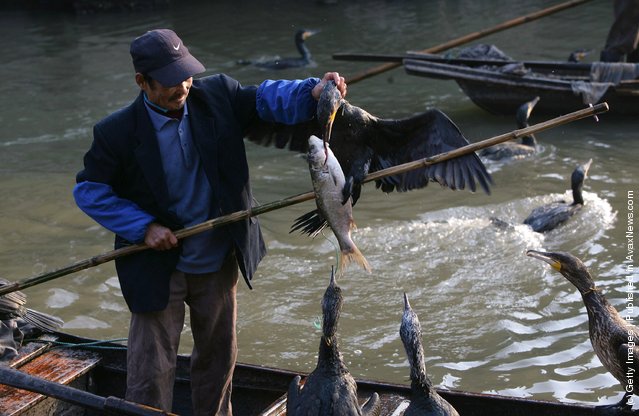
Cormorant Fishing

“Cormorant fishing is a traditional fishing method in which fishermen use trained cormorants to fish in rivers. Historically, cormorant fishing has taken place in Japan and China from around 960 AD. and recorded from other places throughout the world”. – Wikipedia

Photo: A cormorant raised by a fisherman catches a fish on a canal on November 27, 2007 in Xitang Town of Jiashan County, Zhejiang Province, China. (Photo by China Photos/Getty Images)
Details
07 Oct 2011 09:34:00
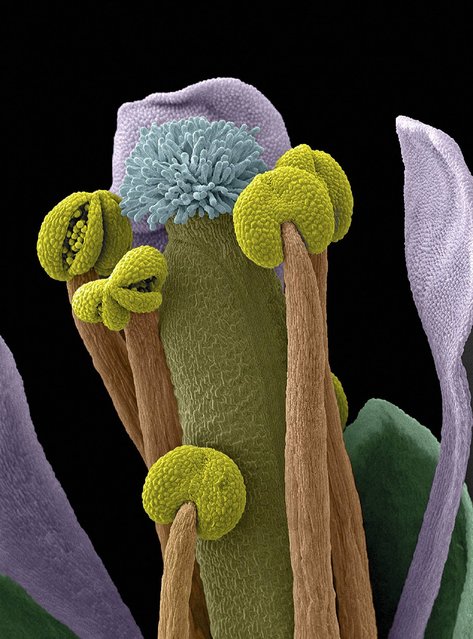
Scanning electron micrograph (SEM) of an Arabidopsis thaliana flower, also commonly known as thale cress. Some of the anthers are open, revealing pollen grains ready for dispersal. Arabidopsis was the first plant to have its entire genome sequenced and is widely used as a model organism in molecular and plant biology. Horizontal width of image is 1200 microns. Magnification 100x. (Photo by Stefan Eberhard/Wellcome Images)

Beautiful, strange and occasionally alarming pictures from the shortlist for this year’s Wellcome image awards – which celebrate the very best in science photography and imaging – from an x-ray of a bat to a micrograph of a kidney stone. The exhibition opens on 12 March at three science centres and the Museum of Science and Industry in Manchester. Photo: Scanning electron micrograph (SEM) of an Arabidopsis thaliana flower, also commonly known as thale cress. Some of the anthers are open, revealing pollen grains ready for dispersal. Arabidopsis was the first plant to have its entire genome sequenced and is widely used as a model organism in molecular and plant biology. Horizontal width of image is 1200 microns. Magnification 100x. (Photo by Stefan Eberhard/Wellcome Images)
Details
11 Mar 2014 05:58:00