Loading...
Done
A child marches in the Lunar New Year Parade in the Chinatown neighborhood of Washington, DC, on January 22, 2023. 2023 is the year of the rabbit in the Chinese horoscope. (Photo by Stefani Reynolds/AFP Photo)

A child marches in the Lunar New Year Parade in the Chinatown neighborhood of Washington, DC, on January 22, 2023. 2023 is the year of the rabbit in the Chinese horoscope. (Photo by Stefani Reynolds/AFP Photo)
Details
30 Jan 2023 23:26:00
Brad Snead walks past melting ice on the Cook Inlet beach, Saturday, March 26, 2011, in Kenai, Alaska, while looking for agates

Brad Snead walks past melting ice on the Cook Inlet beach, Saturday, March 26, 2011, in Kenai, Alaska, while looking for agates. (AP Photo/Peninsula Clarion, M. Scott Moon)
Details
11 Apr 2012 12:18:00
Ryon Healy #25 of the Oakland Athletics is covered in water by Adam Rosales #16 after he hit a walk-off home run in the ninth inning against the Detroit Tigers at Oakland Alameda Coliseum on May 7, 2017 in Oakland, California. (Photo by Ezra Shaw/Getty Images)

Ryon Healy #25 of the Oakland Athletics is covered in water by Adam Rosales #16 after he hit a walk-off home run in the ninth inning against the Detroit Tigers at Oakland Alameda Coliseum on May 7, 2017 in Oakland, California. (Photo by Ezra Shaw/Getty Images)
Details
27 Dec 2017 07:04:00
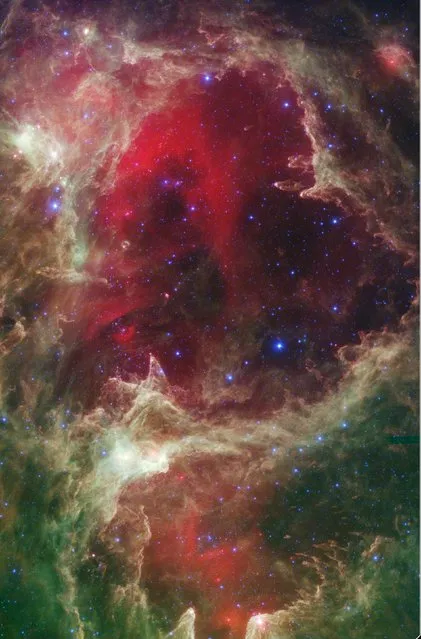
An infrared portrait from NASA's Spitzer Space Telescope which shows generations of stars is seen in this undated NASA handout image released February 14, 2013. In this wispy star-forming region, called W5, the oldest stars can be seen as blue dots in the centers of the two hollow cavities (other blue dots are background and foreground stars not associated with the region). Red shows heated dust that pervades the region's cavities, while green highlights dense clouds. (Photo by NASA/Reuters/JPL-Caltech/Harvard-Smithsonian/Handout)

An infrared portrait from NASA's Spitzer Space Telescope which shows generations of stars is seen in this undated NASA handout image released February 14, 2013. In this wispy star-forming region, called W5, the oldest stars can be seen as blue dots in the centers of the two hollow cavities (other blue dots are background and foreground stars not associated with the region). Red shows heated dust that pervades the region's cavities, while green highlights dense clouds. (Photo by NASA/Reuters/JPL-Caltech/Harvard-Smithsonian/Handout)
Details
03 Mar 2013 08:44:00
NYC morning fog. Wednsday, January 15, 2014, morning dense fog creates spectacular views over the East river of lower Manhattan, Brooklyn and Manhattan bridges as New Yorkers and tourist admire the scenery.  View from Brooklyn Bridge Park in DUMBO Brooklyn. (Photo by Paul Martinka/New York Post)

NYC morning fog. Wednsday, January 15, 2014, morning dense fog creates spectacular views over the East river of lower Manhattan, Brooklyn and Manhattan bridges as New Yorkers and tourist admire the scenery. View from Brooklyn Bridge Park in DUMBO Brooklyn. (Photo by Paul Martinka/New York Post)
Details
16 Jan 2014 11:34:00
A Rajasthani folk dance artist performs while standing on two glasses during the “Dhora Ri Mahak” festival in Bhopal, India, 07 January 2015. The event is being organised by the 'Indira Gandhi Rashtriya Manav Sangrahalaya' anthropology museum. (Photo by Sanjeev Gupta/EPA)

A Rajasthani folk dance artist performs while standing on two glasses during the “Dhora Ri Mahak” festival in Bhopal, India, 07 January 2015. The event is being organised by the “Indira Gandhi Rashtriya Manav Sangrahalaya” anthropology museum. (Photo by Sanjeev Gupta/EPA)
Details
10 Jan 2015 13:51:00
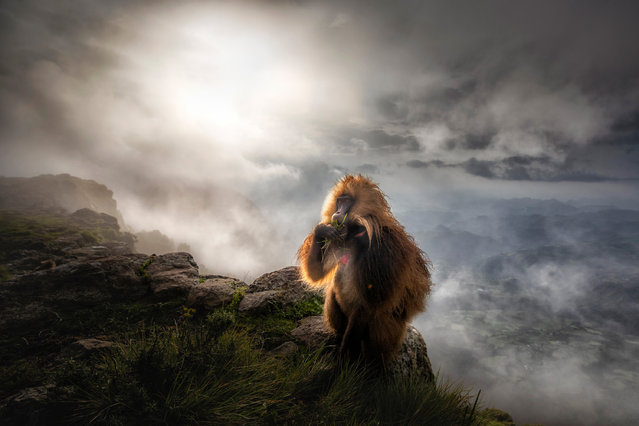
Highly commended, mammals: Gelada after the storm – Marco Gaiotti (Italy). “Gelada baboons are the only monkey species in the world that feed on grasses. They are native to the tableland of Ethiopia. Every morning large family groups wander from their sleeping places in the steep rock face, up to 1,000 metres high, to the feeding grounds at the tablelands. This image clearly depicts their feeding strategy: they pull out bunches of grass, sort the stalks and then lift them to their mouth. This shot was taken towards the end of the rainy season after a heavy storm”. (Photo by Marco Gaiotti/2019 GDT European Wildlife Photographer of the Year)

Highly commended, mammals: Gelada after the storm – Marco Gaiotti (Italy). “Gelada baboons are the only monkey species in the world that feed on grasses. They are native to the tableland of Ethiopia. Every morning large family groups wander from their sleeping places in the steep rock face, up to 1,000 metres high, to the feeding grounds at the tablelands. This image clearly depicts their feeding strategy: they pull out bunches of grass, sort the stalks and then lift them to their mouth. This shot was taken towards the end of the rainy season after a heavy storm”. (Photo by Marco Gaiotti/2019 GDT European Wildlife Photographer of the Year)
Details
31 Oct 2019 00:03:00
In this Thursday, May 8, 2014 photo, guests look down from the Tilt!, a new tourist attraction that provides guests a unique view of the downtown area from the 94th floor of the John Hancock Building, after it was unveiled in Chicago. People hold onto handrails as the glass and steel facade tilts forward 30 degrees. (Photo by Ashlee Rezin/AP Photo/Sun-Times Media)

In this Thursday, May 8, 2014 photo, guests look down from the Tilt!, a new tourist attraction that provides guests a unique view of the downtown area from the 94th floor of the John Hancock Building, after it was unveiled in Chicago. People hold onto handrails as the glass and steel facade tilts forward 30 degrees. (Photo by Ashlee Rezin/AP Photo/Sun-Times Media)
Details
10 May 2014 14:30:00