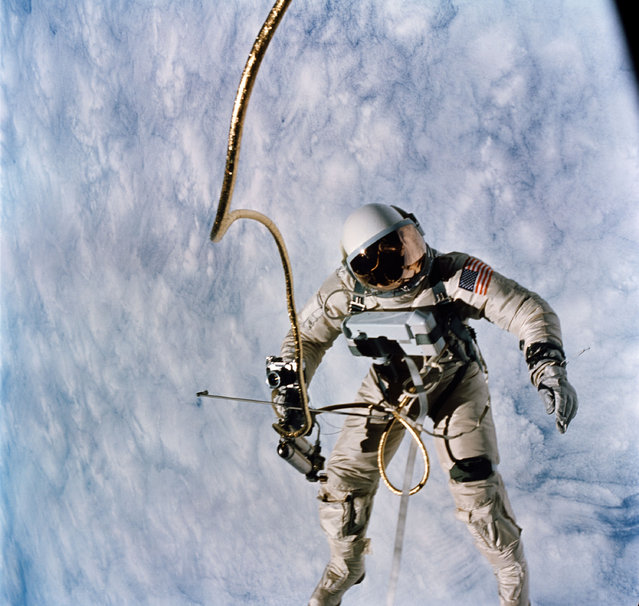
Astronaut Edward H. White II, pilot for the Gemini-Titan 4 (GT-4) spaceflight, floats in the zero-gravity of space during the third revolution of the GT-4 spacecraft on June 3, 1965. White wears a specially designed spacesuit. His face is shaded by a gold-plated visor to protect him from unfiltered rays of the sun. In his right hand he carries a Hand-Held Self-Maneuvering Unit (HHSMU) that gives him control over his movements in space. White also wears an emergency oxygen chest pack; and he carries a camera mounted on the HHSMU for taking pictures of the sky, Earth and the GT-4 spacecraft. He is secured to the spacecraft by a 25-feet umbilical line and a 23-feet tether line. Both lines are wrapped together in gold tape to form one cord. Astronaut James A. McDivitt, command pilot, remained inside the spacecraft during the extravehicular activity (EVA). Astronaut White died in the Apollo/Saturn 204 fire at Cape Kennedy on January 27, 1967. (Photo by NASA)
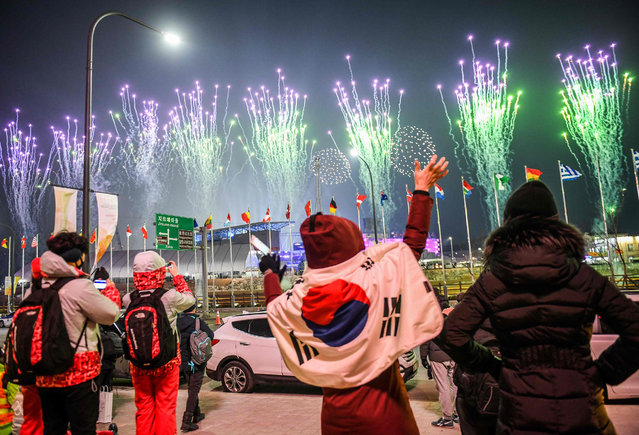
People with a South Korean flag waves as fireworks get off outside the stadium during the opening ceremony of the Pyeongchang 2018 Winter Olympic Games at the Pyeongchang Stadium on February 9, 2018. (Photo by Martin Bernetti/AFP Photo)
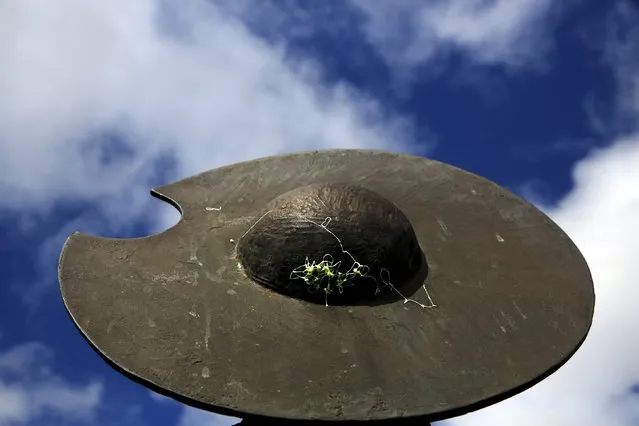
A sculpture of Don Quixote shows him wearing the basin he mistook for the enchanted helmet of the fictional Moorish king Mambrino in Alcazar de San Juan, Spain, April 5, 2016. The arid central Spanish region of La Mancha is the setting for “Don Quixote”, the seventeenth-century novel by Miguel de Cervantes. Four hundred years after his death, references to the characters of Don Quixote, his loyal squire Sancho Panza and his beautiful lady Dulcinea abound in the surrounding villages from sweet treats to theatre productions involving livestock. Cervantes did not give away the name of the birthplace of Don Quixote, a middle-aged gentleman who becomes obsessed with chivalrous ideals. But many identify the village of Argamasilla de Alba as his hometown. The anniversary of Cervantes’ death is marked on the 23 April. (Photo by Susana Vera/Reuters)
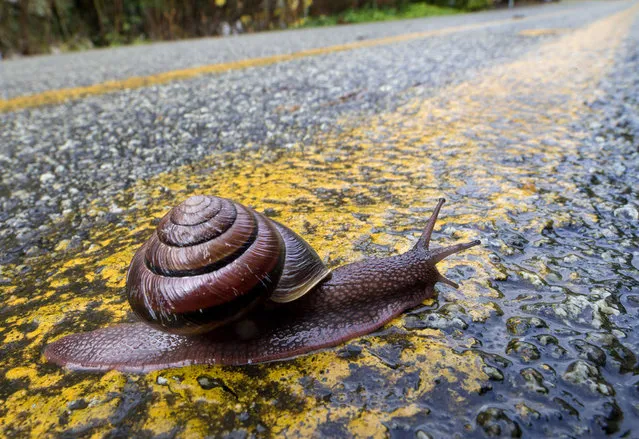
A large Pacific sideband snail slowly crosses a rain wet road in rural Douglas County, Oregon near Elkton on Sunday, December 2, 2012. The moisture loving snail should be very content with the recent heavy rains in southwestern Oregon and northern California. (Photo by Robin Loznak)
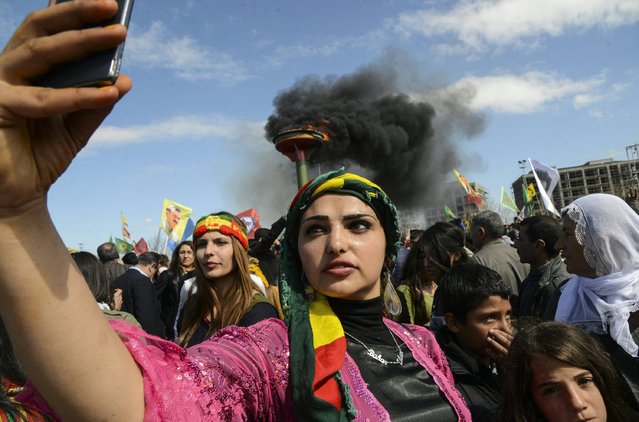
A woman takes a selfie picture as Turkish Kurds gather as part of Newroz celebrations in Diyarbakir, on March 21, 2016. Nowruz, the Farsi-language word for “New Year”, is an ancient Persian festival, celebrated on the first day of spring, on March 21, in Central Asian republics, Iraq, Turkey, Afghanistan and Iran. (Photo by Ilyas Akengin/AFP Photo)
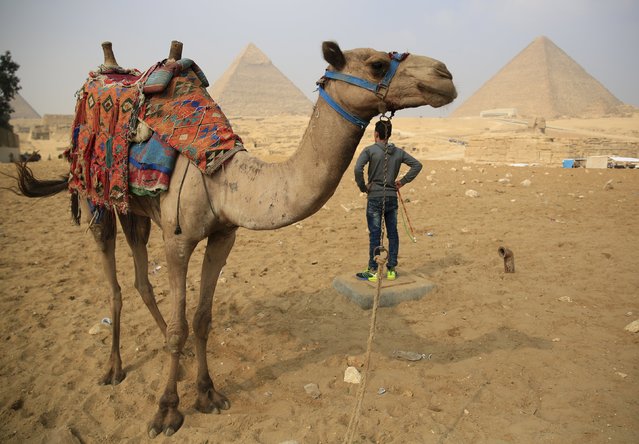
A worker looks on with his camel as he waits for tourists at the Giza Pyramids on the outskirts of Cairo, Egypt, November 8, 2015. Egypt's Tourism Minister Hesham Zaazou said Cairo regretted the suspension of flights and was doing all it could to secure its airports and tourist sites, adding that he would fly to Sharm al-Sheikh to oversee measures to support tourists there. (Photo by Amr Abdallah Dalsh/Reuters)
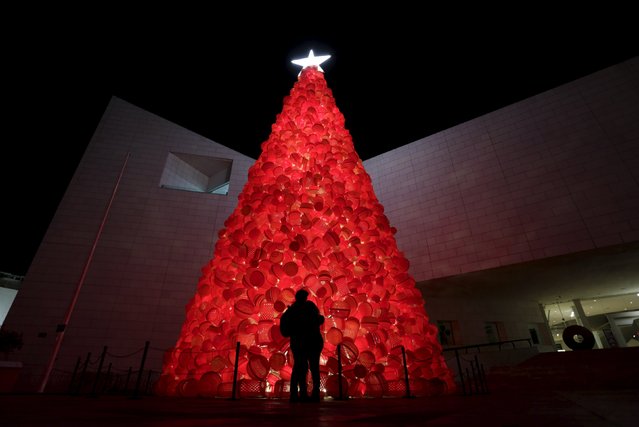
A couple hugs while standing near a Christmas tree made out of plastic bins and plastic hampers outside the Museum of History in Monterrey, Mexico, December 4, 2015. The humble Christmas tree has a rich history, from evergreen trees used to symbolise eternal life in Ancient Egypt to tree worship among pagan Europeans. The modern version has its origins in Germany, where the song “O Tannenbaum” is still a festive favourite. Today the traditional tree with lights and decorations appears in cities including Washington, Moscow and Beirut. Alternative constructions range from recycled rubbish in Mexico City to old window frames in Rakvere, Estonia. Whatever the shape or size, the message is the same: Merry Christmas. (Photo by Neil Hall/Reuters)