Loading...
Done
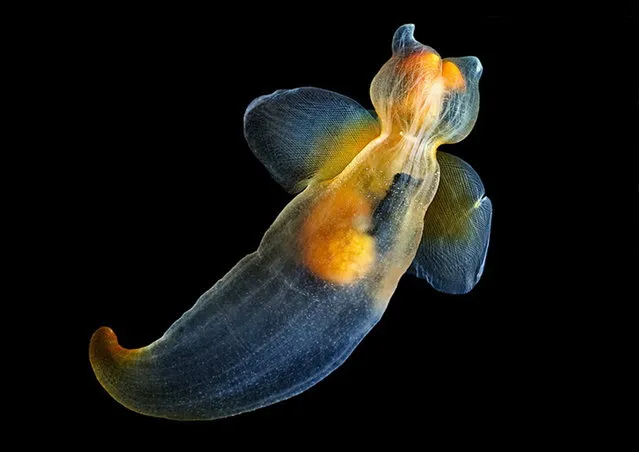
Underwater Photography By Alexander Semenov

In 2007, I graduated from Lomonosov’s Moscow State University in the department of Zoology. I specialized in the study of invertebrate animals, with an emphasis on squid brains. Soon after, I began working at the White Sea Biological Station (WSBS) as a senior laborer. WSBS has a dive station, which is great for all sorts of underwater scientific needs, and after 4 years working there, I became chief of our diving team. I now organize all WSBS underwater projects and dive by myself with a great pleasure and always with a camera.
Details
05 Feb 2013 15:28:00
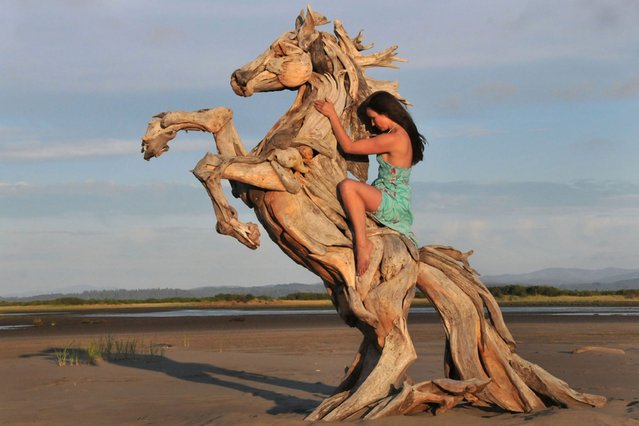
A horse sculpture entirely made from driftwood by artist Jeffro Uitto. (Photo by Jeff Uitto/Caters News)

Artist Jeff Uitto creates intricate sculptures from driftwood he finds along the coast of Washington. Uitto has sculpted wild horses, soaring eagles, and even a giraffe out of salvaged tree branches. But his work is more than giant animal sculptures. Uitto also has a clear talent for creating beautiful home furniture from driftwood. Finding the right piece of driftwood can take months, and the sculpting can take years.

Photo: A horse sculpture entirely made from driftwood by artist Jeffro Uitto. (Photo by Jeff Uitto/Caters News)
Details
28 Jun 2013 06:38:00
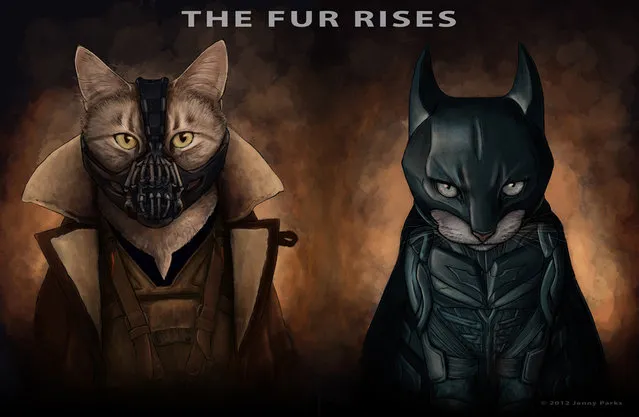
Super Cats By Jenny Parks

Jenny Parks is a scientific illustrator that also happens to be a shameless nerd, with a penchant for drawing animals, dinosaurs, imaginary creatures… and occasionally, people as cats. Somehow, she found herself with a bit of internet fame with the illustration ‘Doctor Mew’, and has been baffled ever since. With a BFA in illustration from the California College of the Arts, and a graduate degree in Science Illustration from UC Santa Cruz, she now resides in San Francisco as a freelance illustrator, fulfilling her destiny to make a living drawing cute, fuzzy things.
Details
25 Jul 2013 10:50:00
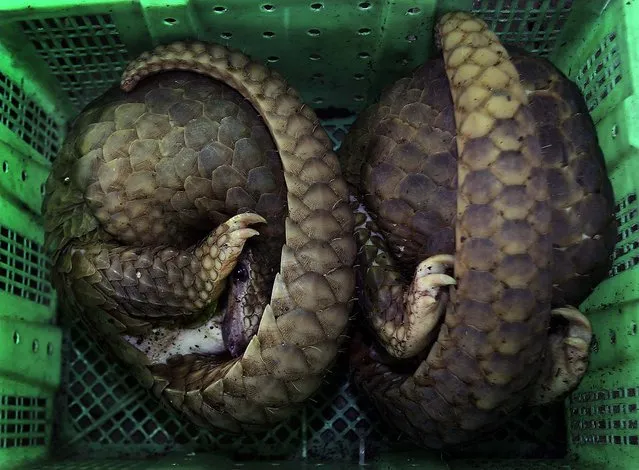
Two rescued pangolins sit in a basket during a news conference in Bangkok on June 7, 2012

Two rescued pangolins sit in a basket during a news conference in Bangkok on June 7, 2012. Thai customs rescued 110 pangolins worth about $35,500 that they say were to be sold outside the country as exotic food. The animals, hidden in a pickup truck, were seized at a customs checkpoint in Prachuap Khiri Khan province, south of Bangkok. (Photo by Sakchai Lalit/Associated Press)
Details
09 Jun 2012 12:20:00
A woman promotes a go-go dance bar in Pattaya, Thailand March 25, 2017. With mascots dressed as smiling fish and a police rock band, Thai authorities launched a “Happy Zone” at the weekend to improve the image of a city notorious for sеx tourism. Stung by foreign headlines portraying the seaside resort of Pattaya as “Sin City” and “The World’s Sеx Capital”, Thailand’s junta has begun a new effort to re-brand it. Businesses in the Happy Zone are asked to make the area feel safer, there are increased security patrols, police launched a mobile phone app for visitors to summon them if an emergency occurs. (Photo by Jorge Silva/Reuters)

A woman promotes a go-go dance bar in Pattaya, Thailand March 25, 2017. With mascots dressed as smiling fish and a police rock band, Thai authorities launched a “Happy Zone” at the weekend to improve the image of a city notorious for sеx tourism. Stung by foreign headlines portraying the seaside resort of Pattaya as “Sin City” and “The World’s Sеx Capital”, Thailand’s junta has begun a new effort to re-brand it. Businesses in the Happy Zone are asked to make the area feel safer, there are increased security patrols, police launched a mobile phone app for visitors to summon them if an emergency occurs. (Photo by Jorge Silva/Reuters)
Details
28 Mar 2017 09:20:00
A woman in Kimono poses for photos in front of mimosa and cherry blossom trees in Tokyo on March 8, 2024. (Photo by Yuichi Yamazaki/AFP Photo)

A woman in Kimono poses for photos in front of mimosa and cherry blossom trees in Tokyo on March 8, 2024. (Photo by Yuichi Yamazaki/AFP Photo)
Details
18 Mar 2024 06:52:00
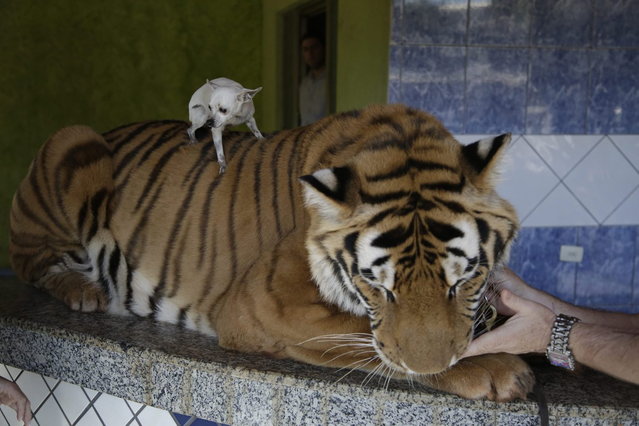
The Borges' family pet dog, Little, is placed on the back of Tom, their tiger, for a photo to be taken, in Maringa, Brazil, Friday, September 27, 2013. The Brazilian family is now locked in a legal dispute for the big cats, they have eight tigers and two lions, with federal wildlife officials working to take them away. While Borges does have a license to raise the animals, Brazilian wildlife officials say he illegally bred the cats, creating a public danger. (Photo by Renata Brito/AP Photo)

“Ary Borges and his family live in southern Brazil like most families the Borges' love animals and have an array of cats living in their home. The only difference between the cats owned by the Borges family and the cat that is cuddled up on your lap as you read this is the Borges' cats weigh over 700 pounds and could kill you just as soon as look at you. The Borges family shares their home with nine tigers, two lionesses, a chimp and a Chihuahua”. – Amanda Schiavo via Latin Times. Photo: The Borges' family pet dog, Little, is placed on the back of Tom, their tiger, for a photo to be taken, in Maringa, Brazil, Friday, September 27, 2013. (Photo by Renata Brito/AP Photo)
Details
04 Oct 2013 11:51:00
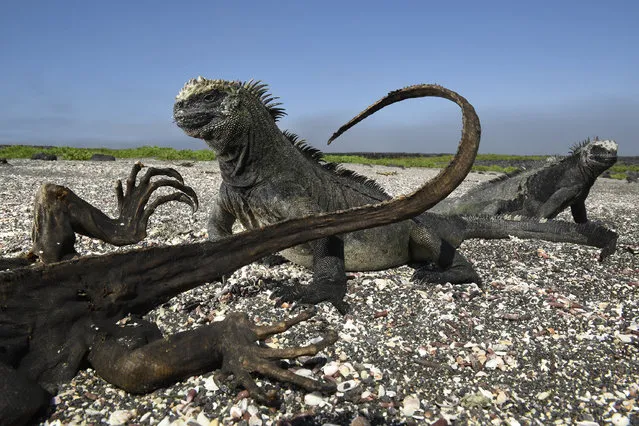
Galapagos – Rocking the Cradle: Four major ocean currents converge along the Galapagos archipelago, creating the conditions for an extraordinary diversity of animal life, April 25, 2016. The islands are home to at least 7,000 flora and fauna species, of which 97 percent of the reptiles, 80 percent of the land birds, 50 percent of the insects and 30 percent of the plants are endemic. The local ecosystem is highly sensitive to the changes in temperature, rainfall and ocean currents that characterize the climatic events known as El Niño and La Niña. These changes cause marked fluctuations in weather and food availability. Many scientists expect the frequency of El Niño and La Niña to increase as a result of climate change, making the Galapagos a possible early-warning location for its effects. (Photo by Thomas P. Peschak for National Geographic/World Press Photo)

Galapagos – Rocking the Cradle: Four major ocean currents converge along the Galapagos archipelago, creating the conditions for an extraordinary diversity of animal life, April 25, 2016. The islands are home to at least 7,000 flora and fauna species, of which 97 percent of the reptiles, 80 percent of the land birds, 50 percent of the insects and 30 percent of the plants are endemic. (Photo by Thomas P. Peschak for National Geographic/World Press Photo)
Details
16 Apr 2018 00:01:00