Loading...
Done
Afghanistan: Dogs of War Part 1

Throughout the course of the long war in Afghanistan, Coalition troops have relied on thousands of military working dogs to help keep them safe, and make their jobs easier. The dogs are trained to detect explosives, to find illegal drugs, to search for missing comrades, or target enemy combatants. Not only are they active on the front lines, but behind the lines they serve as therapy dogs, service dogs, and loyal companions. They also share the same risks as the ground troops, suffering injuries and sometimes death on the battlefields. Gathered here are images of these dogs and their handlers in Afghanistan and back home, from over the past several years, part of the ongoing series here on Afghanistan.
Details
03 Jun 2014 21:02:00
Assistant photographer Adriana Canargo dives with a wild alligator. (Photo by John Chapa/Barcroft Media)

Daredevil Christopher Gillette writhes around with a huge alligator he has saved from death. He works at a Florida sanctuary that rescues the wild beasts if they stroll into neighbourhoods where residents can legally kill them. To raise cash for the centre at Homestead, staff put on shows to feed and wrestle the alligators. Photographer John Chapa, 41, and girlfriend Adriana Canargo, 30, took these shots. Photo: Assistant photographer Adriana Canargo dives with a wild alligator. (Photo by John Chapa/Barcroft Media)
Details
22 Jun 2014 10:35:00
 Flying Squirrel

Flying squirrels are not capable of powered flight like birds or bats; instead, they glide between trees. They are capable of obtaining lift within the course of these flights, with flights recorded to 90 meters (295 ft). The direction and speed of the animal in midair is varied by changing the positions of its two arms and legs, largely controlled by small cartilaginous wrist bones. This changes the tautness of the patagium, a furry parachute-like membrane that stretches from wrist to ankle. It has a fluffy tail that stabilizes in flight. The tail acts as an adjunct airfoil, working as an air brake before landing on a tree trunk.
Details
07 Aug 2012 16:29:00
Lumberjacks From California

Dramatic photos show the measure of a man in contrast to the enormity of nature.
A series of photos from the Humboldt State University Library capture lumberjacks working among the redwoods in Humboldt County, California.
The photos are part of the Ericson Collection....


SEE ALSO: «Huge Plants» AND «Loggers»

Details
09 Oct 2012 05:57:00
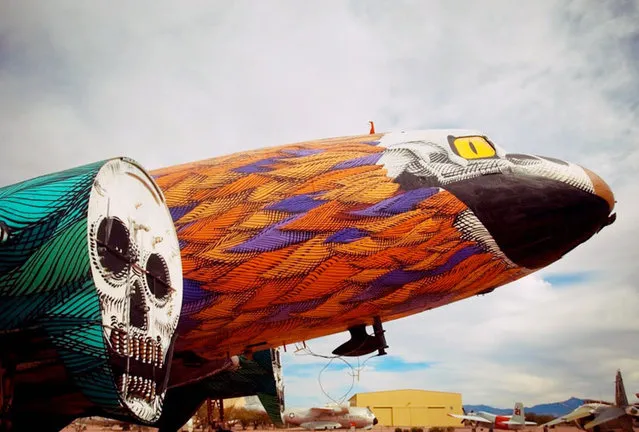
Redesigning Old Military Airplanes

A cemetery of disused war planes in the scorching Arizona desert has been given a new lease of life – as part of an art project.
“The Boneyard Project” resurrects disused warplanes that lie in the famous Boneyard in Arizona by letting graffiti artists paint them.
More than 30 of the world’s best urban artists worked on five ruined US Air Force jets, vividly bringing them back to life with paint and colour.
Details
19 Dec 2012 12:39:00


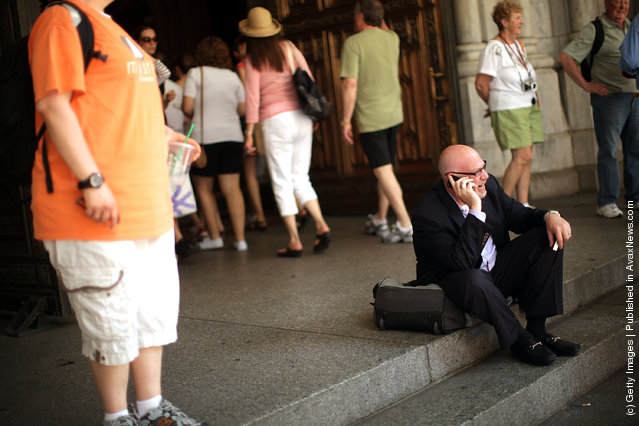
A man speaks on his mobile phone on May 31, 2011 in New York City. In a new report by 31 scientists meeting at the World Health Organization's International Agency for Research on Cancer (WHO/IARC) it was found that using a mobile phone may increase your risk for certain kinds of brain cancers. While further scientific work will be conducted, the group of scientists from 14 countries classified cell phones in the carcinogenic category 2B, which is similar to the pesticide DDT and gasoline engine exhaust. (Photo by Spencer Platt/Getty Images)
Details
01 Jun 2011 06:40:00
Rent-A-Dog In Japan

A woman looks at photographs of dogs to choose a pet to rent at Puppy The World on January 24, 2009 in Tokyo, Japan. Rent-a-dog is becoming increasingly popular amongst people who love dogs but are unable to look after a pet full time due to limited living space or long working hours. Customers pay the dog-rental outlet around 2500 yen (32.5 USD) for an hour, and usually take their rented pet for a walk along the nearby beach. (Photo by Junko Kimura/Getty Images)
Details
24 Oct 2011 13:39:00
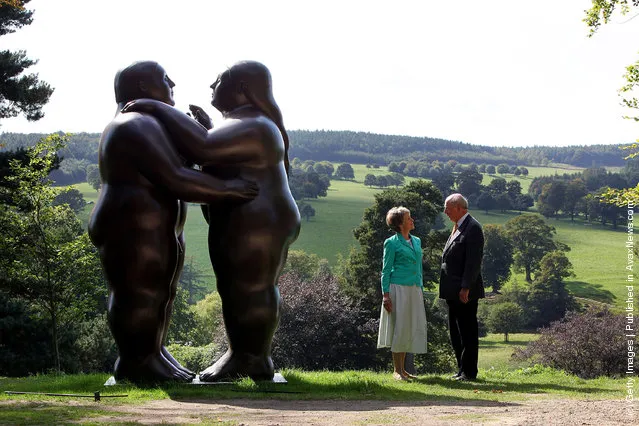
Dancers  by artist Fernando Botero

“Fernando Botero Angulo (born April 19, 1932) is a Colombian figurative artist. His works feature a figurative style, called by some “Boterismo”, which gives them an unmistakable identity. Botero depicts women, men, daily life, historical events and characters, milestones of art, still-life, animals and the natural world in general, with exaggerated and disproportionate volumetry, accompanied by fine details of scathing criticism, irony, humor, and ingenuity”. – Wikipedia

Photo: The Duke and Duchess of Devonshire view “Dancers” by artist Fernando Botero in the gardens of their home Chatsworth House on September 10, 2009, Chatsworth, England. (Photo by Christopher Furlong/Getty Images)
Details
29 Nov 2011 10:02:00