Loading...
Done
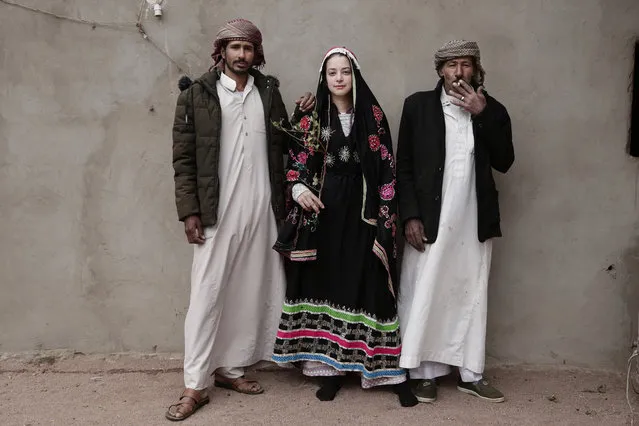
In this March 31, 2019 photo, an Egyptian student borrows a Bedouin wedding dress to pose for a photograph with Bedouin men from the Hamada tribe, in Wadi Sahw, Abu Zenima, in South Sinai, Egypt. Four Bedouin women are for the first time leading tours in Egypt’s Sinai Peninsula, breaking new ground in their deeply conservative community, where women almost never work outside the home or interact with outsiders.  The tourists can only be women, and the tours can’t go overnight. Each day before the sun sets, the group returns to the Hamada’s home village in Wadi Sahu, a narrow desert valley. (Photo by Nariman El-Mofty/AP Photo)

In this March 31, 2019 photo, an Egyptian student borrows a Bedouin wedding dress to pose for a photograph with Bedouin men from the Hamada tribe, in Wadi Sahw, Abu Zenima, in South Sinai, Egypt. Four Bedouin women are for the first time leading tours in Egypt’s Sinai Peninsula, breaking new ground in their deeply conservative community, where women almost never work outside the home or interact with outsiders. The tourists can only be women, and the tours can’t go overnight. Each day before the sun sets, the group returns to the Hamada’s home village in Wadi Sahu, a narrow desert valley. (Photo by Nariman El-Mofty/AP Photo)
Details
11 Apr 2019 00:01:00
This photo released Saturday March 22, 2014 by Stichting Ambulance Wens or Ambulance Wish Foundation shows a giraffe at Blijdorp Zoo in Rotterdam giving a lick to terminally ill Mario Eijs on Wednesday March 19, 2014. The Stichting Ambulancewens “Ambulance Wish Foundation” offers transport for terminally ill patients who cannot walk to help fulfill a last wish, in Eijs' case to be taken to the Blijdorp Zoo in Rotterdam where he worked doing odd jobs for 25 years. (Photo by AP Photo/Stichting Ambulance Wens)

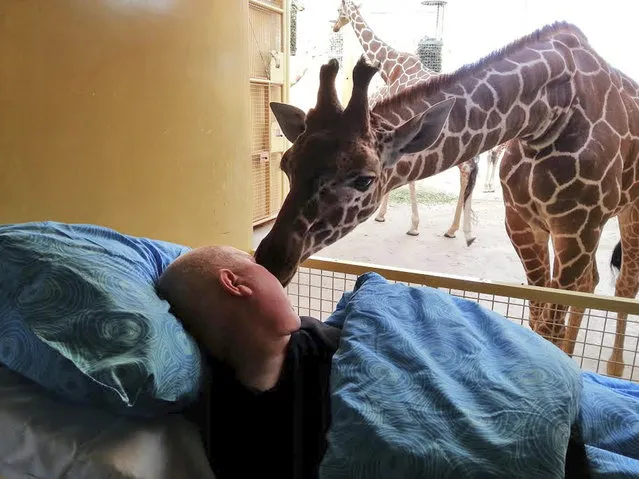
This photo released Saturday March 22, 2014 by Stichting Ambulance Wens or Ambulance Wish Foundation shows a giraffe at Blijdorp Zoo in Rotterdam giving a lick to terminally ill Mario Eijs on Wednesday March 19, 2014. The Stichting Ambulancewens “Ambulance Wish Foundation” offers transport for terminally ill patients who cannot walk to help fulfill a last wish, in Eijs' case to be taken to the Blijdorp Zoo in Rotterdam where he worked doing odd jobs for 25 years. Eijs, who has a mental handicap, is dying of a brain tumor and has difficulty walking or speaking. (Photo by AP Photo/Stichting Ambulance Wens)
Details
29 Mar 2014 14:20:00
People work with cocoa beans in Enchi June 17, 2014. Picture taken June 17, 2014. Ghana emerged as a success story during the 2000s, when war, political instability and a disastrous liberalization brought Ivory Coast's cocoa sector to its knees. Ghana's output more than tripled from 340,000 tons in the 2001/02 season to a record 1,025,000 tons a decade later. Strict controls cemented its reputation as a producer of top quality beans, establishing a brand that fetches a premium. (Photo by Thierry Gouegnon/Reuters)

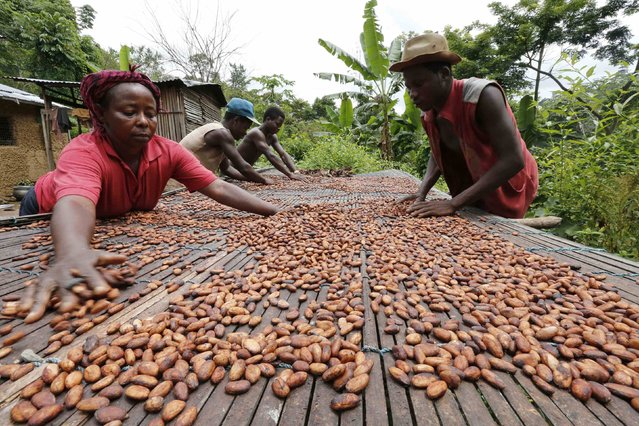
People work with cocoa beans in Enchi June 17, 2014. Picture taken June 17, 2014. Ghana emerged as a success story during the 2000s, when war, political instability and a disastrous liberalization brought Ivory Coast's cocoa sector to its knees. Ghana's output more than tripled from 340,000 tons in the 2001/02 season to a record 1,025,000 tons a decade later. Strict controls cemented its reputation as a producer of top quality beans, establishing a brand that fetches a premium. (Photo by Thierry Gouegnon/Reuters)
Details
03 Aug 2014 07:17:00
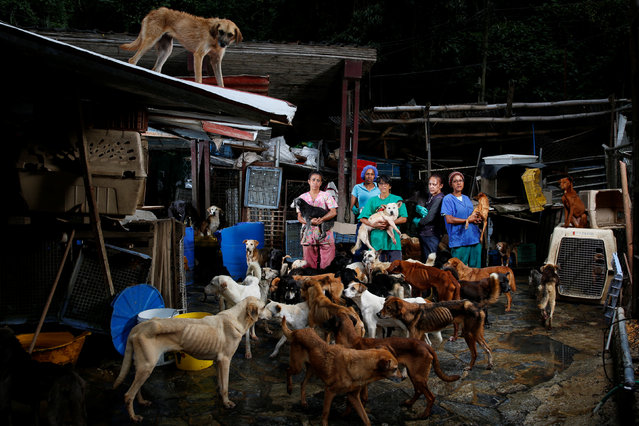
(L-R) Maria Silva, Milena Cortes, Maria Arteaga, Jackeline Bastidas and Gissy Abello pose for a picture at the Famproa dogs shelter where they work, in Los Teques, Venezuela, August 25, 2016. Venezuelans struggling to feed their families let alone their pets are dumping animals on the streets, in parks and at makeshift homes overrun with scrawny animals amid an economic crisis. An hour from Caracas in Los Teques, hundreds of dogs bark and run around the streets scavenging for food outside a makeshift shelter. People come by every few hours to hand over scrawny dogs which are fed by volunteers every day. Venezuela is undergoing a major economic and social crisis, with shortages of basic foods and medicines. Triple digit inflation is hitting everybody hard, including those who own pets. (Photo by Carlos Garcia Rawlins/Reuters)

(L-R) Maria Silva, Milena Cortes, Maria Arteaga, Jackeline Bastidas and Gissy Abello pose for a picture at the Famproa dogs shelter where they work, in Los Teques, Venezuela, August 25, 2016. Venezuelans struggling to feed their families let alone their pets are dumping animals on the streets, in parks and at makeshift homes overrun with scrawny animals amid an economic crisis. An hour from Caracas in Los Teques, hundreds of dogs bark and run around the streets scavenging for food outside a makeshift shelter. (Photo by Carlos Garcia Rawlins/Reuters)
Details
08 Sep 2016 10:01:00
Robot inventor Wu Yulu sits on a rickshaw driven by a robot which he invented in his village in rural Beijing's Tongzhou district, China, 17 November 2016. The 54-year-old Chinese farmer living in rural Beijing's Tongzhou district invented 63 robots in the past 30 years. Wu, who only received primary school education, plans to give up the agricultural work for his robot products. He regularly participates in exhibitions, transfers patent rights and teaches at the university to earn money. (Photo by Wu Hong/EPA)

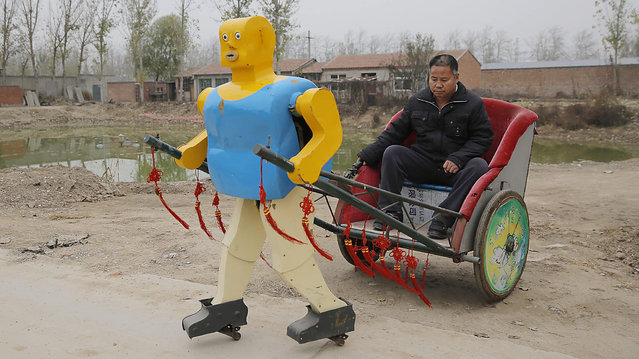
Robot inventor Wu Yulu sits on a rickshaw driven by a robot which he invented in his village in rural Beijing's Tongzhou district, China, 17 November 2016. The 54-year-old Chinese farmer living in rural Beijing's Tongzhou district invented 63 robots in the past 30 years. Wu, who only received primary school education, plans to give up the agricultural work for his robot products. He regularly participates in exhibitions, transfers patent rights and teaches at the university to earn money. (Photo by Wu Hong/EPA)
Details
21 Nov 2016 10:41:00
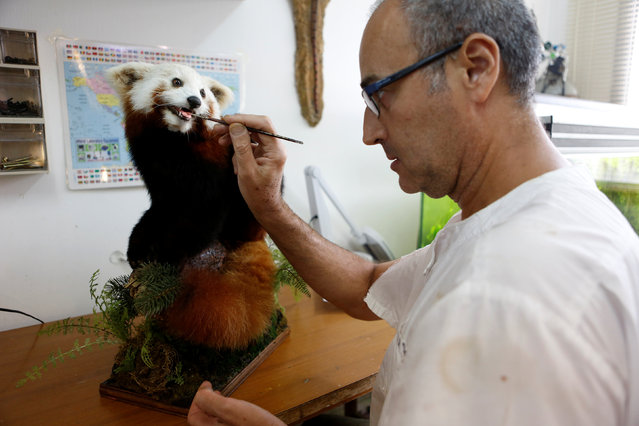
Igor Gavrilov, the main taxidermist of the Zoological centre at Tel Aviv University, works on a taxidermied animal, part of a collection which will be housed at the Steinhardt Museum of Natural History, a new Israeli natural history museum set to open next year in Tel Aviv, Israel June 8, 2016. Legions of insects, sea creatures and ancient fossils are lining up in a new museum shaped liked a giant Noah's Ark, telling the story of a crucial evolutionary byway across Israel. Experts say all humans and other animals had to pass through Israel on their first journey out of Africa into Europe and Asia. (Photo by Nir Elias/Reuters)

Igor Gavrilov, the main taxidermist of the Zoological centre at Tel Aviv University, works on a taxidermied animal, part of a collection which will be housed at the Steinhardt Museum of Natural History, a new Israeli natural history museum set to open next year in Tel Aviv, Israel June 8, 2016. Legions of insects, sea creatures and ancient fossils are lining up in a new museum shaped liked a giant Noah's Ark, telling the story of a crucial evolutionary byway across Israel. (Photo by Nir Elias/Reuters)
Details
25 Aug 2016 09:42:00
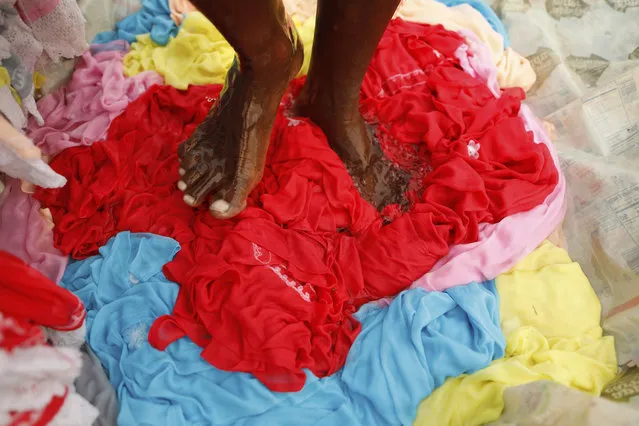
A dhobi, or a washerman washes cloths on the banks of the River Gomti in Lucknow, India, Saturday, September 12, 2020. Dhobis are traditional laundry workers who wash clothes by hand and dry them in the sun, an occupation which has been in existence for generations. Most cities in India have a Dhobi Ghat, or washermen's area, where the city's pile of clothes is laundered. This practice is still popular in India, despite of modern technology. Around 1,000 families work in Lucknow's Dhobi Ghat. However, in light of the novel coronavirus, their wages have decreased drastically. With each family earning around US$100-200 per month. (Photo by Rajesh Kumar Singh/AP Photo)

A dhobi, or a washerman washes cloths on the banks of the River Gomti in Lucknow, India, Saturday, September 12, 2020. Dhobis are traditional laundry workers who wash clothes by hand and dry them in the sun, an occupation which has been in existence for generations. Most cities in India have a Dhobi Ghat, or washermen's area, where the city's pile of clothes is laundered. This practice is still popular in India, despite of modern technology. Around 1,000 families work in Lucknow's Dhobi Ghat. However, in light of the novel coronavirus, their wages have decreased drastically. With each family earning around US$100-200 per month. (Photo by Rajesh Kumar Singh/AP Photo)
Details
25 Sep 2020 00:03:00
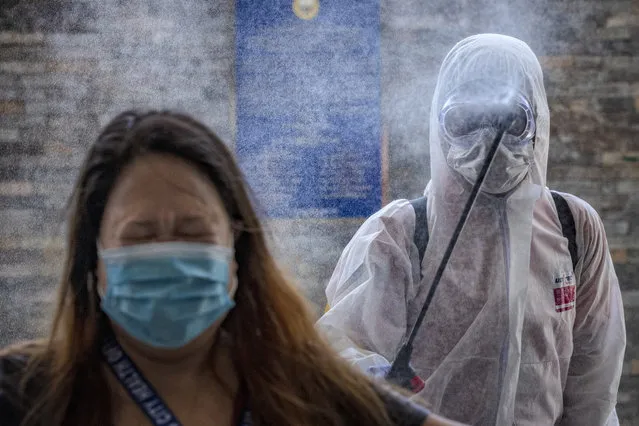
A government employee reacts as she is sprayed with disinfectant before entering a government office building to curb the spread of COVID-19 on March 19, 2020 in Pasig city, Metro Manila, Philippines. The Philippine government has sealed off Luzon, the country's largest and most populous island, to prevent the spread of COVID-19. Land, sea, and air travel has been suspended, while government work, schools, businesses, and public transportation have been ordered shut in a bid to keep some 55 million people at home. The Philippines' Department of Health has so far confirmed 217 cases of the new coronavirus in the country, with at least 17 recorded fatalities. (Photo by Ezra Acayan/Getty Images)

A government employee reacts as she is sprayed with disinfectant before entering a government office building to curb the spread of COVID-19 on March 19, 2020 in Pasig city, Metro Manila, Philippines. The Philippine government has sealed off Luzon, the country's largest and most populous island, to prevent the spread of COVID-19. Land, sea, and air travel has been suspended, while government work, schools, businesses, and public transportation have been ordered shut in a bid to keep some 55 million people at home. The Philippines' Department of Health has so far confirmed 217 cases of the new coronavirus in the country, with at least 17 recorded fatalities. (Photo by Ezra Acayan/Getty Images)
Details
07 Jan 2021 00:05:00