Loading...
Done
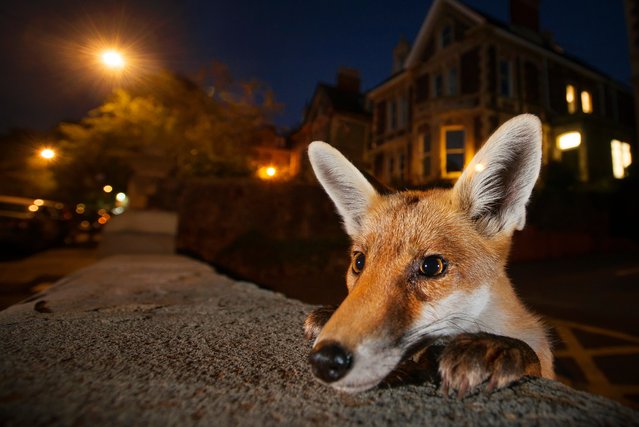
Nosy neighbour by Sam Hobson, UK. Sam knew exactly who to expect when he set his camera on the wall one summer’s evening in a suburban street in Bristol, the UK’s famous fox city. He wanted to capture the inquisitive nature of the urban red fox in a way that would pique the curiosity of its human neighbours about the wildlife around them. (Photo by Sam Hobson/2016 Wildlife Photographer of the Year)

Nosy neighbour by Sam Hobson, UK. Sam knew exactly who to expect when he set his camera on the wall one summer’s evening in a suburban street in Bristol, the UK’s famous fox city. He wanted to capture the inquisitive nature of the urban red fox in a way that would pique the curiosity of its human neighbours about the wildlife around them. (Photo by Sam Hobson/2016 Wildlife Photographer of the Year)
Details
31 Aug 2016 12:05:00
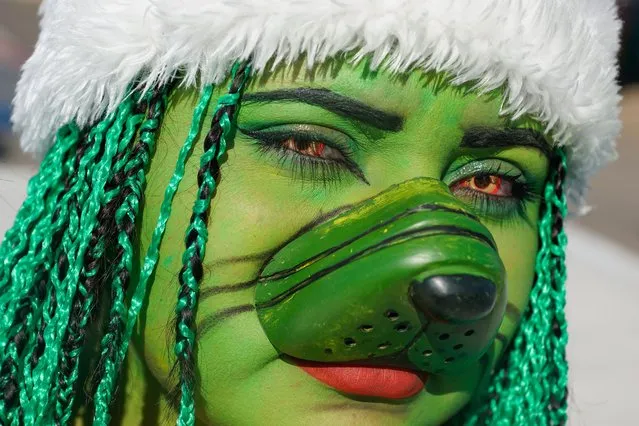
A Salvadoran clown is seen wearing colorful clothes and face make-up during the parade within the framework of the National Salvadoran Clown Day that is celebrated on the first Wednesday of every December by legislative decree in San Salvador, El Salvador on December 07, 2022. After the pandemic crisis, dozens of Salvadoran clowns took to the streets to celebrate their day, and invite families to respect the work of bringing smiles to children and adults in El Salvador. (Photo by Alex Pena/Anadolu Agency via Getty Images)

A Salvadoran clown is seen wearing colorful clothes and face make-up during the parade within the framework of the National Salvadoran Clown Day that is celebrated on the first Wednesday of every December by legislative decree in San Salvador, El Salvador on December 07, 2022. After the pandemic crisis, dozens of Salvadoran clowns took to the streets to celebrate their day, and invite families to respect the work of bringing smiles to children and adults in El Salvador. (Photo by Alex Pena/Anadolu Agency via Getty Images)
Details
16 Feb 2024 08:17:00
A Palestinian father evacuates his wounded daughter from the rubble of a destroyed house after an Israeli air strike in Gaza City, 16 May 2021. A total of 174 people have been killed in Israeli raids on Gaza, including 47 children and 29 women, the Palestinian Ministry of Health said on Sunday. In response violent confrontations between Israeli security forces and Palestinians in Jerusalem, various Palestinian militant factions in Gaza launched rocket attacks on Israel since 10 May, resulting in retaliatory strikes by Israel on Gaza. (Photo by Haitham Imad/EPA/EFE)

A Palestinian father evacuates his wounded daughter from the rubble of a destroyed house after an Israeli air strike in Gaza City, 16 May 2021. A total of 174 people have been killed in Israeli raids on Gaza, including 47 children and 29 women, the Palestinian Ministry of Health said on Sunday. In response violent confrontations between Israeli security forces and Palestinians in Jerusalem, various Palestinian militant factions in Gaza launched rocket attacks on Israel since 10 May, resulting in retaliatory strikes by Israel on Gaza. (Photo by Haitham Imad/EPA/EFE)
Details
17 May 2021 07:52:00
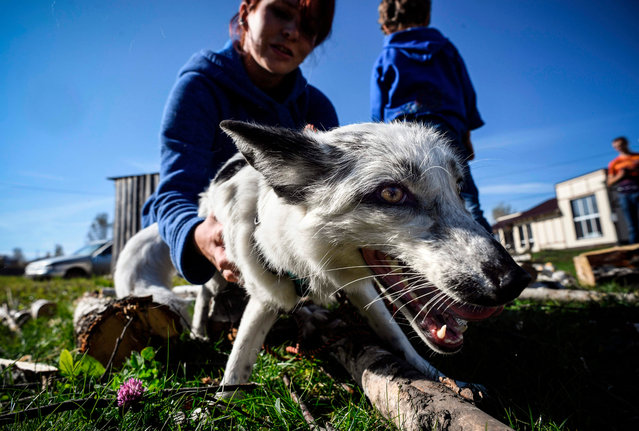
Tatyana Abramova, 33, plays with her home fox Plombir at her countryside house outside Siberian city of Novosibirsk on September 12, 2020. The official start of the Soviet experiment to better understand the domestication of animals by humans began in 1959, and was initiated by geneticists Dmitri Beliaiev and Lioudmila Trout on a farm in Akademgorodok, the scientific center of excellence in Siberia. Their primary objective was to domesticate foxes, to understand how the ancestor of wolves, another canine, evolved into a loyal and loving dog. And understand what this domestication tells us about the genetic evolution of species. (Photo by Alexander Nemenov/AFP Photo)

Tatyana Abramova, 33, plays with her home fox Plombir at her countryside house outside Siberian city of Novosibirsk on September 12, 2020. The official start of the Soviet experiment to better understand the domestication of animals by humans began in 1959, and was initiated by geneticists Dmitri Beliaiev and Lioudmila Trout on a farm in Akademgorodok, the scientific center of excellence in Siberia. Their primary objective was to domesticate foxes, to understand how the ancestor of wolves, another canine, evolved into a loyal and loving dog. And understand what this domestication tells us about the genetic evolution of species. (Photo by Alexander Nemenov/AFP Photo)
Details
25 Oct 2020 00:05:00
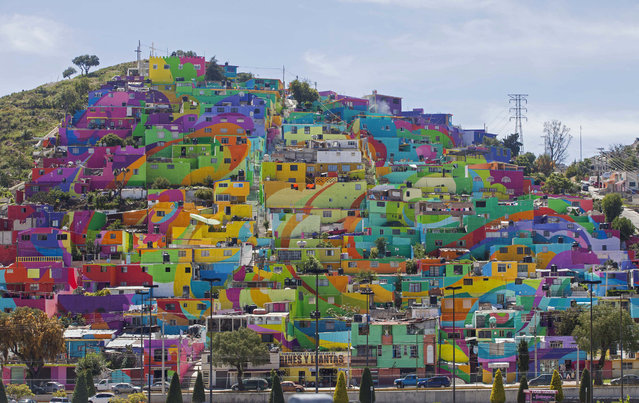
Hundreds of houses painted in bright colors in what organizers claim is Mexico's largest mural, is part of a government-sponsored project is called Pachuca Paints Itself, in the Palmitas neighborhood, in Pachuca, Mexico, Thursday, July 30, 2015. German Crew is the artist collective responsible for painting the mural project. Director Enrique Gomez, who goes by MYBE, said the crew has painted 1,500 square meters with 20,000 liters of paint. (Photo by Sofia Jaramillo/AP Photo)

Hundreds of houses painted in bright colors in what organizers claim is Mexico's largest mural, is part of a government-sponsored project is called Pachuca Paints Itself, in the Palmitas neighborhood, in Pachuca, Mexico, Thursday, July 30, 2015. German Crew is the artist collective responsible for painting the mural project. Director Enrique Gomez, who goes by MYBE, said the crew has painted 1,500 square meters with 20,000 liters of paint. Working hand-in-hand with residents, muralists have painted the facades of 200 homes bright lavender, lime green, incandescent orange – hues more commonly found in a bag of Skittles than in the drab, cement-and-cinderblock neighborhoods where many of Mexico's poor live. The project aims to bring the community together and rehabilitate the area. (Photo by Sofia Jaramillo/AP Photo)
Details
03 Aug 2015 12:02:00
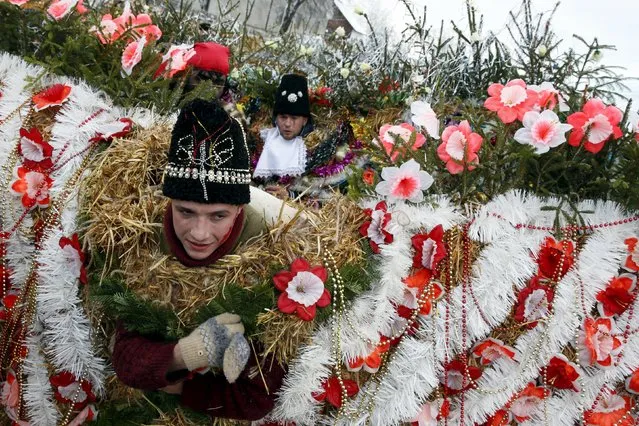
Local residents dressed in costumes perform during celebrations for the Malanka holiday in the village of Krasnoilsk in the Chernivtsi region of Ukraine, January 14, 2016. The Malanka traditional holiday is more popular in the western regions of the country and is also known as the Old New Year celebrated on January 13 and 14 - St. Basil's and St. Melania's Day, according to the old Julian calendar. During the celebrations, youngsters and adults wear traditional carnival costumes and masks, and visit local houses while singing carols, playing pranks or performing short plays. (Photo by Valentyn Ogirenko/Reuters)

Local residents dressed in costumes perform during celebrations for the Malanka holiday in the village of Krasnoilsk in the Chernivtsi region of Ukraine, January 14, 2016. The Malanka traditional holiday is more popular in the western regions of the country and is also known as the Old New Year celebrated on January 13 and 14 – St. Basil's and St. Melania's Day, according to the old Julian calendar. During the celebrations, youngsters and adults wear traditional carnival costumes and masks, and visit local houses while singing carols, playing pranks or performing short plays. (Photo by Valentyn Ogirenko/Reuters)
Details
16 Jan 2016 08:04:00
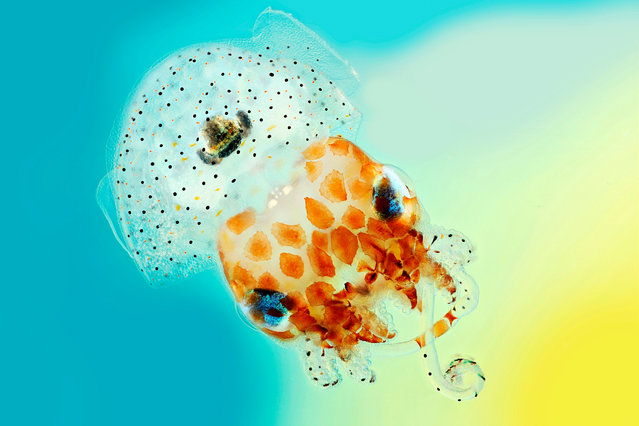
With its huge eyes, comical name and diminutive size, Mark R. Smith’s image of a baby Hawaiian bobtail squid can’t help but raise a smile. A curiously endearing creature, the cephalopod is just 1.5cm across, its mantle cavity bearing more than a passing resemblance to a rather natty shower cap. But it is also a beautiful example of symbiosis – nature’s version of “I’ll scratch your back if you scratch mine” – for on the underside of the squid is a light organ which houses bioluminescent bacteria. The squid offers the bacteria protection and food, while the bacteria emit a glow – a handy trait that the squid uses to offset its silhouette, helping it to evade predators in the depths below. Mark R. Smith’s entry combines several images of a Hawaiian bobtail squid with different focus lengths to create a final picture with greater depth of field than normal. (Photo by Mark R. Smith/Wellcome Images/Macroscopic Solutions)

With its huge eyes, comical name and diminutive size, Mark R. Smith’s image of a baby Hawaiian bobtail squid can’t help but raise a smile. A curiously endearing creature, the cephalopod is just 1.5cm across, its mantle cavity bearing more than a passing resemblance to a rather natty shower cap. But it is also a beautiful example of symbiosis – nature’s version of “I’ll scratch your back if you scratch mine” – for on the underside of the squid is a light organ which houses bioluminescent bacteria. The squid offers the bacteria protection and food, while the bacteria emit a glow – a handy trait that the squid uses to offset its silhouette, helping it to evade predators in the depths below. Mark R. Smith’s entry combines several images of a Hawaiian bobtail squid with different focus lengths to create a final picture with greater depth of field than normal. (Photo by Mark R. Smith/Wellcome Images/Macroscopic Solutions)
Details
08 Mar 2017 00:05:00
A man carries a block of ice left behind by a hailstorm in Sao Paulo, Brazil, on May 19, 2014. (Photo by Nelson Antoine/AP Photo)

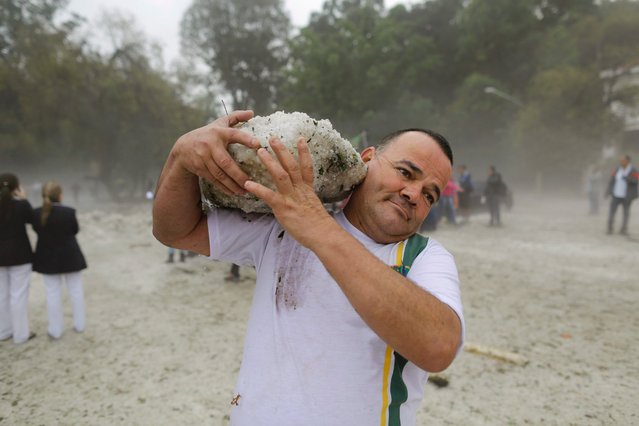
A man carries a block of ice left behind by a hailstorm in Sao Paulo, Brazil, on May 19, 2014. After the severe overnight hailstorm a layer of hailstones as deep as 20 centimeters covered streets and parks, drawing people to make snowmen and play in the ice, an unusual scene to the city. (Photo by Nelson Antoine/AP Photo)
Details
20 May 2014 10:34:00