Loading...
Done
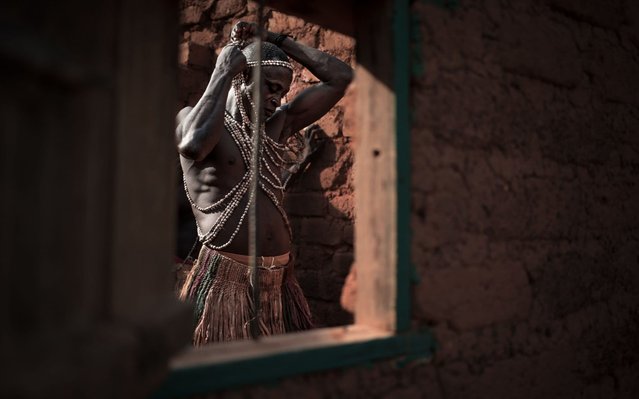
A Broto dancer prepares himself in a disused house of Bambari, in the centre of Central African Republic, before performing on March 14, 2019. The Broto, belonging to the Banda ethnic group, are known for their traditional dances accompanied by heavy horns made of tree roots. Today this tradition falls into disuse and its history is now forgotten by the new generations. (Photo by Florent Vergnes/AFP Photo)

A Broto dancer prepares himself in a disused house of Bambari, in the centre of Central African Republic, before performing on March 14, 2019. The Broto, belonging to the Banda ethnic group, are known for their traditional dances accompanied by heavy horns made of tree roots. Today this tradition falls into disuse and its history is now forgotten by the new generations. (Photo by Florent Vergnes/AFP Photo)
Details
05 Apr 2019 00:01:00
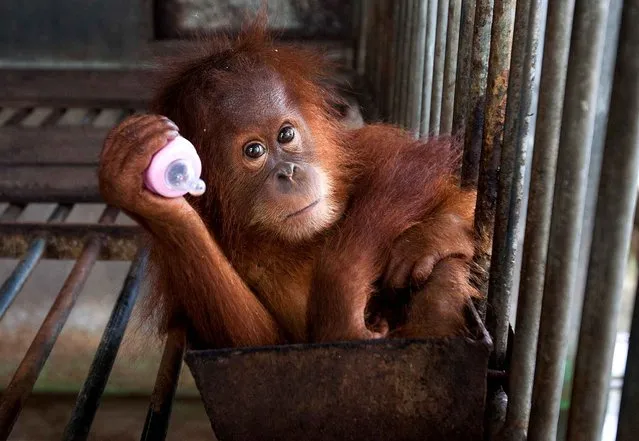
This picture shows a two-year old orangutan seized from a residents house at the provincial Nature Conservation and Agency (BKSDSA) office in Banda Aceh on September 16, 2014. The critically-endangered primates population are dwindling rapidly due to poaching and rapid destruction of their forest habitat that is being converted into palm oil plantations. (Photo by Chaideer Mahyuddin/AFP Photo)

This picture shows a two-year old orangutan seized from a residents house at the provincial Nature Conservation and Agency (BKSDSA) office in Banda Aceh on September 16, 2014. The critically-endangered primates population are dwindling rapidly due to poaching and rapid destruction of their forest habitat that is being converted into palm oil plantations. (Photo by Chaideer Mahyuddin/AFP Photo)
Details
20 Sep 2014 11:09:00
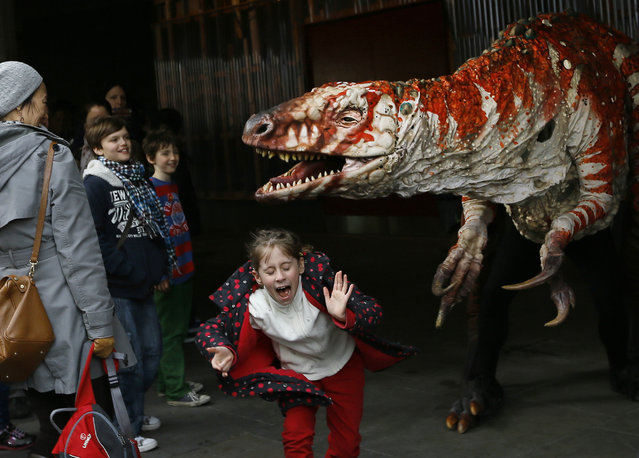
Children react as a carnivorous theropod known as the Australovenator dinosaur walks through crowds along the Southbank, in London, Monday, February 18, 2013. The dinosaur is one of many that can be visited at the Erth's Dinosaur Petting Zoo, visiting from Australia, the creatures can be touched and fed at the Southbank Centre. (Photo by Kirsty Wigglesworth/AP Photo)

Children react as a carnivorous theropod known as the Australovenator dinosaur walks through crowds along the Southbank, in London, Monday, February 18, 2013. The dinosaur is one of many that can be visited at the Erth's Dinosaur Petting Zoo, visiting from Australia, the creatures can be touched and fed at the Southbank Centre. (Photo by Kirsty Wigglesworth/AP Photo)
Details
23 Feb 2013 12:30:00

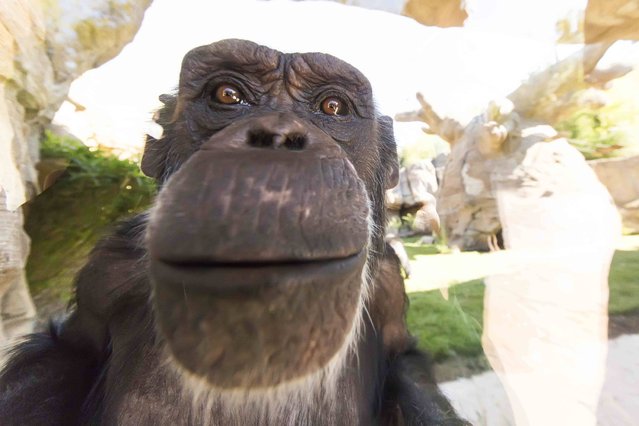
A Chimpanzee is seen with funny expressions at Hanover Zoo on September 27, 2013 in Hanover, Germany. (Photo by Barcroft Media)

A Chimpanzee is seen with funny expressions at Hanover Zoo on September 27, 2013 in Hanover, Germany. (Photo by Barcroft Media)
Details
05 Oct 2013 12:45:00
North Korean children wave to people on a Chinese tourist boat on the banks of Yalu River near the Chongsong county of North Korea, opposite the Chinese border city of Dandong, May 8, 2011. (Photo by Jacky Chen/Reuters)

North Korean children wave to people on a Chinese tourist boat on the banks of Yalu River near the Chongsong county of North Korea, opposite the Chinese border city of Dandong, May 8, 2011. (Photo by Jacky Chen/Reuters)
Details
02 Apr 2015 12:30:00
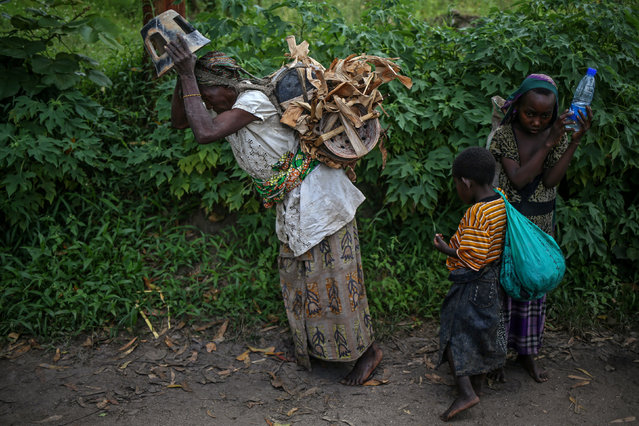
Habimana, 45, and her children walk to market to sell pottery on Idjwi island in the Democratic Republic of Congo, November 23, 2016. (Photo by Therese Di Campo/Reuters)

Habimana, 45, and her children walk to market to sell pottery on Idjwi island in the Democratic Republic of Congo, November 23, 2016. (Photo by Therese Di Campo/Reuters)
Details
13 Jan 2017 08:24:00
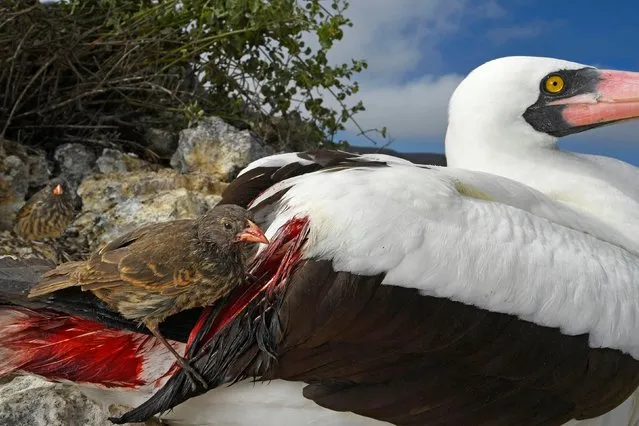
Bloodthirsty by Thomas P Peschak, Germany/South Africa — winner, Behaviour: birds. When rations run short on Wolf Island, in the remote northern Galápagos, the sharp-beaked ground finches become vampires. Their sitting targets are Nazca boobies and other large birds. The finches rely on a scant diet of seeds and insects, which regularly dries up, so they drink blood to survive. ‘I’ve seen more than half a dozen finches drinking from a single Nazca booby,’ says Tom. Rather than leave their nests the boobies tolerate the vampires, and the blood loss doesn’t seem to cause permanent harm. (Photo by Thomas P Peschak/2018 Wildlife Photographer of the Year)

Bloodthirsty by Thomas P. Peschak, Germany/South Africa — winner, Behaviour: birds. When rations run short on Wolf Island, in the remote northern Galápagos, the sharp-beaked ground finches become vampires. Their sitting targets are Nazca boobies and other large birds. The finches rely on a scant diet of seeds and insects, which regularly dries up, so they drink blood to survive. ‘I’ve seen more than half a dozen finches drinking from a single Nazca booby,’ says Tom. Rather than leave their nests the boobies tolerate the vampires, and the blood loss doesn’t seem to cause permanent harm. (Photo by Thomas P. Peschak/2018 Wildlife Photographer of the Year)
Details
19 Oct 2018 00:05:00
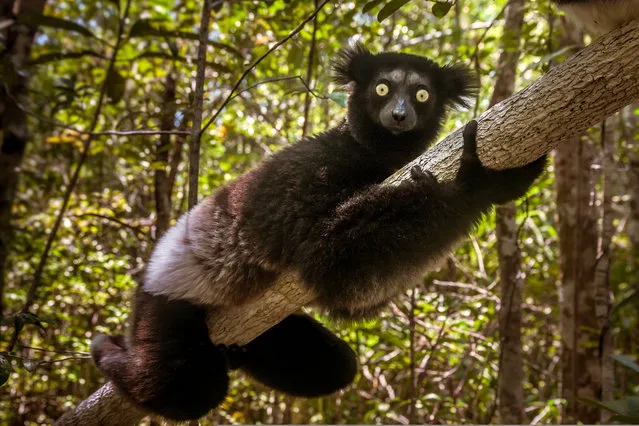
The secretive indri (Indri indri) of Madagascar, the largest living lemur. It is also critically endangered and highly evolutionarily distinct with no close relatives, which makes its branch one of most precarious on the mammal evolutionary tree. In the likely event that the indri goes extinct, we will lose 19m years of unique evolutionary history from the mammal tree of life. (Photo by Pierre-Yves Babelon/Aarhus University)

The secretive indri (Indri indri) of Madagascar, the largest living lemur. It is also critically endangered and highly evolutionarily distinct with no close relatives, which makes its branch one of most precarious on the mammal evolutionary tree. In the likely event that the indri goes extinct, we will lose 19m years of unique evolutionary history from the mammal tree of life. (Photo by Pierre-Yves Babelon/Aarhus University)
Details
18 Nov 2018 00:02:00