Loading...
Done
Vanessa: Hunts Point, Bronx

Vanessa: Hunts Point, Bronx

Vanessa, thirty-five, had three children with an abusive husband. She “lost her mind, started doing heroin”, after losing the children, who were taken away and given to her mother. The drugs led to homelessness and prostitution. She grew up on Arthur Avenue in the Bronx, but now spends her time in Hunts Point, “trying to survive everyday. Just doing whatever it takes”.
Details
13 May 2012 10:13:00
Little squirrel in Minsk worked with the taxi driver

Belarusian soldiers found a little squirrel two years ago. The little baby squirrel was just about to die but the officer of the team Peter Pankraty start feeding and taking care of it. The squirrel survived and two years later it just refuses to be separated by its saviour. Now Peter is taxi driver and squirrel Minsk makes him a good company through the entire shift. He uses the squirrel as an attraction and even promotes the tax at his taxi as “Just 45 cents and a few nuts per km”.
Details
04 Oct 2012 08:46:00


Indian ivory furniture legs in the shape of a goddess from the first century AD are displayed in the 'Afghanistan Crossroads of the Ancient World' exhibition at The British Museum on March 1, 2011 in London, England. Displaying treasures that were in great danger during the years of civil war and Taliban rule, these surviving artifacts reveal Afghanistan's ancient culture, its fragility and its remarkable place in world history. The exhibition opens to the public on March 3 and runs until July 3, 2011. (Photo by Peter Macdiarmid/Getty Images). LONDON, ENGLAND – MARCH 01
Details
07 Mar 2011 14:39:00
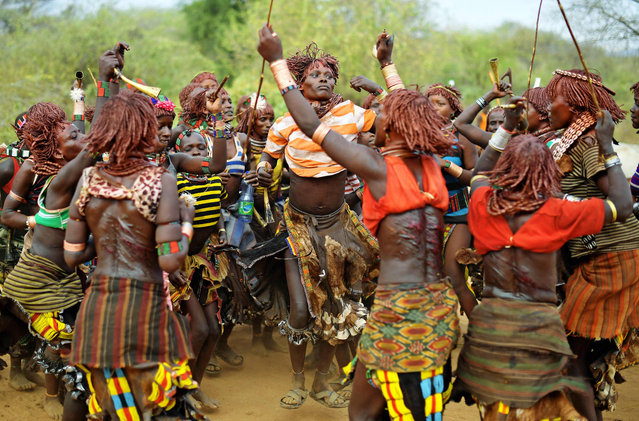
Hamar women dance before a bull jumping ceremony in Ethiopia's southern Omo Valley region near Turmi on September 19, 2016. The Hamar are a Nilotic ethnic group in Ethiopia. The construction of the Gibe III dam, the third largest hydroelectric plant in Africa, and large areas of very “thirsty” cotton and sugar plantations and factories along the Omo river are impacting heavily on the lives of tribes living in the Omo Valley who depend on the river for their survival and way of life. Human rights groups fear for the future of the tribes if they are forced to scatter, give up traditional ways through loss of land or ability to keep cattle as globalisation and development increases. (Photo by Carl De Souza/AFP Photo)

Hamar women dance before a bull jumping ceremony in Ethiopia's southern Omo Valley region near Turmi on September 19, 2016. The Hamar are a Nilotic ethnic group in Ethiopia. The construction of the Gibe III dam, the third largest hydroelectric plant in Africa, and large areas of very “thirsty” cotton and sugar plantations and factories along the Omo river are impacting heavily on the lives of tribes living in the Omo Valley who depend on the river for their survival and way of life. (Photo by Carl De Souza/AFP Photo)
Details
02 Oct 2016 08:45:00
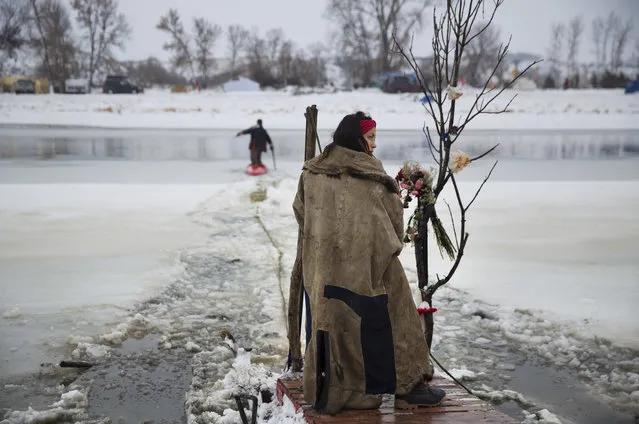
In this Thursday, December 1, 2016 photo, Cat Bigney, part of the Oglala Native American tribe, waits on the shore of the Cannonball river for travelers to arrive by canoe at the Oceti Sakowin camp where people have gathered to protest the Dakota Access oil pipeline in Cannon Ball, N.D. So far, those at the camp have shrugged off the heavy snow, icy winds and frigid temperatures. But if they defy next week's government deadline to abandon the camp, demonstrators know the real deep freeze lies ahead. Life-threatening wind chills and towering snow drifts could mean the greatest challenge is simple survival. (Photo by David Goldman/AP Photo)

In this Thursday, December 1, 2016 photo, Cat Bigney, part of the Oglala Native American tribe, waits on the shore of the Cannonball river for travelers to arrive by canoe at the Oceti Sakowin camp where people have gathered to protest the Dakota Access oil pipeline in Cannon Ball, N.D. So far, those at the camp have shrugged off the heavy snow, icy winds and frigid temperatures. But if they defy next week's government deadline to abandon the camp, demonstrators know the real deep freeze lies ahead. Life-threatening wind chills and towering snow drifts could mean the greatest challenge is simple survival. (Photo by David Goldman/AP Photo)
Details
06 Dec 2016 10:22:00
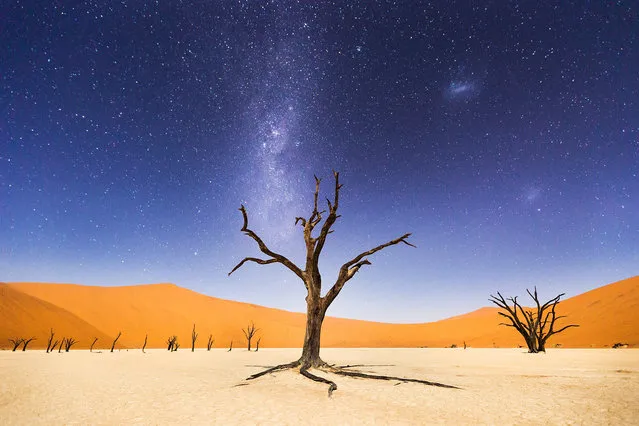
Merit: A Night at Deadvlei. The night before returning to Windhoek, we spent several hours at Deadveli. The moon was bright enough to illuminate the sand dunes in the distance, but the skies were still dark enough to clearly see the milky way and magellanic clouds. Deadveli means “dead marsh. (Photo and caption by Beth McCarley/National Geographic Traveler Photo Contest)

Merit: A Night at Deadvlei. The night before returning to Windhoek, we spent several hours at Deadveli. The moon was bright enough to illuminate the sand dunes in the distance, but the skies were still dark enough to clearly see the milky way and magellanic clouds. Deadveli means “dead marsh. The camelthorn trees are believed to be about 900 years old, but have not decomposed because the environment is so dry. (Photo and caption by Beth McCarley/National Geographic Traveler Photo Contest)
Details
04 Aug 2015 11:50:00
Dead sperm whales are seen washed up on a beach on Texel Island, The Netherlands, January 13, 2016. The five sperm whales that beached on the Dutch lsland of Texel on Tuesday have died overnight, Dutch media reported. It is extremely unusual for so many whales to be in Dutch waters, a spokesman for the Ecomare marine centre told local paper Noordhollands Dagblad. (Photo by Cris Toala Olivares/Reuters)

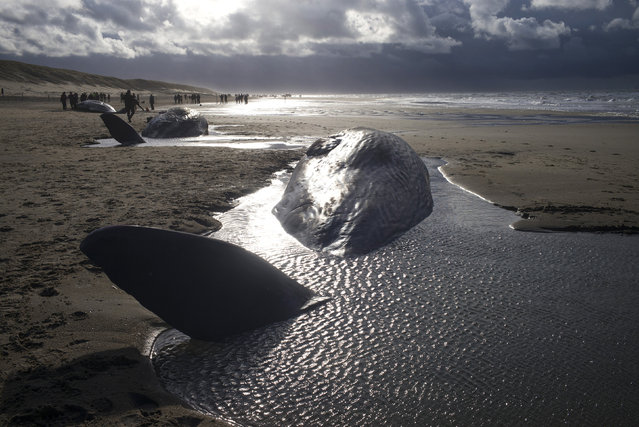
Dead sperm whales are seen washed up on a beach on Texel Island, The Netherlands, January 13, 2016. The five sperm whales that beached on the Dutch lsland of Texel on Tuesday have died overnight, Dutch media reported. It is extremely unusual for so many whales to be in Dutch waters, a spokesman for the Ecomare marine centre told local paper Noordhollands Dagblad. Efforts to get the whales back into open water on Tuesday evening failed and rescuers finally withdrew from the beach at around midnight. The area of beach where the whales are has been closed to the public, to minimise the distress to the animals. (Photo by Cris Toala Olivares/Reuters)
Details
15 Jan 2016 08:04:00
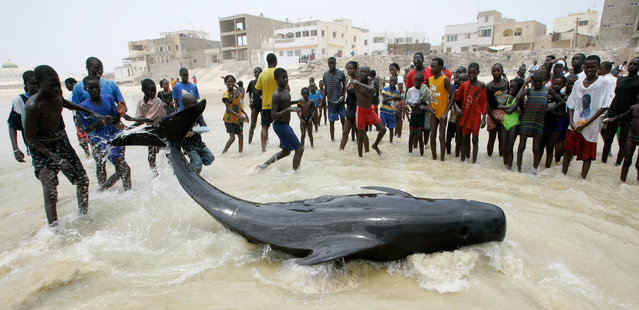
Onlookers gather around a struggling beached whale in the Yoff neighborhood of Dakar, Senegal Wednesday, May 21, 2008. Residents worked Wednesday morning to save some of the more than 80 whales that were stranded on the beach Tuesday night. This whale was successfully towed out to sea by a fishing boat, though at least 20 others lay dead on the beach by midday Wednesday. (Photo by Rebecca Blackwell/AP Photo)

Onlookers gather around a struggling beached whale in the Yoff neighborhood of Dakar, Senegal Wednesday, May 21, 2008. Residents worked Wednesday morning to save some of the more than 80 whales that were stranded on the beach Tuesday night. This whale was successfully towed out to sea by a fishing boat, though at least 20 others lay dead on the beach by midday Wednesday. (Photo by Rebecca Blackwell/AP Photo)
Details
26 Oct 2014 12:08:00