Loading...
Done
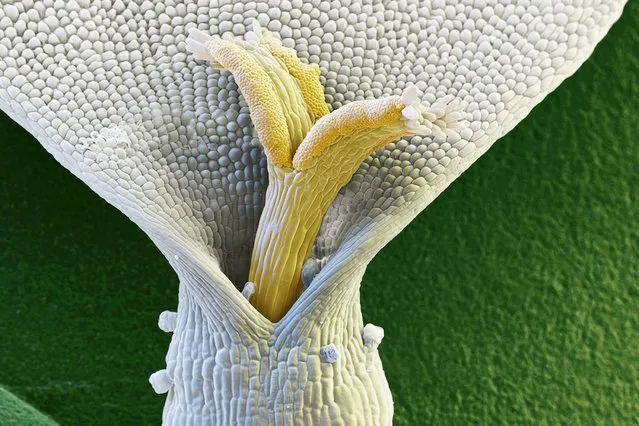
The floret of a Chamomile flower up close and personal. (Photo by Oliver Meckes/Barcroft Media)

These images have been created using a colour scanning electron microscope (SEM) by the award-winning Eye of Science, comprised of snapper Oliver Meckes and biologist Nicole Ottawa. For a decade the pair, based in Reutlingen in the south of Germany, worked with an old SEM they saved from the scrapheap, but for the last five years they have used a £250,000 FEI Quanta Series Field Emission SEM. Oliver said: “Flowers are beautiful in 'normal' view, but when you look closer, some parts get very bizarre and unexpected structures appear – flowers within flowers, worlds within worlds”. Photo: The floret of a Chamomile flower up close and personal. (Photo by Oliver Meckes/Barcroft Media)
Details
26 May 2014 13:51:00
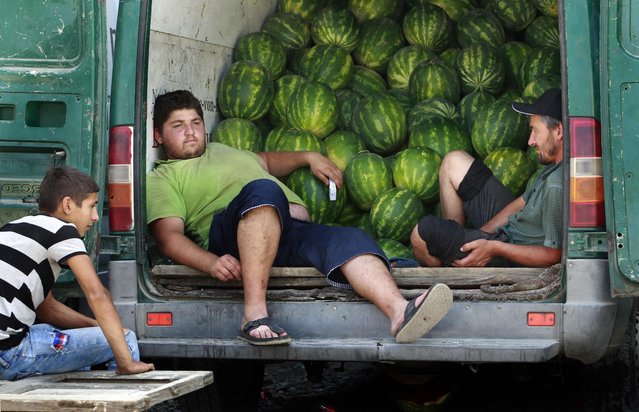
Georgian men take a break from selling fruit and vegetable at a street market in Tbilisi, Georgia, Wednesday, July 20, 2016. (Photo by Shakh Aivazov/AP Photo)

Georgian men take a break from selling fruit and vegetable at a street market in Tbilisi, Georgia, Wednesday, July 20, 2016. (Photo by Shakh Aivazov/AP Photo)
Details
02 Aug 2016 08:05:00
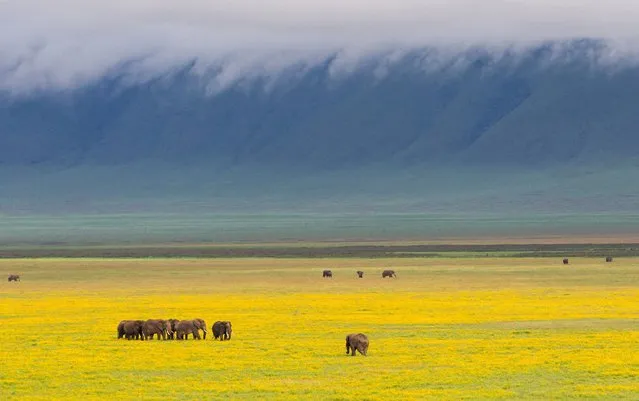
Ngorongoro Crater (Tanzania). At 610m deep and 260 sq km, this is the largest unflooded caldera in the world. A blue-green vision from above it's a haven for engangered wildlife and Maasai livestock. The crater was formed three million years ago when a giant volcano, which could have been as high as Kilimanjaro, exploded and collapsed. The caldera formed the concentric fractures in the crust cracked down to a magma reservoir deep underground. (Photo by John Bryant/Getty Images)

Ngorongoro Crater (Tanzania). At 610m deep and 260 sq km, this is the largest unflooded caldera in the world. A blue-green vision from above it's a haven for engangered wildlife and Maasai livestock. The crater was formed three million years ago when a giant volcano, which could have been as high as Kilimanjaro, exploded and collapsed. The caldera formed the concentric fractures in the crust cracked down to a magma reservoir deep underground. (Photo by John Bryant/Getty Images)
Details
28 Mar 2014 08:08:00
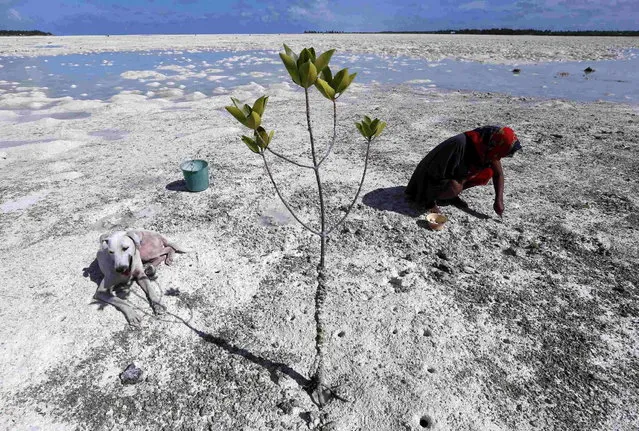
A dog sits in the shade of a mangrove tree as a woman uses a fork to dig for shellfish on the reef-mud flats of a lagoon located at South Tarawa in the central Pacific island nation of Kiribati May 23, 2013. (Photo by David Gray/Reuters)

A dog sits in the shade of a mangrove tree as a woman uses a fork to dig for shellfish on the reef-mud flats of a lagoon located at South Tarawa in the central Pacific island nation of Kiribati May 23, 2013. Kiribati consists of a chain of 33 atolls and islands that stand just metres above sea level, spread over a huge expanse of otherwise empty ocean. With surrounding sea levels rising, Kiribati President Anote Tong has predicted his country will likely become uninhabitable in 30-60 years because of inundation and contamination of its freshwater supplies. (Photo by David Gray/Reuters)
Details
13 Jun 2013 09:23:00
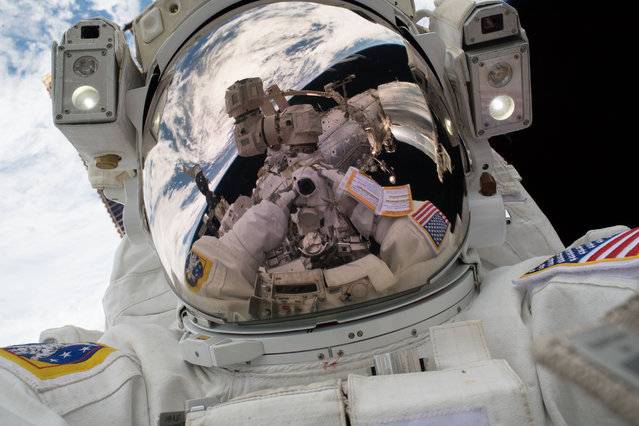
Spacewalker Mark Vande Hei took his own photograph during the first spacewalk of 2018,  on January 23, 2018. These sky-high pictures are better known as “space-selfies”. (Photo by Mark Vande Hei/NASA)

Spacewalker Mark Vande Hei took his own photograph during the first spacewalk of 2018, on January 23, 2018. These sky-high pictures are better known as “space-selfies”. (Photo by Mark Vande Hei/NASA)
Details
05 Feb 2018 06:27:00
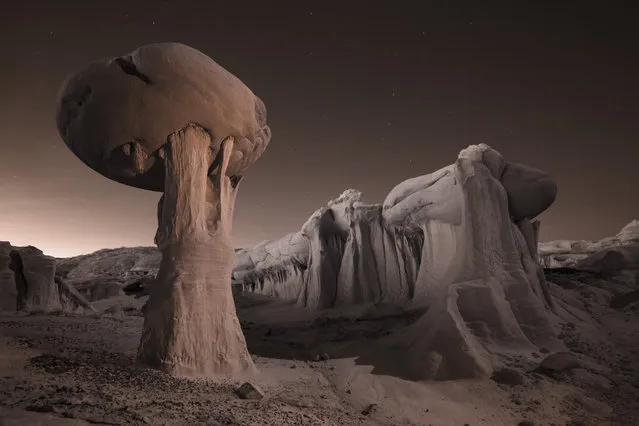
An infrared image at dusk of strange clay rock formations in Ah-Shi-Sle-Pah Wilderness in Farmington, New Mexico. (Photo by David Clapp/Barcroft Images)

The barren landscapes of the south-western US provided inspiration for photographer David Clapp. He visited Nevada, New Mexico, Utah and Arizona as part of his project on other-worldy locations, with surreal results. Here: An infrared image at dusk of strange clay rock formations in Ah-Shi-Sle-Pah Wilderness in Farmington, New Mexico. (Photo by David Clapp/Barcroft Images)
Details
31 May 2016 11:54:00
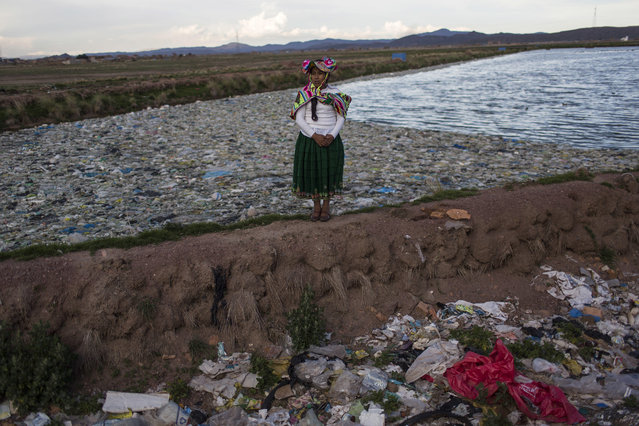
In this February 1, 2017 photo, environmental activist Maruja Inquilla poses for a photo next to a Municipal waste treatment plant with water that flows into Lake Titicaca, in Juliaca, in the Puno region of Peru. “If the frogs could talk they would say, This is killing me”," said Inquilla, who recently showed up at the Puno governor's house carrying plastic bags filled with hundreds of dead frogs in protest. (Photo by Rodrigo Abd/AP Photo)

In this February 1, 2017 photo, environmental activist Maruja Inquilla poses for a photo next to a Municipal waste treatment plant with water that flows into Lake Titicaca, in Juliaca, in the Puno region of Peru. “If the frogs could talk they would say, This is killing me”," said Inquilla, who recently showed up at the Puno governor's house carrying plastic bags filled with hundreds of dead frogs in protest. (Photo by Rodrigo Abd/AP Photo)
Details
04 Mar 2017 00:02:00
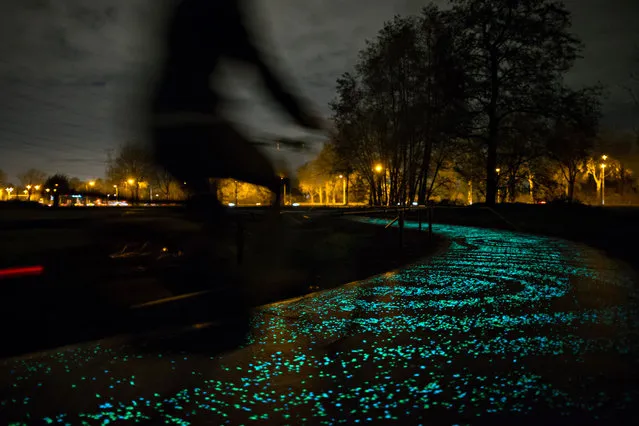
Dutch artist Daan Roosegaarde paid homage to Vincent Van Gogh's famous “Starry Night” painting by creating a glowing bike path relying on solar-powered LED lights. The 650-yard route  which opened November 12, 2014 extends between Eindhoven and Neunen, Netherlands, where Van Gogh spent part of his life. Its the first event marking the 125th anniversary of Van Gogh's death July 29, 2015. (Photo by Pim Hendriksen/Studio Roosegaarde)

Dutch artist Daan Roosegaarde paid homage to Vincent Van Gogh's famous “Starry Night” painting by creating a glowing bike path relying on solar-powered LED lights. The 650-yard route which opened November 12, 2014 extends between Eindhoven and Neunen, Netherlands, where Van Gogh spent part of his life. Its the first event marking the 125th anniversary of Van Gogh's death July 29, 2015. (Photo by Pim Hendriksen/Studio Roosegaarde)
Details
23 Nov 2014 13:31:00