Loading...
Done
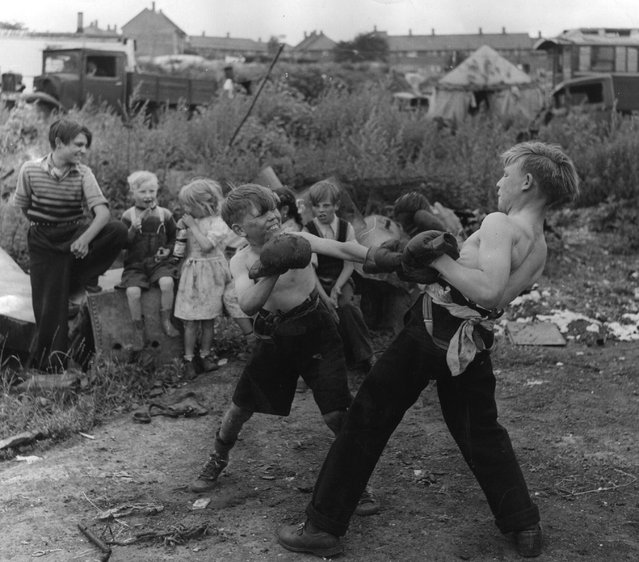
The unromantic gypsies. Children boxing in a gypsy camp in Kent, England on July 1, 1951. Like all boys these gypsy lads like to try their hand at boxing. Encouraged by their friends they fight it out on Corke's Meadow. Few Romanies now live a life of wandering romance. Most are like the three hundred squatters of Corke's Meadow, Kent, which is part of a “gypsy problem” that involves about 100,000 today. Of those about 25,000 can be rightly called gypsies, the rest are Mumpers and Posh-rats and Hobos. Corke's Meadow has both kinds. “Picture Post” cameraman Bert Hardy photographs the Corke's Meadow gypsies in their encampment. (Photo by Hulton-Deutsch Collection/Corbis via Getty Images)

The unromantic gypsies. Children boxing in a gypsy camp in Kent, England on July 1, 1951. Like all boys these gypsy lads like to try their hand at boxing. Encouraged by their friends they fight it out on Corke's Meadow. Few Romanies now live a life of wandering romance. Most are like the three hundred squatters of Corke's Meadow, Kent, which is part of a “gypsy problem” that involves about 100,000 today. Of those about 25,000 can be rightly called gypsies, the rest are Mumpers and Posh-rats and Hobos. Corke's Meadow has both kinds. “Picture Post” cameraman Bert Hardy photographs the Corke's Meadow gypsies in their encampment. (Photo by Hulton-Deutsch Collection/Corbis via Getty Images)
Details
12 Mar 2017 00:01:00
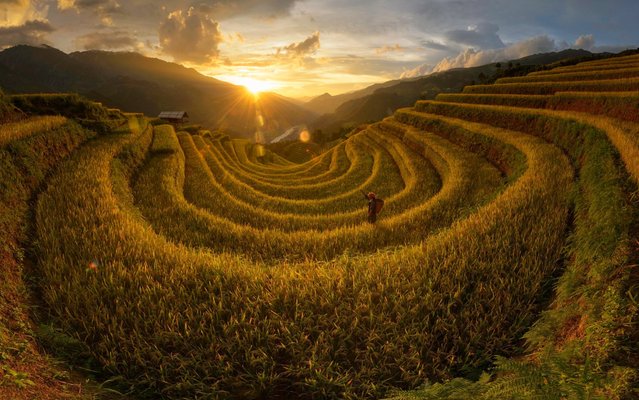
Lush green rice terraces sprawl over 2,200 hectares of mountainside ready to be harvested. These stunning images, captured by photographer Saravut Whanset, show the incredible terraces throughout the course of the day, including at sunrise and sunset. Workers tend to the fields, with each terrace between 1 and 1.5 metres wide, while wooden huts stand on stilts on the mountainside. The beautiful panoramic pictures were taken in Mu Cang Chai, Vietnam, with the fields located at the foot of the Hoang Lien Son mountain range, 1,000 metres above sea level. (Photo by Saravut Whanset/Solent News and Photo Agency)

Lush green rice terraces sprawl over 2,200 hectares of mountainside ready to be harvested. These stunning images, captured by photographer Saravut Whanset, show the incredible terraces throughout the course of the day, including at sunrise and sunset. Workers tend to the fields, with each terrace between 1 and 1.5 metres wide, while wooden huts stand on stilts on the mountainside. The beautiful panoramic pictures were taken in Mu Cang Chai, Vietnam, with the fields located at the foot of the Hoang Lien Son mountain range, 1,000 metres above sea level. (Photo by Saravut Whanset/Solent News and Photo Agency)
Details
13 Nov 2017 07:21:00
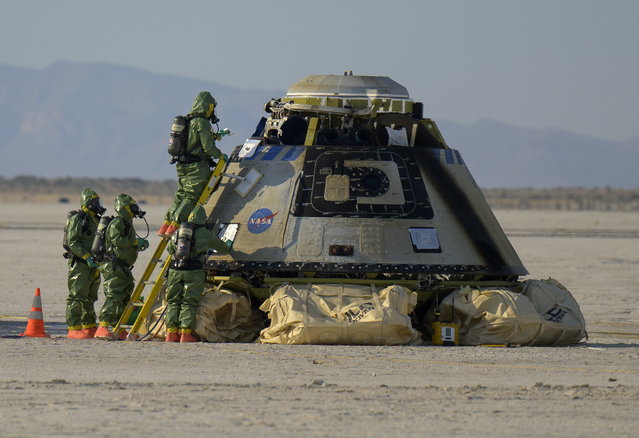
A handout picture made available by the National Aeronautics and Space Administration (NASA) shows, NASA teams working around Boeing’s CST-100 Starliner spacecraft after it landed at White Sands Missile Range’s Space Harbor, in Las Cruces, New Mexico, 25 May 2022. Boeing’s Orbital Flight Test-2 (OFT-2) is Starliner’s second uncrewed flight test to the International Space Station as part of NASA's Commercial Crew Program. OFT-2 serves as an end-to-end test of the system's capabilities. (Photo by Bill Ingalls/NASA/EPA/EFE)

A handout picture made available by the National Aeronautics and Space Administration (NASA) shows, NASA teams working around Boeing’s CST-100 Starliner spacecraft after it landed at White Sands Missile Range’s Space Harbor, in Las Cruces, New Mexico, 25 May 2022. Boeing’s Orbital Flight Test-2 (OFT-2) is Starliner’s second uncrewed flight test to the International Space Station as part of NASA's Commercial Crew Program. OFT-2 serves as an end-to-end test of the system's capabilities. (Photo by Bill Ingalls/NASA/EPA/EFE)
Details
31 May 2022 04:54:00
Photographers gather to take pictures of pilot Andre Borschberg (C) ahead of the take off of Solar Impulse 2-a solar powered plane- in Nanjing, China, May 31, 2015. The world's largest solar-powered airplane, Solar Impulse 2, took off from eastern China's Nanjing on Sunday to continue its round-the-world voyage. The Swiss-made plane left Nanjing's Lukou International Airport at 2:39 in the early morning, with former fighter pilot Borschberg at the controls alone for the entire 8,200-kilometer flight from Nanjing to Hawaii, the toughest leg of its marathon adventure.   REUTERS/Solar Impulse/Handout via Reuters

Photographers gather to take pictures of pilot Andre Borschberg (C) ahead of the take off of Solar Impulse 2-a solar powered plane- in Nanjing, China, May 31, 2015. The world's largest solar-powered airplane, Solar Impulse 2, took off from eastern China's Nanjing on Sunday to continue its round-the-world voyage. The Swiss-made plane left Nanjing's Lukou International Airport at 2:39 in the early morning, with former fighter pilot Borschberg at the controls alone for the entire 8,200-kilometer flight from Nanjing to Hawaii, the toughest leg of its marathon adventure. (Photo by Reuters/Solar Impulse)
Details
06 Jun 2015 12:09:00
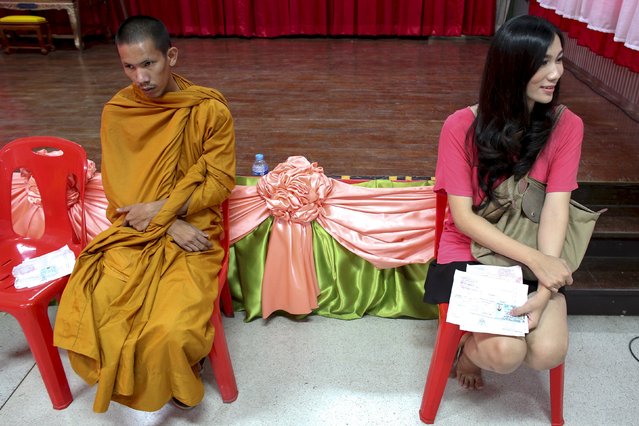
Nopparat (R), a 24-year-old transgender, and a Buddhist monk (L) wait to speak to officers during an army draft held at a school in Bang Na in Bangkok April 3, 2015. Thai men over 21 must serve in the army. Those who volunteer serve six months, but others choose the annual lottery, which goes on for 10 days in recruitment centres around Thailand. Only those not considered physically capable of service, the mentally ill and those who have significantly altered their physical appearance, such as transgenders, are exempt. Picture taken April 3, 2015. (Photo by Athit Perawongmetha/Reuters)

Nopparat (R), a 24-year-old transgender, and a Buddhist monk (L) wait to speak to officers during an army draft held at a school in Bang Na in Bangkok April 3, 2015. Thai men over 21 must serve in the army. Those who volunteer serve six months, but others choose the annual lottery, which goes on for 10 days in recruitment centres around Thailand. Only those not considered physically capable of service, the mentally ill and those who have significantly altered their physical appearance, such as transgenders, are exempt. Picture taken April 3, 2015. (Photo by Athit Perawongmetha/Reuters)
Details
06 Apr 2015 09:54:00
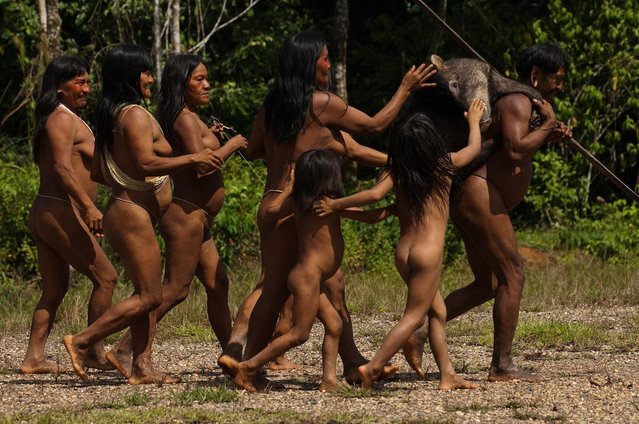
Spectacular images offering insight into the lives of the Huaorani people in the Ecuadorian Amazon have been revealed showing how they use traditional methods to hunt monkeys for food. The stunning pictures were taken by conservation photographer Pete Oxford from Torquay, Devon in the Ecuadorian Amazon. “The Huaorani Indians are a forest people highly in tune with their environment. Many are now totally acculturated since the 1950s by missionaries”, said Pete. “Today they face radical change to their culture to the proximity of oil exploration within their territory and the Yasuni National Park and Biosphere Reserve, they are vastly changed. Some still live very traditionally and for this shoot, through my Huaorani friend, a direct relative of those photographed he wanted to depict them as close to their original culture as possible. They still largely hunt with blow pipes and spears eating a lot of monkeys and peccaries”. The Huaorani are also known as the Waorani, Waodani or the Waos and are native Amerindians. Their lands are located between the Curaray and Napo rivers and speak the Huaorani language. Pete says that during his visit he was welcomed into the group and hopes that ancient cultures can be saved. Here: The tribe were seen celebrating after a hunter returned to camp with a wild pig. (Photo by Pete Oxford/Mediadrumworld.com)

Spectacular images offering insight into the lives of the Huaorani people in the Ecuadorian Amazon have been revealed showing how they use traditional methods to hunt monkeys for food. The stunning pictures were taken by conservation photographer Pete Oxford from Torquay, Devon in the Ecuadorian Amazon. Here: The tribe were seen celebrating after a hunter returned to camp with a wild pig. (Photo by Pete Oxford/Mediadrumworld.com)
Details
20 Jan 2017 07:58:00
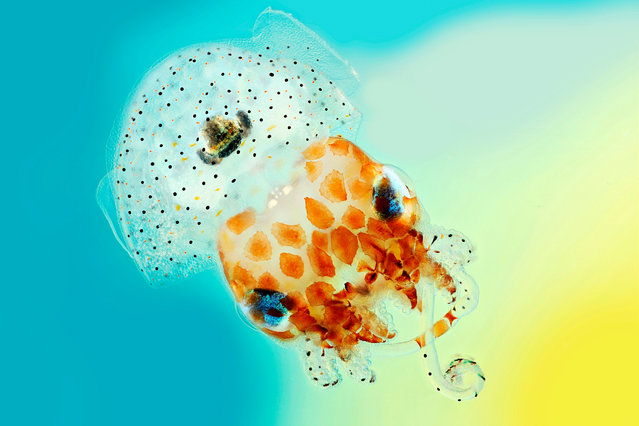
With its huge eyes, comical name and diminutive size, Mark R. Smith’s image of a baby Hawaiian bobtail squid can’t help but raise a smile. A curiously endearing creature, the cephalopod is just 1.5cm across, its mantle cavity bearing more than a passing resemblance to a rather natty shower cap. But it is also a beautiful example of symbiosis – nature’s version of “I’ll scratch your back if you scratch mine” – for on the underside of the squid is a light organ which houses bioluminescent bacteria. The squid offers the bacteria protection and food, while the bacteria emit a glow – a handy trait that the squid uses to offset its silhouette, helping it to evade predators in the depths below. Mark R. Smith’s entry combines several images of a Hawaiian bobtail squid with different focus lengths to create a final picture with greater depth of field than normal. (Photo by Mark R. Smith/Wellcome Images/Macroscopic Solutions)

With its huge eyes, comical name and diminutive size, Mark R. Smith’s image of a baby Hawaiian bobtail squid can’t help but raise a smile. A curiously endearing creature, the cephalopod is just 1.5cm across, its mantle cavity bearing more than a passing resemblance to a rather natty shower cap. But it is also a beautiful example of symbiosis – nature’s version of “I’ll scratch your back if you scratch mine” – for on the underside of the squid is a light organ which houses bioluminescent bacteria. The squid offers the bacteria protection and food, while the bacteria emit a glow – a handy trait that the squid uses to offset its silhouette, helping it to evade predators in the depths below. Mark R. Smith’s entry combines several images of a Hawaiian bobtail squid with different focus lengths to create a final picture with greater depth of field than normal. (Photo by Mark R. Smith/Wellcome Images/Macroscopic Solutions)
Details
08 Mar 2017 00:05:00
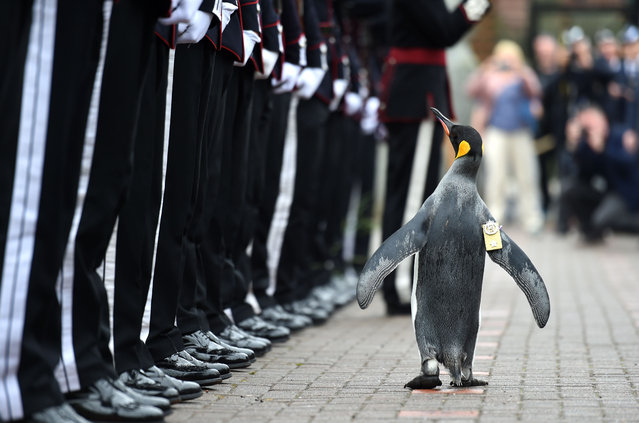
In a handout picture released by the British Ministry of Defence via their Defence News Imagery website on August 22, 2016, Nils Olav the penguin inspects the Guard of Honour formed by His Majesty the King of Norway's Guard on August 22, 2016 at Edinburgh Zoo in Scotland. His Majesty the King of Norway's Guard paid a very special visit to RZSS Edinburgh Zoo to bestow a unique honour upon resident king penguin Sir Nils Olav. Already a knight, the most famous king penguin in the world was given the new title of “Brigadier Sir Nils Olav”. (Photo by Mark Owens/AFP Photo)

In a handout picture released by the British Ministry of Defence via their Defence News Imagery website on August 22, 2016, Nils Olav the penguin inspects the Guard of Honour formed by His Majesty the King of Norway's Guard on August 22, 2016 at Edinburgh Zoo in Scotland. His Majesty the King of Norway's Guard paid a very special visit to RZSS Edinburgh Zoo to bestow a unique honour upon resident king penguin Sir Nils Olav. Already a knight, the most famous king penguin in the world was given the new title of “Brigadier Sir Nils Olav”. (Photo by Mark Owens/AFP Photo)
Details
23 Aug 2016 10:18:00