Loading...
Done
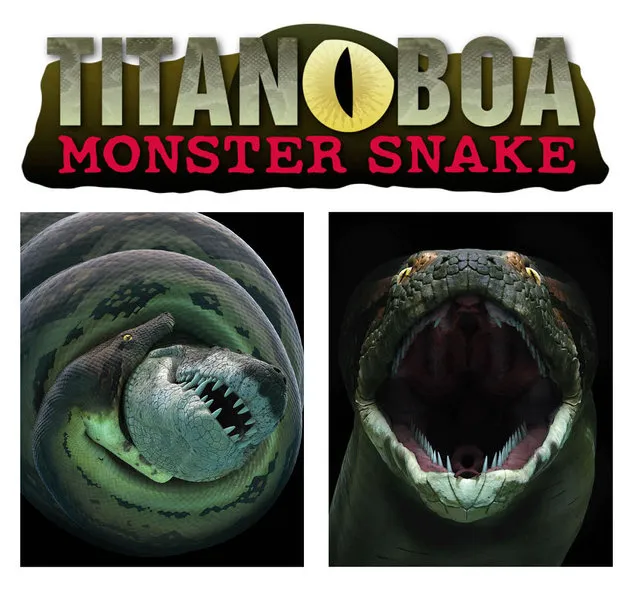
Titanoboa: Monster Snake

Titanoboa, meaning "titanic boa," is an extinct genus of snake that lived approximately 60–58 million years ago, during the Paleocene epoch, a 10-million-year period immediately following the dinosaur extinction event. The only known species is Titanoboa cerrejonensis, the largest, longest, and heaviest snake ever discovered, which supplanted the previous record holder, Gigantophis.

A full-scale model of the snake was unveiled at New York City's Grand Central station before the exhibit opens at the Smithsonian in Washington DC.
Details
06 Feb 2014 12:38:00


A Haka is performed before the ceremonial departure of the 'vaka' or traditional canoes ahead of their cross-Pacific voyage from Viaduct Harbour on April 13, 2011 in Auckland, New Zealand. Powered by sun and wind only, the 15,000 nautical mile journey to Hawaii via French Polynesia will set off on April 15, aiming to raise awareness of environmental issues such as ocean noise pollution, acidification and anoxic waters, whilst recapturing traditional Pacific voyaging. The votyage is named “Te Mana o Te Moana” meaning “The Spirit of the Sea”. (Photo by Phil Walter/Getty Images)
Details
13 Apr 2011 07:45:00
Tsuchiura National Fireworks Competition, Tsuchiura City, Ibaraki Prefecture. (Photo by Makoto Igari/Caters News Agency)

These kaleidoscopic images showcase the sheer beauty of the mammoth firework displays held across Japan every summer. The Japanese word for fireworks, hanabi, means fire flower, and each year, local governments in Japan throw around 7,000 festivals, or hanabi taikai. Here: Tsuchiura National Fireworks Competition, Tsuchiura City, Ibaraki Prefecture. (Photo by Makoto Igari/Caters News Agency)
Details
25 Sep 2018 00:01:00
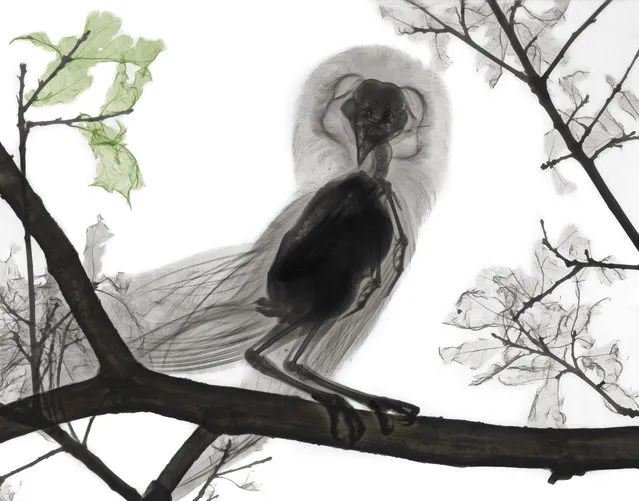
Coloured X-ray of a barn owl. A physicist has used X-ray to create an extraordinary collection of artwork. Arie van't Riets pictures reveal birds, fish, monkeys and flowers in an incredible new light. The 66-year-old, from Bathmen in the Netherlands, began X-raying flowers as a means to teach radiographers and physicians how the machine worked. But after adding a bit of colour to the pictures, the retired medical physicist realised the potential for an exciting new collection of art. (Photo by Arie van't Riet/Barcroft Media)

Coloured X-ray of a barn owl. A physicist has used X-ray to create an extraordinary collection of artwork. Arie van't Riets pictures reveal birds, fish, monkeys and flowers in an incredible new light. The 66-year-old, from Bathmen in the Netherlands, began X-raying flowers as a means to teach radiographers and physicians how the machine worked. But after adding a bit of colour to the pictures, the retired medical physicist realised the potential for an exciting new collection of art. (Photo by Arie van't Riet/Barcroft Media)
Details
08 Jul 2014 13:25:00
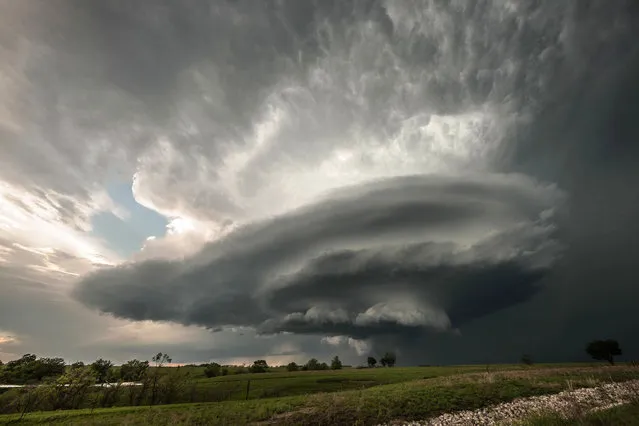
The rotating updraft base of a supercell thunderstorm, and a rear flank downdraft containing rain and hail, backlit by the setting sun, on May 10, 2014, in Climax, Kansas, United States. To most of us, dark clouds on the horizon usually means rain – but here in Kansas, they can also signal the start of a supercell. The huge formations, also known as rotating thunderstorms, are among the most powerful weather phenomenon found over land. (Photo by Stephen Locke/Barcroft Media)

The rotating updraft base of a supercell thunderstorm, and a rear flank downdraft containing rain and hail, backlit by the setting sun, on May 10, 2014, in Climax, Kansas, United States. To most of us, dark clouds on the horizon usually means rain – but here in Kansas, they can also signal the start of a supercell. The huge formations, also known as rotating thunderstorms, are among the most powerful weather phenomenon found over land. They can occur anywhere where the conditions are right, but are normally found in more arid climates. These awe-inspiring supercells were captured south of Climax city by storm chaser Stephen Locke. (Photo by Stephen Locke/Barcroft Media)
Details
18 Jul 2014 12:01:00
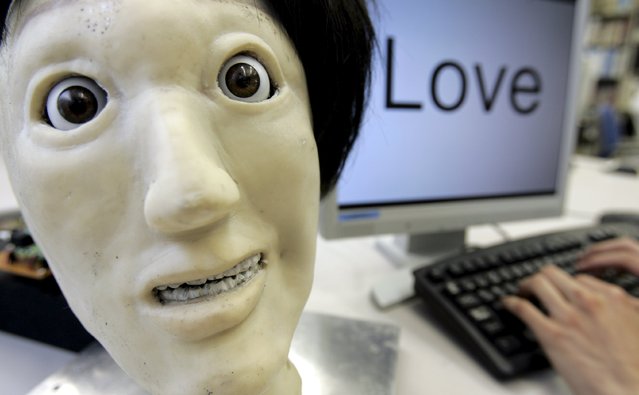
A humanoid robot named Kansei, meaning “sensibility” in Japanese, makes a facial expression depicting “happiness”, next to the word “Love” during a demonstration at a laboratory of Meiji University's Robot and Science Institute in Kawasaki, south of Tokyo in this June 4, 2007 file photo. (Photo by Yuriko Nakao/Reuters)

A humanoid robot named Kansei, meaning “sensibility” in Japanese, makes a facial expression depicting “happiness”, next to the word “Love” during a demonstration at a laboratory of Meiji University's Robot and Science Institute in Kawasaki, south of Tokyo in this June 4, 2007 file photo. Three-fourths of robot installations over the next decade are expected to be concentrated in four areas: transportation equipment, including the automotive sector; computer and electronic products; electrical equipment and machinery. Labor costs have climbed in countries such as China that have been popular for outsourcing production, while technological advances for robots allow them to be more flexible and perform more tasks. (Photo by Yuriko Nakao/Reuters)
Details
17 Apr 2015 09:39:00
A young Chinese girl kicks during a kung-fu class at Ritan Park on June 11, 2016 in Beijing, China. Ritan, meaning “sun altar”, is among the oldest parks in Beijing, built in the early 1500s during the Ming dynasty for the emperor to make sacrifices to the sun. Less than half a kilometer square, Ritan these days is considered an oasis of green space in a sprawling city of skyscrapers, notorious air pollution, and a population of over 20 million people. Most Chinese live in small apartments with no access to gardens, leaving parks as a welcome haven for people, especially the elderly, to exercise, socialize, or enjoy a degree of privacy. (Photo by Kevin Frayer/Getty Images)

A young Chinese girl kicks during a kung-fu class at Ritan Park on June 11, 2016 in Beijing, China. Ritan, meaning “sun altar”, is among the oldest parks in Beijing, built in the early 1500s during the Ming dynasty for the emperor to make sacrifices to the sun. (Photo by Kevin Frayer/Getty Images)
Details
14 Jun 2016 13:01:00
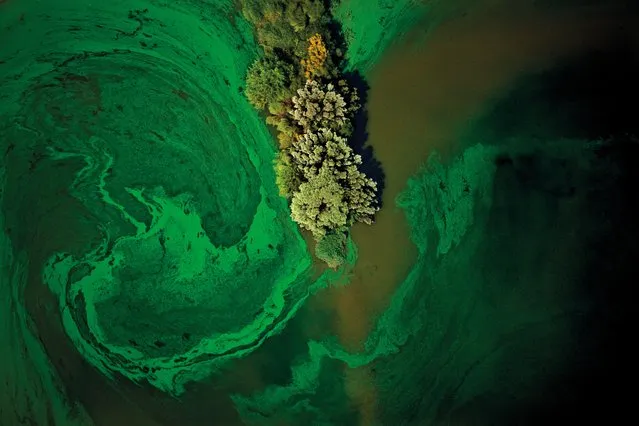
Luling, Louisiana US. New evidence contradicts previous claims of the relative safety of glyphosate, the world’s most widely used herbicide, which is manufactured here. It is often used in conjunction with seeds that have been genetically modified to tolerate its application, meaning that anyone consuming these crops is eating a genetically modified plant, and whatever residue of the pesticide that remains. (Photo by J. Henry Fair/Industrial Scars/Papadakis Publisher)

Luling, Louisiana, US. New evidence contradicts previous claims of the relative safety of glyphosate, the world’s most widely used herbicide, which is manufactured here. It is often used in conjunction with seeds that have been genetically modified to tolerate its application, meaning that anyone consuming these crops is eating a genetically modified plant, and whatever residue of the pesticide that remains. (Photo by J. Henry Fair/Industrial Scars/Papadakis Publisher)
Details
25 Oct 2016 10:40:00