Loading...
Done
The Adventures of BeetleCam

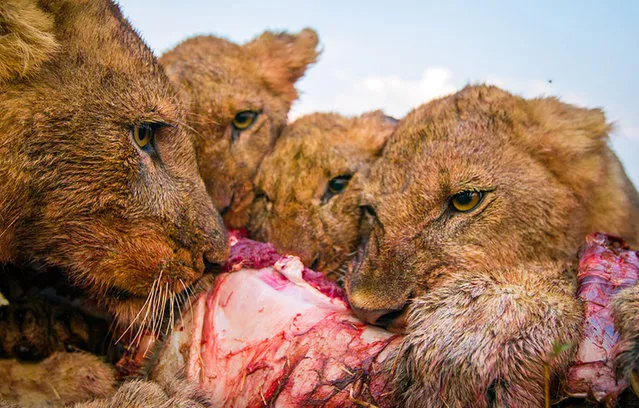
In 2009 we embarked on a project to get unique close-up, ground level photographs of African wildlife. To achieve this I built BeetleCam; a remote controlled buggy with a DSLR camera mounted on top. Matt and I travelled to Tanzania and used the buggy to get groundbreaking photographs of elephants and buffalo. However, we lost a camera and BeetleCam was almost destroyed in our only encounter with a lion.

We returned home and published “The Adventures of BeetleCam”. The story quickly went viral, appearing all over the web, in print and on television networks worldwide. However, we weren’t entirely satisfied… just imagine what we could get with a lion-proof BeetleCam!
Details
09 Nov 2012 10:01:00
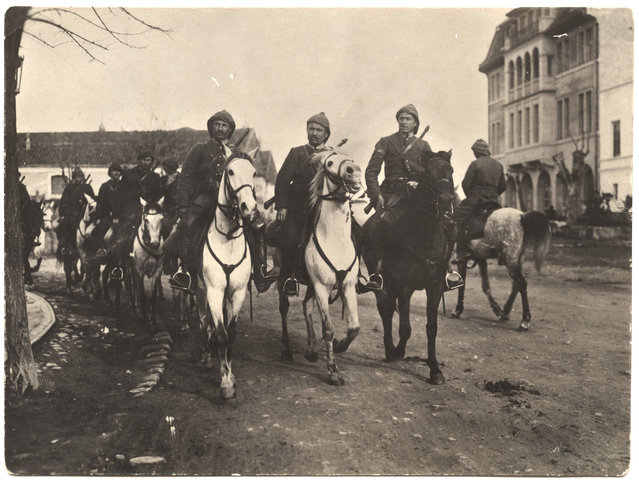
Turkish army, including cavalry, infantry and artillery. (Photo by Dr. P.A. Smithe/National World War I Museum, Kansas City, Mo.)

Dr. P.A. Smithe was sent by the American Red Cross as a doctor and surgeon to work at a hospital in Vienna. He sailed to Europe in December 1915 and returned home in August 1916, according to his daughter, who donated his images to the National World War I Museum. Photo: Turkish army, including cavalry, infantry and artillery. (Photo by Dr. P.A. Smithe/National World War I Museum, Kansas City, Mo.)
Details
29 Jul 2014 11:53:00
A devotee lights oil lamps at a religious ceremony during the Diwali or Deepavali festival at a Hindu temple in Colombo, Sri Lanka October 18, 2017. (Photo by Dinuka Liyanawatte/Reuters)

A devotee lights oil lamps at a religious ceremony during the Diwali or Deepavali festival at a Hindu temple in Colombo, Sri Lanka October 18, 2017. Diwali, the Hindu festival of lights, marks the triumph of good over evil, and commemorates the return of Hindu deity Rama to his birthplace Ayodhya after victory against the demon king Ravana. (Photo by Dinuka Liyanawatte/Reuters)
Details
20 Oct 2017 06:26:00
In this March 31, 2019 photo, an Egyptian student borrows a Bedouin wedding dress to pose for a photograph with Bedouin men from the Hamada tribe, in Wadi Sahw, Abu Zenima, in South Sinai, Egypt. Four Bedouin women are for the first time leading tours in Egypt’s Sinai Peninsula, breaking new ground in their deeply conservative community, where women almost never work outside the home or interact with outsiders.  The tourists can only be women, and the tours can’t go overnight. Each day before the sun sets, the group returns to the Hamada’s home village in Wadi Sahu, a narrow desert valley. (Photo by Nariman El-Mofty/AP Photo)

In this March 31, 2019 photo, an Egyptian student borrows a Bedouin wedding dress to pose for a photograph with Bedouin men from the Hamada tribe, in Wadi Sahw, Abu Zenima, in South Sinai, Egypt. Four Bedouin women are for the first time leading tours in Egypt’s Sinai Peninsula, breaking new ground in their deeply conservative community, where women almost never work outside the home or interact with outsiders. The tourists can only be women, and the tours can’t go overnight. Each day before the sun sets, the group returns to the Hamada’s home village in Wadi Sahu, a narrow desert valley. (Photo by Nariman El-Mofty/AP Photo)
Details
11 Apr 2019 00:01:00
A young bull flees from a Brazilian vaqueiro, or cowboy, competing in the “Pega de Boi” (Ox Catch) tournament in Cabrobo, Pernambuco State, Brazil, on September 4, 2022. The riders compete in pairs to retrieve a cord from a bull which has been released and runs away from them and they are timed on how quickly they can return with the cord. The leather clothing provides them with protection from the dense savannah vegetation which contains a lot of large thorns. Riders have been known to die competing in the tournament (Photo by Carl de Souza/AFP Photo)

A young bull flees from a Brazilian vaqueiro, or cowboy, competing in the “Pega de Boi” (Ox Catch) tournament in Cabrobo, Pernambuco State, Brazil, on September 4, 2022. The riders compete in pairs to retrieve a cord from a bull which has been released and runs away from them and they are timed on how quickly they can return with the cord. The leather clothing provides them with protection from the dense savannah vegetation which contains a lot of large thorns. Riders have been known to die competing in the tournament (Photo by Carl de Souza/AFP Photo)
Details
25 Sep 2022 04:38:00
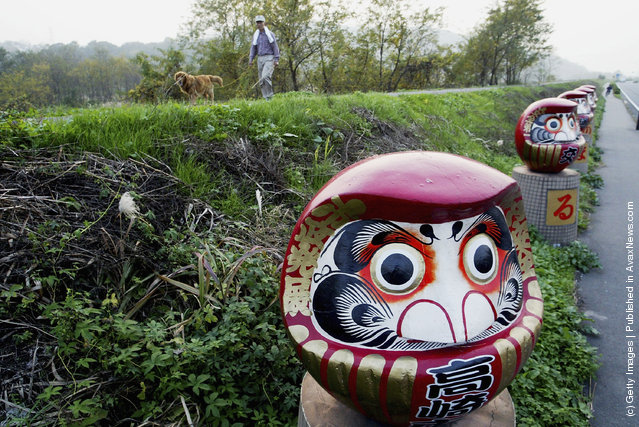
Daruma Dolls

A series of Japanese good luck charms, called “Daruma”, are lined up ahead of the major national elections November 9, 2003 in Takasaki, Japan. The Daruma is said to bring exceptional good luck in all walks of life, but is used especially during election time by all candidates. People think that if they face a difficult situation, as symbolized by the doll that returns to its original position when knocked over, they will always bounce back. (Photo by Koichi Kamoshida/Getty Images)
Details
05 Dec 2011 13:09:00


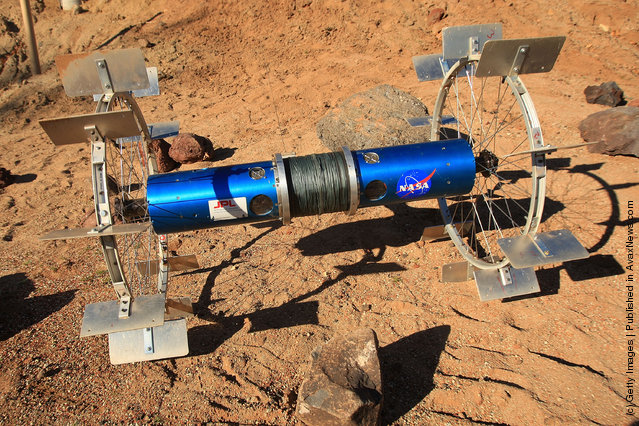
Axel, a research prototype rover for exploring the Moon, Mars and other planets, is remotely driven over rocks as engineers from Jet Propulsion (JPL) and grad students from Caltech (California Institute of Technology) demonstrate its mobile over the steep and rocky grounds of the JPL Mars Yard on January 14, 2009 in Pasadena, California. The rover is capable of descending cliffs or into craters and returning by a cable tethered to its starting point. Development of the Axel rover is a point effort funded by NASA Exploration Systems Mission Directorate (ESMD) and lead by Principal Investigator Issa Newnas and Co-Investigator and Caltech professor of mechanical engineering bio engineering Joel Burdick. (Photo by David McNew/Getty Images)
Details
05 Apr 2011 07:47:00


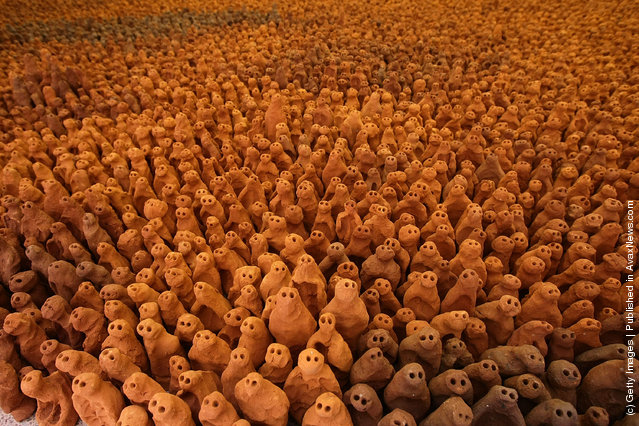
Figures from Antony Gormley's “Field For The British Isles” adorns an exhibition space in St Helen's College in the town of it's creation 15 years ago, June 23, 2008, St Helens, England. The installation of over 40,000 clay figures has returned to the place where it was made by local people from local clay. Artist Antony Gormley describes his creation as “25 tons of clay energised by fire, sensitised by touch and made conscious by being given eyes ... a field of gazes which looks at the observer making him or her its subject”. (Photo by Christopher Furlong/Getty Images)
Details
10 May 2011 09:20:00