A fox runs out onto the pitch before the start of the second half. Celtic League 2012/13, Round 19, Leinster v Ulster, RDS, Ballsbridge, Dublin, March 30, 2013. (Photo by Paul Mohan)
People take pictures with public art instalation titled “GIANTS: Rising Up” by the French artist JR, at Harbour City, Hong Kong, China on March 16, 2023. (Photo by Lam Yik/Reuters)
The sun bear (Ursus malayanus), also known as the honey bear, is a bear found primarily in the tropical rainforest (the dense lowland forests) in Southeast Asia; North-East India, Bangladesh, Myanmar, Thailand, Laos, Cambodia, Vietnam, Southern China, Peninsular Malaysia, and the islands of Sumatra and Borneo.
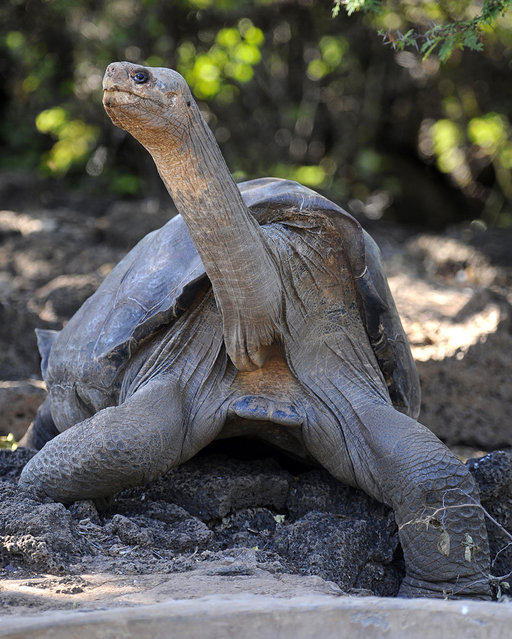
“The last known individual of the subspecies was a male named Lonesome George (Spanish: El Solitario Jorge/George), who died on 24 June 2012. In his last years, he was known as the rarest creature in the world. George served as a potent symbol for conservation efforts in the Galápagos and internationally”. – Wikipedia. (Photo by Rodrigo Buendia/AFP)
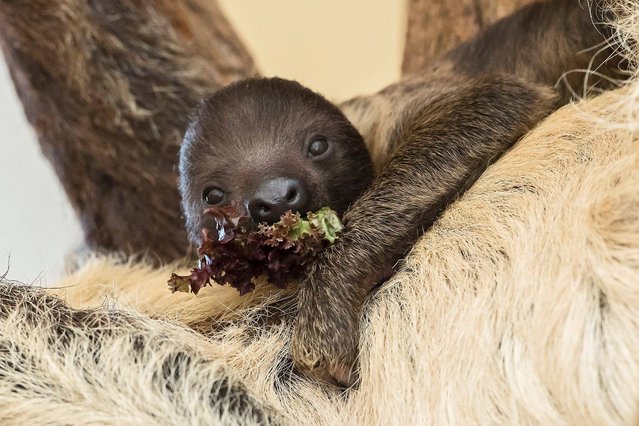
This handout picture taken on December 13, 2016 and released on December 14, 2016 by the Tiergarten Schoenbrunn zoo in Vienna, Austria, shows a baby sloth eating some salad as it hangs on it's mother's belly in their enclosure. The baby was born already on November 18, 2016, but according to the zoo it could be picured for the first time only now as it usually hides in it's mother's soft coat. (Photo by Daniel Zupanc/AFP Photo)
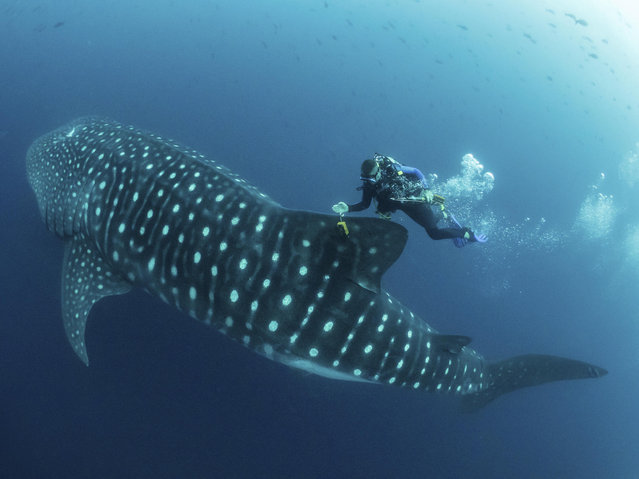
In this 2017 photo provided by Simon Pierce, Jonathan Green checks on a fin-mounted satellite tag on a whale shark in the Galapagos Islands area of Ecuador. Despite typically being bigger than a double-decker bus, the elusive whale shark has only tiny, almost useless teeth. It's also one of the least understood animals in the ocean. (Photo by Simonjpierce.com via AP Photo)
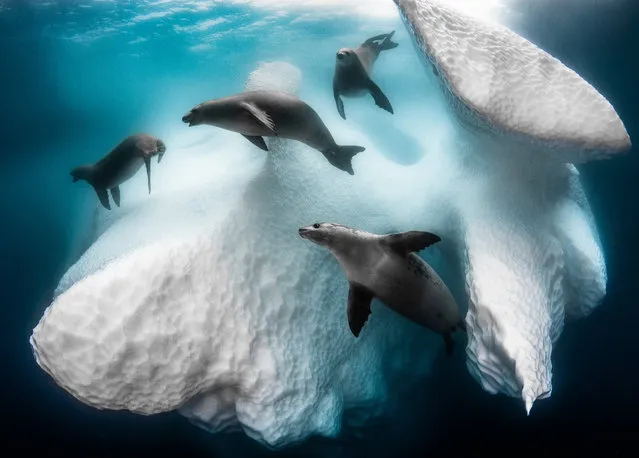
Underwater photographer of the year 2020 and wide angle category winner: Frozen Mobile Home by Greg Lecoeur (France) in the Antarctic peninsula, Antarctica. Crabeater seals swim around an iceberg. These massive and mysterious habitats are dynamic kingdoms that support marine life. As they swing and rotate slowly through polar currents, icebergs fertilise the oceans by carrying nutrients from land that spark blooms of phytoplankton, fundamental to the carbon cycle. (Photo by Greg Lecoeur/Underwater Photographer of the Year 2020)