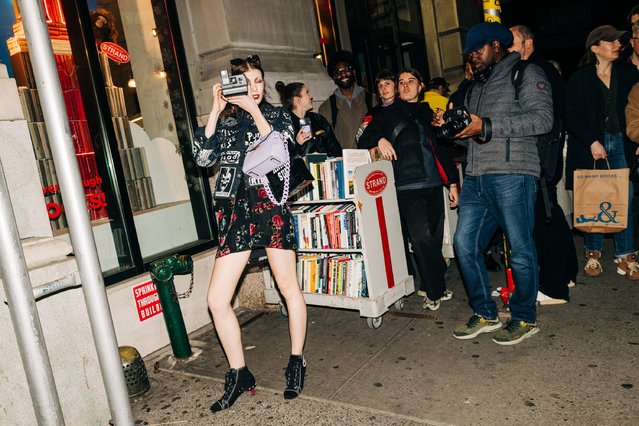
A model takes a picture of photographers outside the Anna Sui show at the Strand Rare Book Room in New York on February 10, 2024. (Photo by Jeenah Moon for The Washington Post)
Hemispheric color differences on Saturn's moon Rhea are apparent in this false-color view from NASA's Cassini spacecraft in this March 2, 2010 file photo. (Photo by Reuters/NASA/JPL/SSI)
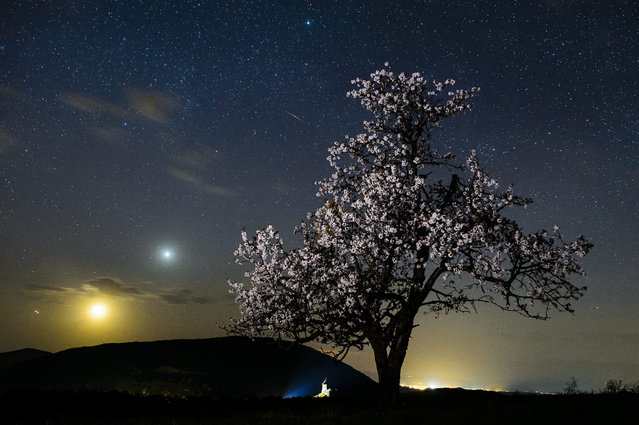
A meteorite burns up in the atmosphere as seen in this photo taken near of Salgotarjan, 109 kms northeast of Budapest, Hungary, late 21 April 2015. The Moon and Venus can be seen on the left. (Photo by Peter Komka/EPA)
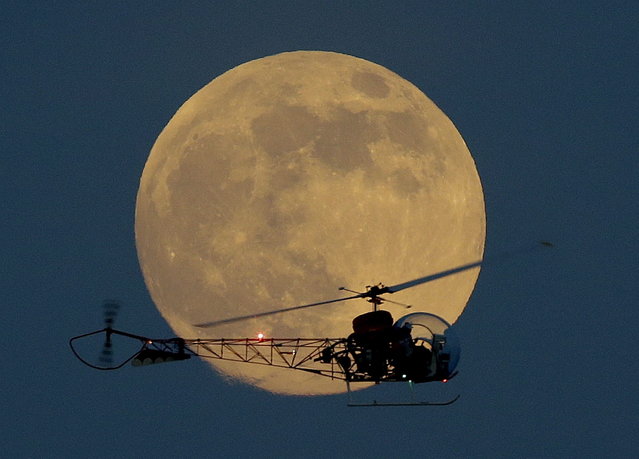
The moon is seen in its waxing gibbous stage as it rises behind the helicopter from the original Batman television show, which people can ride at the New Jersey State Fair, Saturday, June 22, 2013, in East Rutherford, N.J. The moon, which will reach its full stage on Sunday, is expected to be 13.5 percent closer to earth during a phenomenon known as supermoon. (Photo by Julio Cortez/AP Photo)
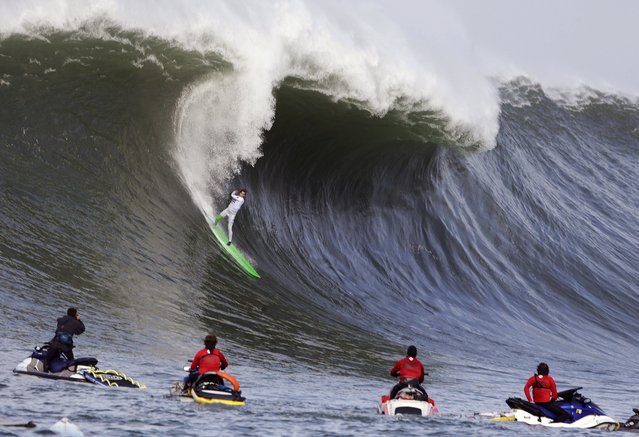
Nic Lamb rides a wave during the third heat of the first round of the Mavericks Invitational big wave surf contest Friday, January 24, 2014, in Half Moon Bay, Calif. (Photo by Eric Risberg/AP Photo)
Jacob Yighe, right, attends the Met Gala Party for Jean Paul Gaultier x Shayne Oliver Group held at Sapphire in Manhattan on May 6, 2024. (Photo by Jeenah Moon for The Washington Post)
A so-called “Supermoon” dominates the sky while traffic rolls in the streets in Naypyitaw, Myanmar, 03 December 2017. According to the National Aeronautics and Space Administration (NASA) a series of three “Supermoons” – dubbed the “Supermoon trilogy” – will appear in the sky on 03 December 2017, on 01 January 2018 and and 31 January 2018. A “Supermoon” commonly is a full moon at its closest distance to the earth with the moon appearing larger than usual. (Photo by Hein Htet/EPA/EFE)